
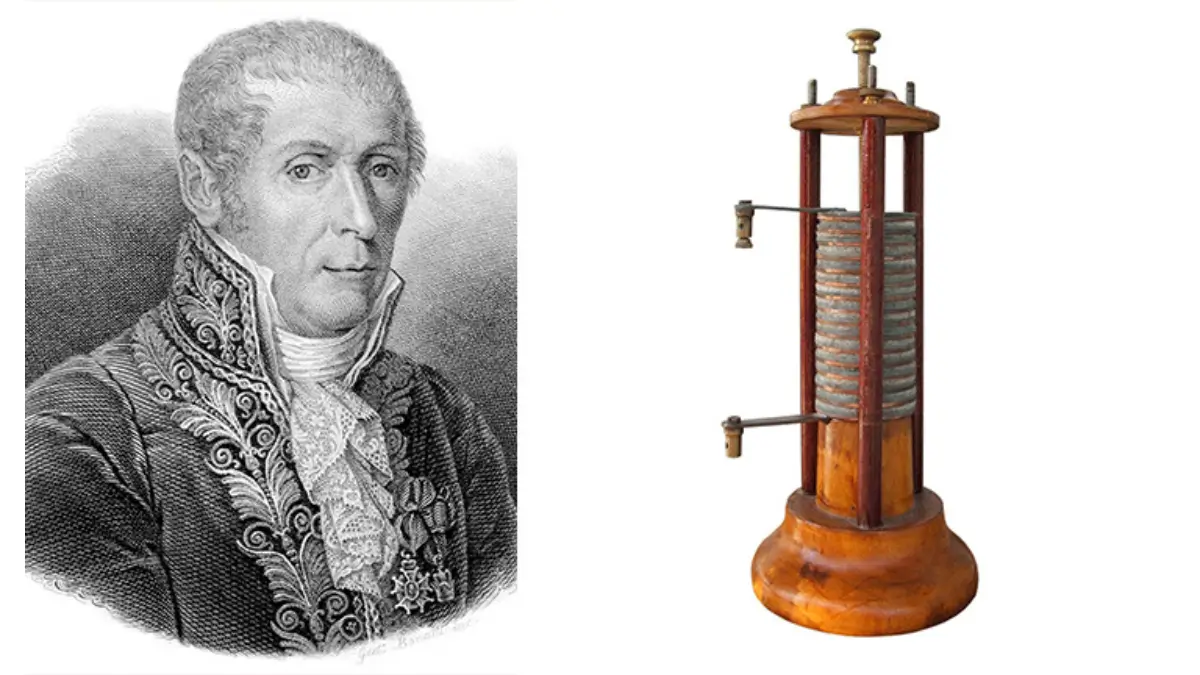
Electricity is a very important part of our life today, but its journey started many years ago with simple experiments and clever ideas. One of the biggest steps in this journey was the creation of the first battery. It helped people understand how electric power can be stored and used. The story of the first battery is interesting and shows how science slowly changed the world.
Early Attempts to Store Energy
Before real batteries existed, scientists could only store electricity for a very short moment. One famous device was the Leyden jar, created in the 1740s. It could hold electric charge but released it very quickly in one sudden spark, not in a steady flow.
Benjamin Franklin used many Leyden jars together and called the group a “battery.” However, these were not true batteries because they could not give continuous electricity.
Alessandro Volta and the First Real Battery (1800)
The first real battery was made in 1800 by Italian scientist Alessandro Volta. His invention was called the Voltaic Pile.
It was built using layers of copper and zinc plates, with pieces of cardboard soaked in salty water between them. This simple setup produced a steady electric current, something never done before. Because of his great invention, Napoleon Bonaparte honored Volta with the title of Count.
The unit of electric potential—the volt—is also named after him.
Better Batteries and Important Improvements
After Volta’s discovery, many scientists worked to make batteries safer, stronger, and more useful.
Daniell Cell – 1836
John Frederic Daniell made a new type of battery that solved the problem of gas forming inside earlier batteries. It became very reliable and was widely used in telegraph machines.
Lead-Acid Battery – 1859
Gaston Planté created the first rechargeable battery. This type is still used today in cars and trucks.
Leclanché Cell – 1866
Georges Leclanché invented a battery using zinc and manganese dioxide. This design became the base for dry cells, which are used in torches, radios, and many household items.
Rechargeable Batteries and Modern Technology
In the 1900s, scientists created nickel-cadmium (NiCd) batteries, which could be used many times after recharging.
A major breakthrough came with the lithium-ion battery. These were improved and commercialized in 1991 by Akira Yoshino, based on earlier work by John Goodenough and other scientists.
Today, lithium-ion batteries power:
- Smartphones
- Laptops
- Electric vehicles
- Power banks
They are light, powerful, and can store a lot of energy.
Was There a Battery Before Volta?
Some ancient objects, like the Baghdad Battery from around 200 BC, look like they might have been used as simple batteries. However, scientists are not fully sure about their purpose. That is why Volta’s invention is considered the first real battery in history.
How Modern Batteries are Different?
Modern batteries use advanced materials like lithium, nickel, and cobalt. They are designed to:
- Store more energy
- Last longer
- Recharge many times
- Work safely in complex devices
They are much better than the early chemical cells that produced only small amounts of electricity.
Impact of Batteries on Technology
Batteries changed the world by making electricity portable. First, they helped improve communication through telegraphs. Later, they powered radios, torches, and small devices. Today, they help run electric vehicles, renewable energy systems, drones, and modern gadgets. Batteries truly made wireless technology possible.


 Which Place is known as the Onion Hub of...
 RBI Plans to Make TReDS Registration Eas...
 KreditBee Joins Unicorn Club After Raisi...











