
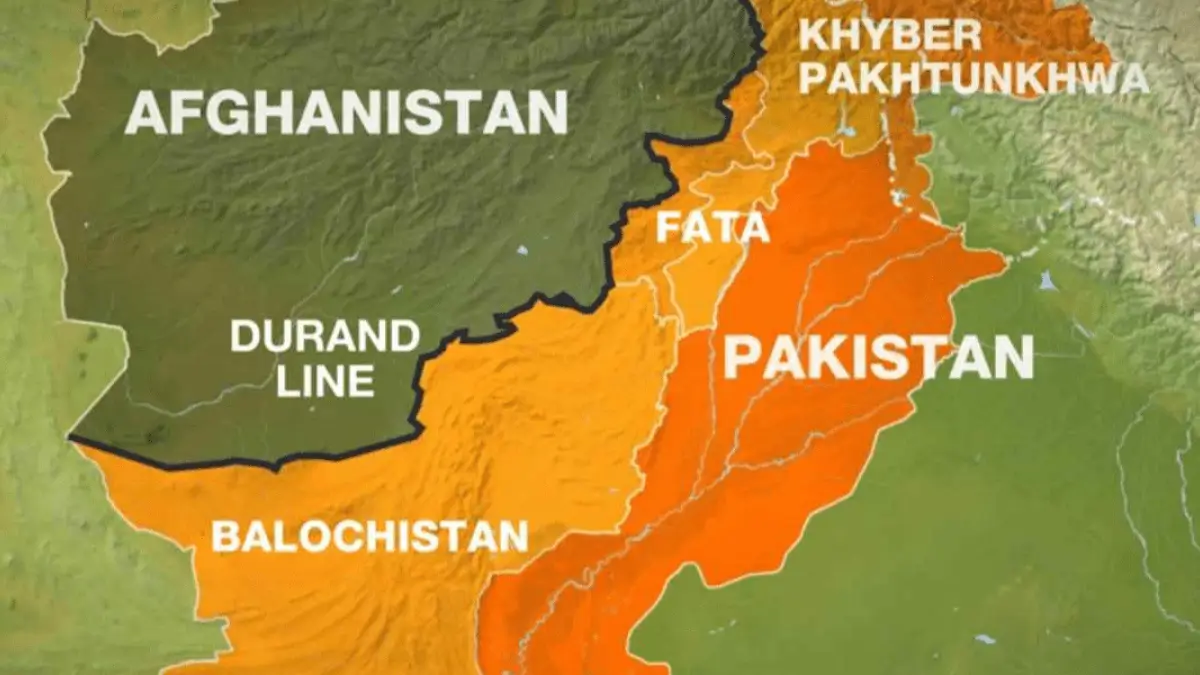
The Durand Line is one of the most important and debated borders in South Asia. It separates two neighboring countries and has a long history connected with colonial rule and regional politics. Even today, it remains a sensitive issue, especially between Afghanistan and Pakistan. In this article, we will understand in simple words which countries this line separates and why it was created?
Which Countries are Separated by the Durand Line?
The Durand Line is a border that separates Afghanistan and Pakistan.
It is about 2,460 km long and stretches across mountains, valleys, and tribal areas. This boundary starts from the Hindu Kush mountains in the north and goes down to the Balochistan region in the south.
Many important areas and passes, like the Khyber Pass, lies along this line. It also cuts through regions where tribes like the Pashtuns and Baloch people live on both sides.
How was the Durand Line Created?
The Durand Line was created in the year 1893. It was drawn after an engagement between:
- Sir Mortimer Durand, a British official
- Abdul Rahman Khan, the ruler of Afghanistan at that time
This agreement was made during the time when British India controlled large parts of the Indian subcontinent.
Why was the Durand Line Established?
The main reason behind creating this line was political and strategic control.
At that time, Britain and Russia were competing for power in Asia. This rivalry is known as the Great Game. Britain wanted to protect its Indian territories from Russian influence.
So, the Durand Line was created to:
- Mark the boundary between British India and Afghanistan
- Create a buffer zone for safety
- Control tribal regions near the border.
Historical Background
Before the line was drawn, there were several conflicts between the British and Afghanistan:
- First Anglo-Afghan War (1839-1842): British were defeated.
- Second Anglo-Afghan War (1878-1880): British gained more control.
- Treaty of Gandamak (1879): Britain controlled Afghanistan’s foreign affairs.
Finally, in 1893, the Durand Line agreement was signed.
Later, in 1919, after another conflict, Afghanistan regained control over its foreign policy, but the border remained.
What Happened After 1947?
When India was divided in 1947, the new country Pakistan took control of this border.
However, Afghanistan has never fully accepted the Durand Line as an official international border. It believes that the agreement was forced during colonial rule.
India’s View on the Durand Line
India also has a small connection to this border. It claims a small part of the Durand Line through Gilgit-Baltistan, which is currently under Pakistan’s control but considered part of Jammu and Kashmir by India.
Why is the Durand Line Still Important Today?
The Durand Line is still a sensitive and disputed boundary between:
- Afghanistan does not officially accept it.
- It divides ethnic groups like Pashtuns.
- It has strategic importance in regional politics.
Because of these reasons, it continues to be a topic of discussion and tension in South Asia.


 Which City is known as the Perfume Capit...
 List of Important Days in April 2026, Na...
 Weekly Current Affairs One Liners (06th ...











