
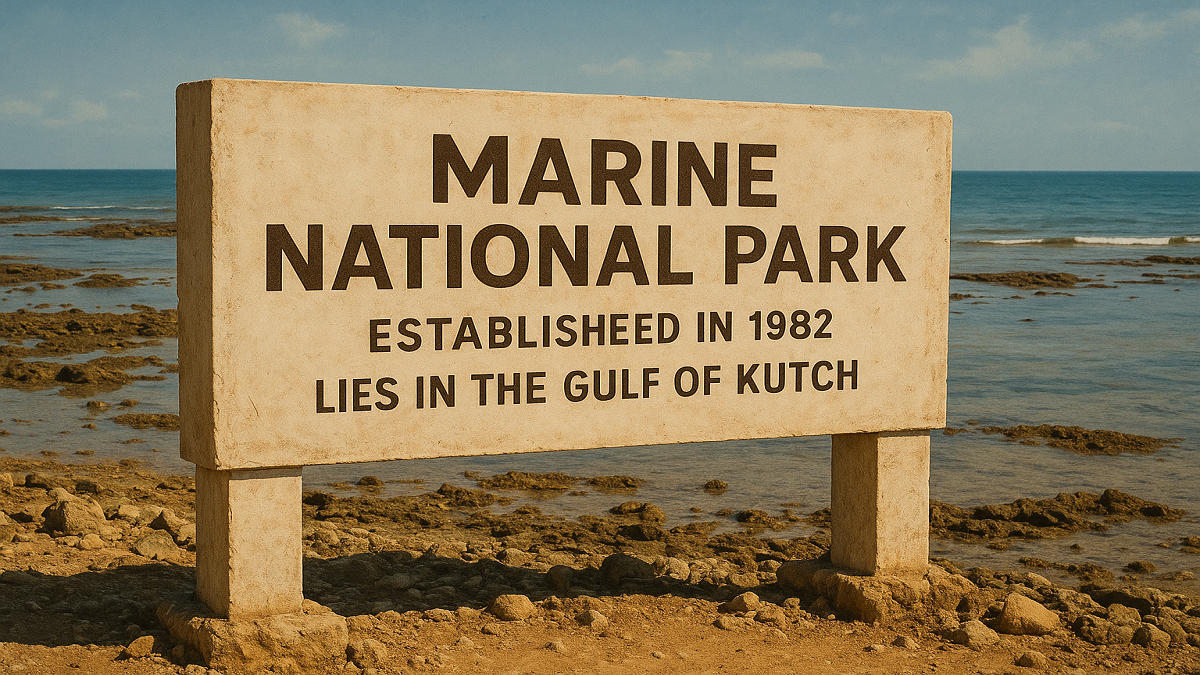
India is a land of rich natural diversity. To protect this diversity, the government has established several national parks and wildlife sanctuaries across the country. While most of these parks are on land, India also has special protected areas in the sea. One such unique place is the Marine National Park, located in the Gulf of Kutch, Gujarat.
This park was established in 1982 and is famous as India’s first Marine National Park. Unlike normal parks filled with forests, tigers, or elephants, this park mainly protects marine ecosystems such as corals, mangroves, fishes, dolphins, and turtles.
Let us explore its history, geography, biodiversity, importance, and challenges in detail.
Background and Establishment
- In the late 1970s, the government realized that the marine life in the Gulf of Kutch was under threat.
- Activities like overfishing, oil exploration, and industrial pollution were destroying coral reefs and mangroves.
- To protect this fragile ecosystem, in 1980 the Gulf of Kutch was declared a Marine Sanctuary.
- Later in 1982, a core area of 110 square kilometers inside the sanctuary was given higher protection status and declared as Marine National Park.
Thus, this became the first and only Marine National Park in India at that time.
Location and Geography
- State: Gujarat
- Region: Gulf of Kutch (Arabian Sea coast)
- Total Area: About 162.89 sq. km (110 sq. km as National Park + 452 sq. km as Sanctuary buffer zone)
- Islands: Around 42 small islands, locally called “Bets”.
Some famous islands include Pirotan Island, Narara Island, Poshitra, and Ajad.
These islands are surrounded by coral reefs and mangroves, making them biodiversity hotspots.
Flora – Plant Life in the Park
Even though this is a marine park, plants also play a very important role.
1. Mangroves
- These are salt-tolerant trees that grow along the coast.
- Species like Avicennia marina dominate the region.
- They act as a natural barrier against cyclones and coastal erosion.
- They provide nursery grounds for fishes and prawns.
2. Sea Grasses and Algae
- Sea grasses help marine animals like dugongs (sea cows) survive.
- More than 70 species of algae are found here.
These plants are the foundation of the marine food chain, as they produce oxygen and food for fishes, turtles, and other animals.
Fauna – Animal Life in the Park
The Gulf of Kutch Marine National Park is a paradise for marine creatures.
1. Coral Reefs
- Corals are tiny living organisms that build hard skeletons.
- Together, they form coral reefs, often called the “rainforests of the sea”.
- They are home to hundreds of fish and invertebrate species.
- Types: Fringing reefs and patch reefs are most common here.
2. Marine Animals
- Mammals: Dolphins, Porpoises, and the rare Dugong (Sea Cow).
- Reptiles: Green Sea Turtle, Olive Ridley Turtle, and Hawksbill Turtle.
- Fishes: Butterflyfish, Parrotfish, Lionfish, Groupers, and many more.
- Invertebrates: Octopus, Squids, Jellyfish, Sea Cucumbers, Starfish, Sea Urchins.
3. Birds
- Many migratory birds visit the park in winter.
- Species: Flamingos, Pelicans, Herons, and Painted Storks.
Thus, the park protects both marine and coastal ecosystems, making it very diverse.
Unique Features of the Park
- First Marine National Park of India – Established in 1982.
- Coral Reefs – The only place in India where reefs are so close to the shore.
- Tidal Influence – During low tide, tourists can walk into the reef area and see marine life without diving.
- Rare Species – Home to the endangered Dugong (sea cow) and important nesting sites for sea turtles.
Tourism and Educational Importance
The Marine National Park is not just a protected area but also a place of learning and tourism.
- Tourism: Visitors can go to Pirotan Island and Narara Island. During low tide, they can see starfish, sea cucumbers, corals, and small fishes.
- Education: Schools and colleges organize study tours here to teach students about marine biodiversity.
- Research: Scientists and marine biologists study coral reef health, mangrove restoration, and the effects of climate change here.


 Which Place is known as the Onion Hub of...
 Who were the Seven Sisters of Petroleum?...
 What is the State Flower of Florida? Che...











