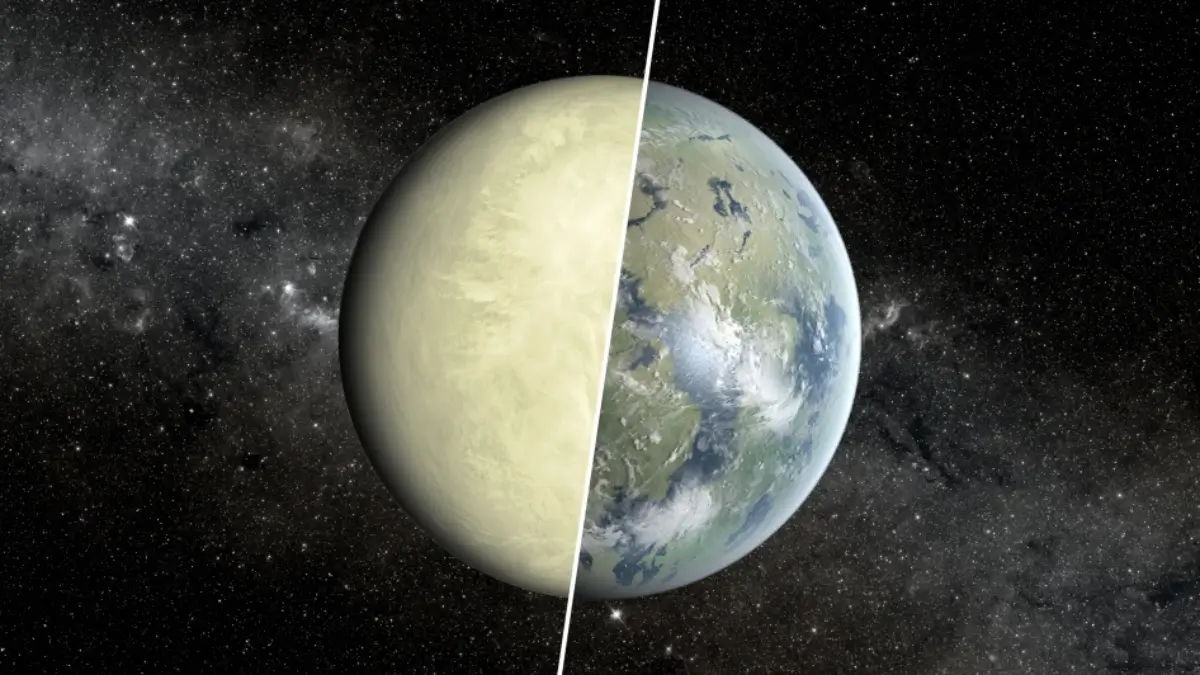
In our solar system, each planet is unique in its own way—some are small and rocky, while others are large and made of gas. However, there is one planet that closely resembles Earth in size, composition, and structure. Because of these surprising similarities, scientists often refer to it as the “twin planet” of Earth.
Earth’s Twin Planet
Venus is known as the Earth’s twin planet because it is almost the same in size, mass, and structure as Earth. Both are rocky planets with similar diameters and inner layers. However, Venus is very different in environment — it has a thick carbon dioxide atmosphere, extreme heat, and dense clouds that make it the hottest planet in our solar system.
Why Venus is Called Earth’s Twin Planet?
Venus is known as Earth’s twin planet because both are almost the same in size and structure.
- Size and diameter: Venus has a diameter of about 12,104 km, while Earth’s diameter is 12,742 km — making them nearly equal in size.
- Rocky planets: Both are terrestrial planets, meaning they have solid, rocky surfaces rather than gas.
- Similar composition: Each planet has a metallic core and rocky mantle, showing a similar internal structure.
Because of these similarities, scientists often refer to Venus as Earth’s sister planet. However, its surface conditions and atmosphere are completely different.
Differences Between Earth and Venus
Even though Venus looks like Earth in size, it is very different in climate and environment.
Atmosphere
Venus has a thick atmosphere made mostly of carbon dioxide (CO₂). It is covered with dense clouds of sulfuric acid, which trap heat and make the planet extremely hot.
Extreme Temperature
The surface temperature on Venus can reach up to 465°C, making it the hottest planet in the solar system, even hotter than Mercury, which is closer to the Sun.
Air Pressure
The air pressure on Venus is about 90 times greater than on Earth, enough to crush most spacecraft within minutes.
Rotation Direction
Unlike Earth, Venus spins in the opposite direction — a phenomenon called retrograde rotation. This means that on Venus, the Sun rises in the west and sets in the east.
The Brightest Planet in the Sky
After the Moon, Venus is the brightest object in the night sky. It shines beautifully just before sunrise and shortly after sunset. Because of this, it is often called the “Morning Star” or “Evening Star.”
The reason for its brightness is its thick cloud cover, which reflects sunlight back into space. This reflection makes Venus easily visible to the naked eye from Earth.
Amazing Facts About Venus
- Second planet from the Sun: Venus orbits the Sun at a distance of about 108 million kilometers, making it Earth’s closest neighbor.
- Hottest planet: Its dense CO₂ atmosphere traps heat, making Venus even hotter than Mercury.
- Rotates backward: Venus spins clockwise, opposite to most other planets.
- Longest day: One day on Venus equals 243 Earth days, while its year lasts only 225 Earth days — meaning a day on Venus is longer than a year!
- Thick pressure: The surface pressure is 90 times higher than Earth’s, enough to crush metal spacecraft.
- Acidic clouds: The clouds are filled with sulfuric acid droplets, blocking sunlight from reaching the surface directly.
Why Venus Fascinates Scientists?
Despite its deadly heat and pressure, Venus fascinates scientists because studying it helps us understand how Earth’s climate could change under extreme greenhouse conditions. It shows what happens when carbon dioxide builds up uncontrollably in a planet’s atmosphere — a warning for our own planet’s future.


 Who is known as the Father of Mobile Pho...
 Which is the Highest Airport in the Worl...
 Which Country is the Largest Exporter of...