India is rightly called a land of rivers. From the Himalayas in the north to the coastal plains in the south, rivers have shaped the geography, culture, and economy of the country for centuries. They provide water for agriculture, drinking, and industries, and also serve as important routes of transport and centers of religious and cultural life.
The Ganga River, Lifeline of North India
The Ganga River, also called the Ganges, is the most sacred river in India and is often referred to as the lifeline of North India. It originates from the Gangotri Glacier in Uttarakhand at an altitude of over 7,000 meters. From there, it travels across the northern plains of India before finally entering Bangladesh, where it is called the Padma River.
The river basin of the Ganga is the largest in India, covering around 26% of the country’s total land area. Nearly 43% of India’s population depends directly or indirectly on this river for their livelihood. This makes the Ganga not just a geographical feature but a civilizational backbone of India.
States Covered by the Ganga River
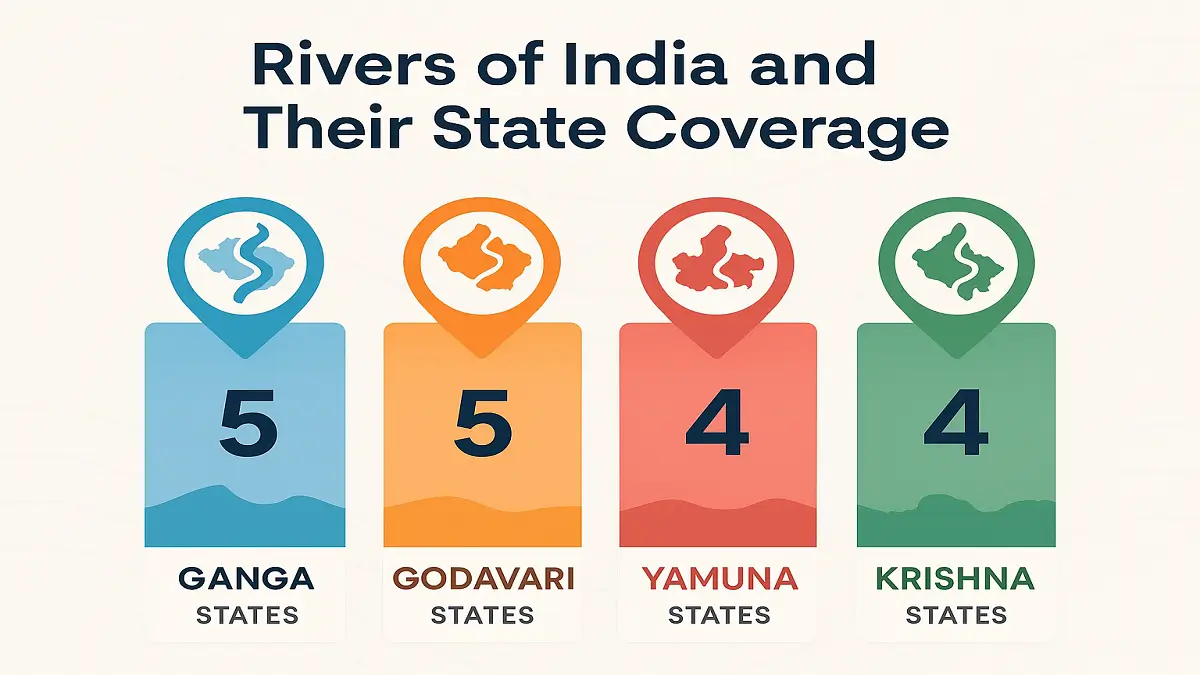
The Ganga flows through five major Indian states, making it the river with the widest coverage in the country.
- Uttarakhand – The Ganga originates from the Gangotri Glacier in the Himalayas. The river first takes the form of the Bhagirathi and later joins with the Alaknanda at Devprayag to officially become the Ganga.
- Uttar Pradesh – The river flows across a large part of Uttar Pradesh, passing through important cities like Haridwar, Kanpur, Allahabad (Prayagraj), and Varanasi. This stretch is home to major pilgrimage centers.
- Bihar – In Bihar, the Ganga is the most crucial river for agriculture and irrigation. Fertile alluvial plains along its banks make the region one of the most productive in India.
- Jharkhand – The river briefly flows through the Sahibganj district in Jharkhand, making it an important water source for the region.
- West Bengal – In West Bengal, the Ganga divides into several distributaries, including the famous Hooghly River, before entering Bangladesh.
Beyond India, the Ganga continues into Bangladesh, where it joins the Brahmaputra and Meghna rivers before forming the world’s largest delta, the Sundarbans, and emptying into the Bay of Bengal.
Why the Ganga is Considered Important
The importance of the Ganga River is not limited to its length or coverage. It holds immense cultural, economic, ecological, and historical significance.
- Cultural Significance: The Ganga is worshipped as a holy river in Hinduism. Cities like Haridwar, Varanasi, and Allahabad are among the most sacred pilgrimage centers. Rituals like the Kumbh Mela and Ganga Aarti are globally renowned.
- Economic Value: The fertile alluvial soil of the Ganga plains makes it one of the most productive agricultural zones, supporting crops like wheat, rice, sugarcane, and pulses.
- Transport and Connectivity: Historically, the Ganga served as a natural waterway for trade and transport. Even today, the National Waterway-1 on the Ganga plays a vital role in inland transport.
- Biodiversity: The river supports diverse aquatic life, including the endangered Ganges river dolphin, freshwater fish species, and migratory birds.
Other Rivers with Large State Coverage
Although the Ganga flows through the maximum number of states, other rivers in India also cross multiple regions and hold immense importance.
- Godavari River: Known as the Dakshin Ganga (Ganga of the South), it flows mainly through Maharashtra, Telangana, Andhra Pradesh, Chhattisgarh, and Odisha. It is the longest river in peninsular India.
- Yamuna River: A major tributary of the Ganga, the Yamuna flows through Uttarakhand, Haryana, Delhi, and Uttar Pradesh. It passes through Delhi, making it one of the most well-known rivers in India.
- Krishna River: The Krishna flows through Maharashtra, Karnataka, Telangana, and Andhra Pradesh, supporting agriculture and hydroelectric projects.
These rivers, along with the Ganga, form the river system of India, which is one of the most extensive in the world.


 Who is known as the Father of Scientific...
 Which River is known as the River of Lif...
 Who is known as the King of the Deccan?