
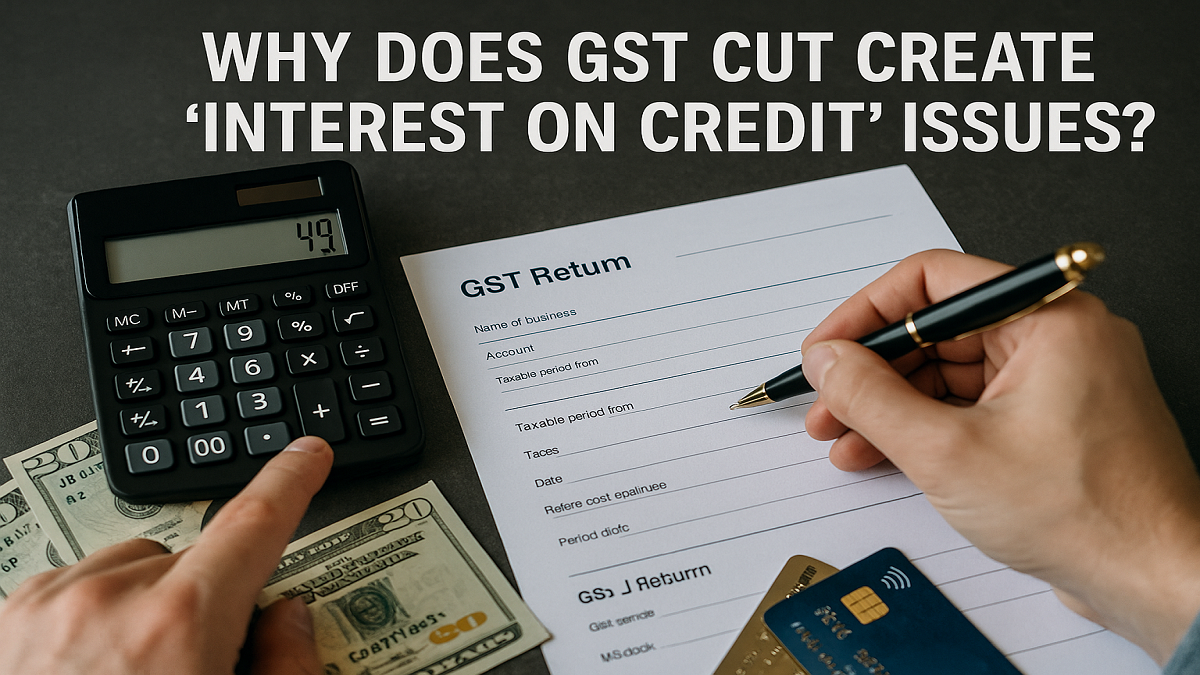
The Goods and Services Tax (GST) is one of the most important components of India’s indirect tax system. While a GST rate cut often brings relief to consumers by lowering prices of goods and services, it creates certain financial challenges for businesses. One such problem is the “interest on credit” issue, which directly affects a company’s cash flow and working capital.
In this article, we will explain why GST cuts create interest on credit issues, with examples, and why it matters for both businesses and the economy.
What is “Interest on Credit”?
Interest on credit is the extra cost a business pays when it borrows money to manage its operations. If a company’s funds are blocked (for example, in the form of pending tax refunds), it often takes loans to keep its business running. On such loans, the company must pay interest, which becomes an additional financial burden.
How GST Works in Simple Terms
- Businesses pay GST on raw materials or services they purchase.
- They also collect GST from customers when selling finished goods.
- The tax already paid on inputs is called Input Tax Credit (ITC).
- Businesses can set off ITC against the GST they collect from customers.
Why GST Cuts Create Problems
1. Mismatch in Input Tax Credit (ITC)
When GST rates are reduced, businesses start collecting less GST from customers. But the input GST they already paid on raw materials (at a higher rate) remains the same. This creates a mismatch — companies have more ITC than they can use.
2. Blocked Working Capital
The unused ITC becomes blocked funds for businesses. They cannot use it immediately, and refund processes from the government are often slow and delayed. Meanwhile, companies still need cash to pay suppliers, salaries, and operating costs.
3. Dependence on Borrowing
To meet expenses, businesses borrow money from banks or financial institutions. This loan comes with interest costs. Since the GST refund is stuck, businesses indirectly pay extra money as interest on borrowed credit.
4. Impact on Profit Margins
Lower GST rates reduce selling prices, which benefits consumers. However, businesses face higher financial stress because of blocked refunds and interest costs. This squeezes their profit margins and affects long-term sustainability.
Example for Better Understanding
- A company buys raw materials worth ₹1,00,000 and pays 18% GST = ₹18,000.
- Later, GST on finished goods is reduced from 18% to 12%.
- When the company sells goods worth ₹1,00,000, it collects only ₹12,000 GST from customers.
- But it already paid ₹18,000 GST on inputs.
- The extra ₹6,000 ITC is blocked until the government processes refunds.
- To manage day-to-day expenses, the company takes a loan. On that loan, it pays interest, which becomes an “interest on credit issue.”
Why This Matters
- For Businesses: Increases financial burden and reduces profitability.
- For Consumers: Prices may not fall as much as expected, since companies add extra costs.
- For the Economy: Frequent GST cuts without quick refund mechanisms can discourage investment and affect business growth.


 India's Major Ports Handle Record 915.17...
 Moody's Cuts India's FY27 Growth Forecas...
 A Smarter Tax System: AI-Powered 'Kar Sa...











