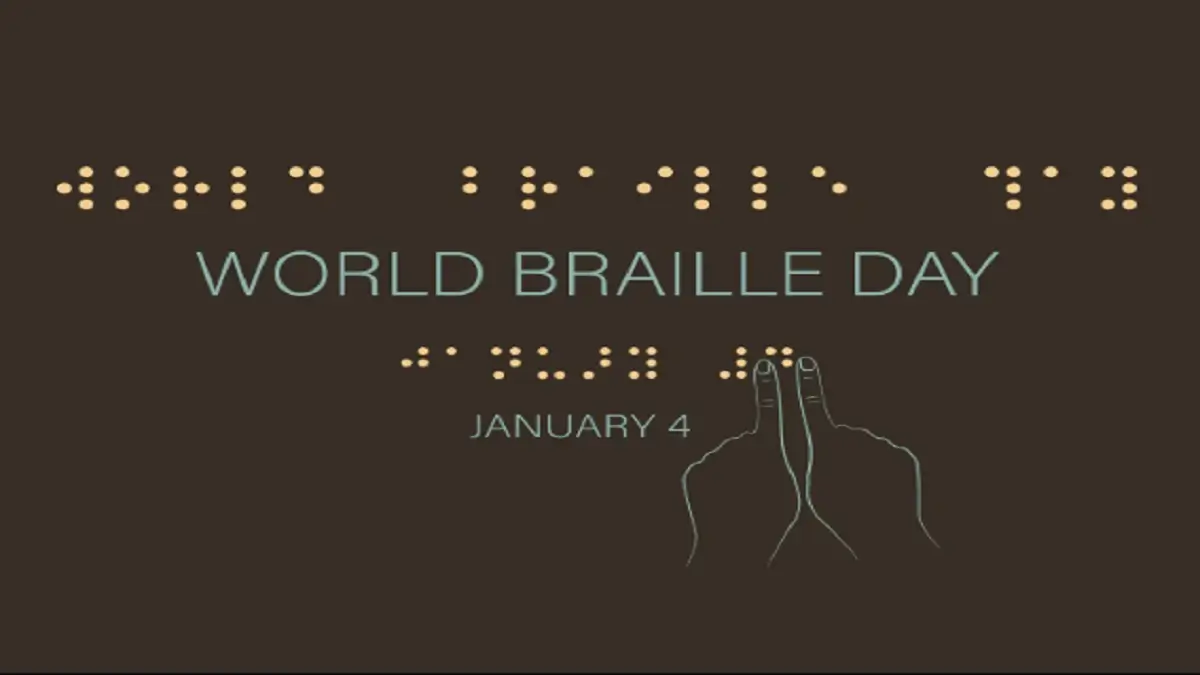
Every year on January 4, the world observes World Braille Day, a day dedicated to celebrating one of the most powerful tools of inclusion ever created. Braille is not just a system of reading and writing; it represents access to information, independence, and dignity for millions of people with visual impairments across the globe. This day reminds us that true development is possible only when knowledge is accessible to all.
Why Is World Braille Day Observed on January 4?
World Braille Day marks the birth anniversary of Louis Braille, the French educator who invented the Braille system. Louis Braille lost his eyesight at a very young age due to an accident. Instead of allowing blindness to limit his future, he transformed his experience into innovation by developing a system based on six raised dots, which could be read through touch.
Although Braille was invented in the 19th century, its global importance received official recognition when the United Nations declared January 4 as World Braille Day in 2019. This declaration reinforced the idea that Braille is not a special aid, but a basic human right, essential for equality and inclusion.
Braille: More Than a Writing System
For persons with visual impairments, Braille is the foundation of literacy and education. It enables individuals to read textbooks, understand mathematics, learn music, and access scientific knowledge. Without Braille, education would remain incomplete and inaccessible for many.
Beyond education, Braille plays a crucial role in everyday life. It supports employment opportunities by allowing visually impaired individuals to read documents, take notes, and work independently. It also improves public safety, as Braille is commonly used on medicine labels, elevator buttons, and public signage, ensuring people can move safely and confidently in public spaces.
Most importantly, Braille promotes social equality. It reduces discrimination by ensuring that information is not restricted to those who can see, but shared equally with everyone.
Why World Braille Day Is Still Relevant Today
Despite rapid technological advancements like screen readers and voice assistants, Braille remains irreplaceable. Digital tools cannot fully replace tactile reading, especially in education and skill development. Many visually impaired individuals still face challenges such as lack of Braille textbooks, limited access to inclusive classrooms, and poor implementation of accessibility standards in public infrastructure.
World Braille Day acts as a call to action for governments, educational institutions, and private organizations to invest in inclusive policies. It encourages the adoption of accessible formats in education, transportation, healthcare, and digital services so that no individual is left behind.
UNESCO BMW and Global Efforts for Braille Promotion
Organizations like UNESCO BMW are playing a vital role in promoting Braille literacy worldwide. Their efforts focus on integrating Braille into mainstream education systems, supporting digital Braille innovations, and advocating for strong policies that protect the rights of persons with disabilities. Such initiatives help bridge the gap between technological progress and accessibility.
How Can Individuals Contribute?
Awareness begins with understanding. People can support World Braille Day by encouraging accessible signage in public places, supporting organizations that provide Braille learning materials, and promoting inclusive education. Small actions at the community level can collectively bring meaningful change.


 RBI Foundation Day 2026: History, Functi...
 List of Important Days in April 2026, Na...
 Utkal Divas 2026 Odisha: Formation Day H...