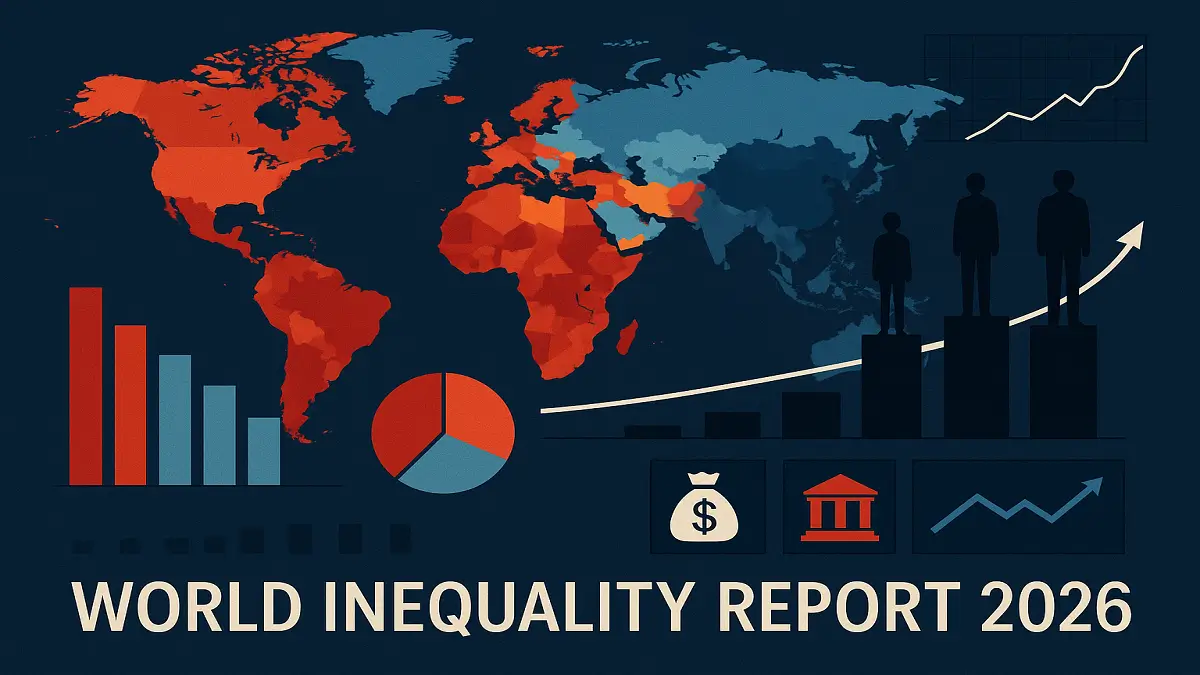
The World Inequality Report 2026, released by the World Inequality Lab and edited by economists Lucas Chancel, Ricardo Gómez-Carrera, Rowaida Moshrif, and Thomas Piketty, reveals a stark picture of rising global inequality. Despite global wealth reaching historic highs, its distribution remains deeply imbalanced, with a tiny global elite holding a disproportionate share.
Written against a backdrop of weakening multilateralism and widening social divides, the 2026 report underscores how inequality continues to deepen across income, wealth, gender, geography, and even climate impact.
Global Wealth Inequality: Concentration at the Very Top
One of the most striking findings is the enormous concentration of wealth among the ultra-rich:
- The top 0.001% (fewer than 60,000 individuals) now own three times more wealth than the bottom 50% of the world population combined.
- Their wealth share has risen from ~4% in 1995 to over 6% in 2025.
- The global top 10% controls 75% of total wealth, while the bottom 50% holds just 2%.
- The top 1% alone controls 37% of global wealth, more than 18 times the wealth of the bottom half of humanity.
The top one-in-a-million group collectively holds 3% of global wealth, while the top one-in-100 million (only 56 people worldwide) have average wealth of €53 billion each.
These numbers highlight how the inequality problem extends not only between the rich and poor but within the top income brackets themselves.
India: Among the Most Unequal Countries
The report places India among the world’s most unequal economies:
Income Inequality
- The top 10% in India capture 58% of national income.
- The bottom 50% receives only 15%.
- In 2021 (WIR 2022), these shares were 57% and 13%, indicating growing disparity.
Wealth Inequality
- The richest 10% own 65% of total wealth.
- The top 1% alone holds 40% of wealth.
Low Female Labour Participation
- Female labour participation remains extremely low at 15.7%, with no improvement in the past decade.
- This reflects persistent gendered barriers in employment and wages.
Average income and wealth levels remain modest:
- Average annual income per capita: €6,200 (PPP)
- Average wealth per adult: €28,000 (PPP)
The report concludes that inequality in India is “deeply entrenched” across income, wealth, and gender, highlighting structural challenges in the economy.
Global Income Patterns: Then and Now (1980–2025)
The report compares global distribution in 1980 vs. 2025:
1980
- Global elite concentrated in Europe, North America & Oceania.
- China and India were almost entirely in the bottom half of the global distribution.
- Sub-Saharan Africa was heavily concentrated in the lowest percentiles.
2025
-
China has moved upward, with much of its population now in the middle 40% and a section entering upper-middle ranks.
-
India has lost relative ground:
- Earlier, a significant portion was in the middle 40%.
- Today, almost all are in the bottom 50%.
-
Sub-Saharan Africa remains in the lower half.
These changes indicate shifting global economic structures but also highlight the widening gaps within and across countries.
Gender Inequality: A Persistent Global Issue
The gender pay and labour gap remains pronounced:
- Excluding unpaid work, women earn 61% of what men earn per working hour.
- Including unpaid labour, women’s income drops to 32% of men’s.
- Women capture just over 25% of total global labour income — nearly unchanged since 1990.
Regional Breakdown of Women’s Share in Labour Income
- Middle East & North Africa: 16%
- South & Southeast Asia: 20%
- Sub-Saharan Africa: 28%
- East Asia: 34%
- Europe, North America & Oceania: ~40%
Despite progress in education and employment, gender inequality remains a global reality.
Climate Inequality: Emissions and Wealth
The report introduces a crucial inequality dimension — carbon inequality:
- The poorest 50% of the world population contributes only 3% of emissions linked to private capital ownership.
- The top 10% is responsible for 77% of such emissions.
- The wealthiest 1% accounts for 41% of emissions — nearly double the bottom 90%.
This data shows how climate responsibility is heavily skewed toward the rich, intensifying debates on climate justice.
Why Inequality Persists: Taxation Gaps and Policy Failures
The report highlights policy-driven factors deepening inequality:
- Effective tax rates rise for most people but fall sharply for billionaires and centi-millionaires.
- The ultra-rich often escape taxation through loopholes, depriving governments of revenue for public goods.
- This creates a regressive system, where the wealthy pay proportionally less than poorer households.
Needed Policy Actions
- Progressive taxation on income and wealth
- Strengthened financial transparency
- Higher public investment in:
- Education
- Universal healthcare
- Childcare and nutrition
-
Redistributive programmes such as:
- Cash transfers
- Pensions
- Unemployment benefits
These steps can narrow inequality and support inclusive growth.


 Best Airlines in the World 2026: Best Fu...
 Top 10 Self-Made Women Billionaires 2026...
 Hurun Rich List 2026: Elon Musk Still No...