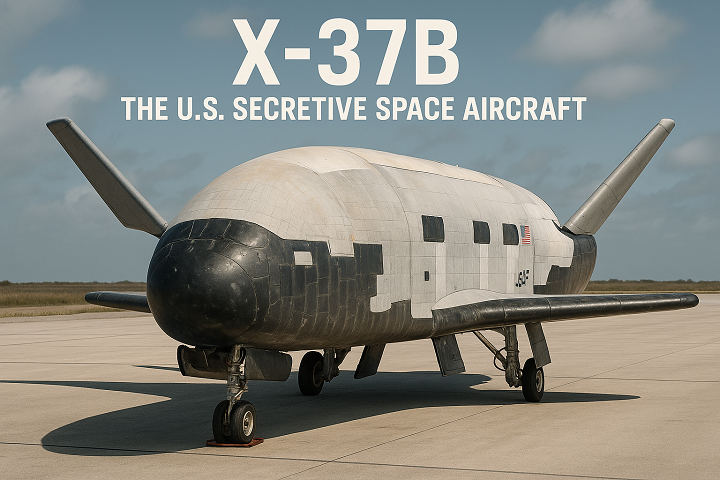
The X-37B, officially called the Orbital Test Vehicle (OTV), is one of the most secretive projects of the U.S. Air Force and Space Force. Often described as a “mini space shuttle,” it has completed several long-duration missions in Earth’s orbit. Its advanced design, reusability, and classified experiments make it central to the new era of space warfare and technology competition, especially with rivals like China and Russia.
What is X-37B?
- Developed by NASA (initially) and later transferred to Boeing for the U.S. Department of Defense.
- First launched: 2010.
- Operated by: U.S. Space Force (previously U.S. Air Force Rapid Capabilities Office).
- Size: About 9 m long, 4.5 m wingspan.
- Payload Bay: Similar to a small pickup truck bed.
- Missions: Can stay in orbit for over 900 days continuously (record: 908 days).
Purpose (as known):
- Testing reusable spacecraft technologies.
- Carrying classified experiments (possibly surveillance, advanced sensors, space materials testing, or even space weapons).
- Enhancing U.S. space dominance in the era of militarized space.
Comparison with Other Space Technologies
1. X-37B vs Traditional Satellites
| Feature | X-37B | Traditional Satellites |
|---|---|---|
| Reusability | Fully reusable spacecraft | Single-use (cannot return) |
| Flexibility | Can change orbit, maneuver, land & relaunch | Fixed orbit |
| Mission Duration | 900+ days | Varies (5–15 years) |
| Use | Classified experiments, military payloads | Communication, weather, GPS, surveillance |
2. X-37B vs SpaceX Reusable Rockets (Falcon 9/Starship)
| Feature | X-37B | SpaceX Reusable Rockets |
|---|---|---|
| Type | Spaceplane (stays in orbit) | Rocket (launch system) |
| Payload | Small, secret experiments | Large payloads (satellites, cargo, humans) |
| Reusability | Returns like a plane | Booster reused; capsule sometimes reused |
| Role | Military-focused | Commercial + NASA missions |
While SpaceX focuses on commercial & interplanetary goals, X-37B’s priority is strategic defense and classified testing.
3. X-37B vs Space Shuttle (Retired NASA Program)
| Feature | X-37B | Space Shuttle |
|---|---|---|
| Size | Much smaller (9 m long) | Huge (37 m long) |
| Crew | Unmanned (autonomous) | Crewed (7 astronauts) |
| Missions | Classified, experimental | ISS construction, satellite deployment |
| Cost | Cheaper (smaller operations) | Very expensive |
4. X-37B vs China’s Spaceplane (Shenlong / CSSHQ)
China has reportedly developed a similar spaceplane, often compared to the X-37B.
| Feature | X-37B (U.S.) | Shenlong (China) |
|---|---|---|
| First Flight | 2010 | First spotted 2020 |
| Missions | 6+ successful long missions | Few test missions (details secret) |
| Technology | Advanced reentry tech, U.S. military experiments | Believed to test similar stealth & reusable tech |
| Military Impact | Strengthens U.S. dominance in space | Seen as China’s attempt to counterbalance |
This comparison highlights the growing U.S.-China space race and the increasing militarization of space.
Strategic Importance of X-37B
- Space Superiority – Can test technologies that enhance U.S. control in orbit.
- Reusable Tech – Reduces costs and improves rapid deployment.
- Classified Edge – Keeps rivals guessing about its true capabilities.
- Space Warfare Potential – Could theoretically disable enemy satellites or test directed-energy weapons.


 New COVID Variant BA.3.2: Symptoms, Risk...
 NASA’s Artemis 2 Set for April 2026 Laun...
 Akasha300 3D Printer Explained: How It W...