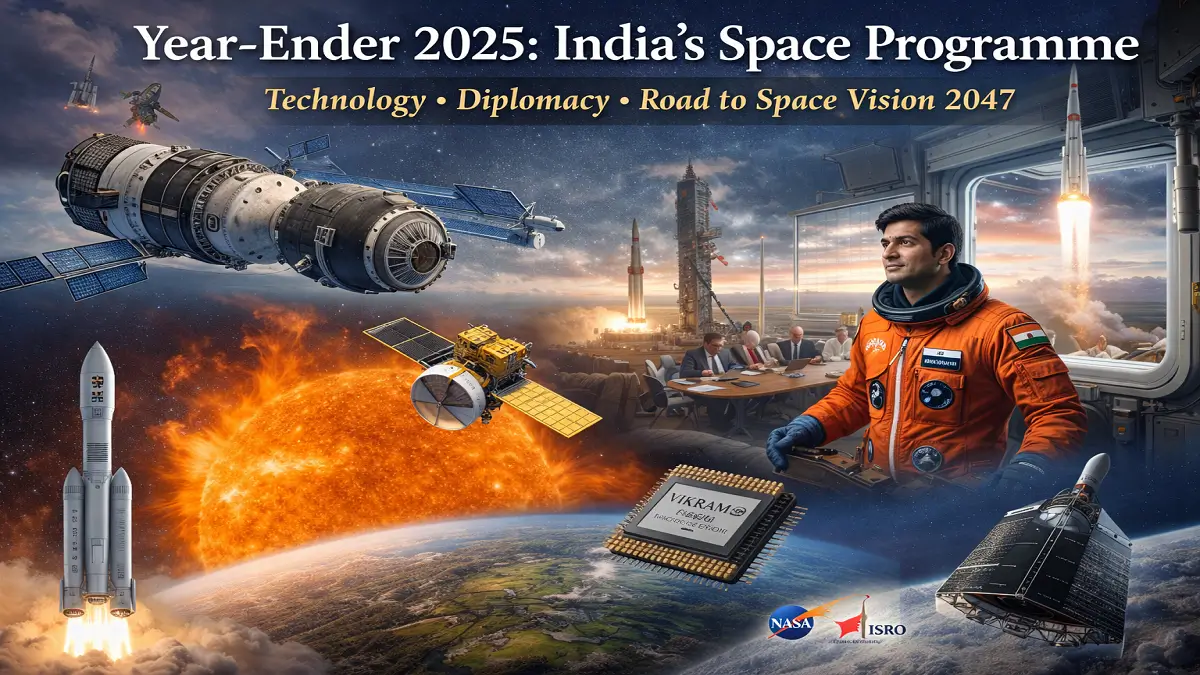
The year 2025 marked a transformative phase for India’s space programme, as the country moved decisively beyond launch capability towards mastering advanced technologies, human spaceflight readiness, global partnerships, and commercial expansion. According to the Department of Space’s year-end review, India’s progress in 2025 aligned closely with its long-term roadmap under Space Vision 2047, which aims to establish India as a leading global space power by the centenary of Independence.
Breakthrough Missions: Docking, Biology and In-Orbit Experiments
SPADEX: Mastering Space Docking
One of the most significant technological achievements of 2025 was the SPADEX (Space Docking Experiment) mission, launched aboard PSLV-C60.
- Two satellites successfully docked and undocked in orbit
- Demonstrated power transfer and circumnavigation
- Docking was achieved twice, highlighting reliability
This capability is critical for future space stations, crewed missions, and on-orbit servicing, placing India among a small group of nations with autonomous docking expertise.
CROPS-1: India’s First Space Biology Experiment
India entered the domain of space biology with CROPS-1, conducted on the POEM-4 platform.
- Cowpea seeds germinated in microgravity
- Plants grew up to the two-leaf stage
- Provided early insights for life-support systems in long-duration missions
POEM-4: Expanding In-Orbit Research
The POEM-4 platform completed 1,000 orbits, hosting:
- 24 payloads from ISRO and private entities
- Experiments in AI, robotics, green propulsion, and biology
This showcased ISRO’s focus on low-cost access to space and industry-academia participation.
Solar Science and Earth Observation Leadership
Aditya-L1: Unlocking Solar Secrets
In 2025, ISRO released the first scientific datasets from Aditya-L1, positioned at the Sun–Earth L1 point.
The data offers global researchers insights into:
- Photosphere
- Chromosphere
- Corona
This strengthened India’s standing in solar physics and space weather research.
Earth Observation & Agriculture
ISRO’s satellites played a key role in agricultural forecasting, accurately estimating:
-
India’s wheat production at over 122 million tonnes
NISAR: India–NASA Collaboration
The launch of NISAR (NASA–ISRO Synthetic Aperture Radar) marked a milestone in global cooperation.
- Dual-frequency radar satellite
- Tracks ground deformation, ice sheets, earthquakes, and natural disasters
- Positioned India as a key contributor to global Earth monitoring
Launch Infrastructure and Propulsion Advances
New Launch Facilities
-
Third Launch Pad at Sriharikota approved by the Union Cabinet
Designed for human spaceflight and next-generation launch vehicles
-
SSLV Launch Complex at Kulasekarapattinam advanced
Supports the growing small-satellite market
Historic Launch and Propulsion Milestones
-
100th launch from Sriharikota achieved with GSLV-F15
-
Key propulsion achievements:
- Semi-cryogenic engine power head hot tests
- 1,000-hour life test of electric plasma thrusters
- First in-space restart of C25 cryogenic stage during LVM3-M5
These advances enhance payload capacity, mission flexibility, and reusability prospects.
Human Spaceflight Gains Momentum
Gaganyaan Programme Progress
Human spaceflight remained a top priority in 2025:
- First integrated air drop test of the crew module parachute system
- Marked a major safety milestone for Gaganyaan
Indian Astronaut on the ISS
In a historic achievement:
- Shubhanshu Shukla flew to the International Space Station aboard Axiom-04
- Spent 18 days in orbit
- Conducted microgravity experiments and public outreach
This marked India’s entry into ISS-based human research.
Space Medicine and Analog Missions
- Analog missions conducted in Ladakh’s Tso Kar Valley
- New framework with SCTIMST for astronaut health research
- Strengthened India’s space medicine ecosystem
Indigenous Technology and Private Sector Expansion
Indigenous Space Electronics
India achieved self-reliance with:
- VIKRAM3201 and KALPANA3201
- First 32-bit indigenous space-grade microprocessors
- Developed with SCL Chandigarh
Commercialisation of SSLV
- Technology transfer agreement signed
- Enables industry-led SSLV launches
- Boosts India’s commercial launch market
Startup Participation
- Successful static test of KALAM-1200 solid rocket motor
- Developed by an Indian startup at ISRO facilities
- Reflects the impact of space sector reforms
Global Engagement and Strategic Vision
International Leadership
In 2025, India:
- Assumed leadership in the International Charter on Space and Major Disasters
- Hosted GLEX 2025 in New Delhi
- Showcased achievements at IAC 2025 in Sydney
Chintan Shivir 2025
The Department of Space organised Chintan Shivir 2025 to:
- Refine implementation strategies for Space Vision 2047
- Focus on human presence in space, commercial growth, and advanced science missions

 Who Invented the QR Code? Check Here
 Who is known as the Father of Microbiolo...
 Which City is known as the City of Thous...