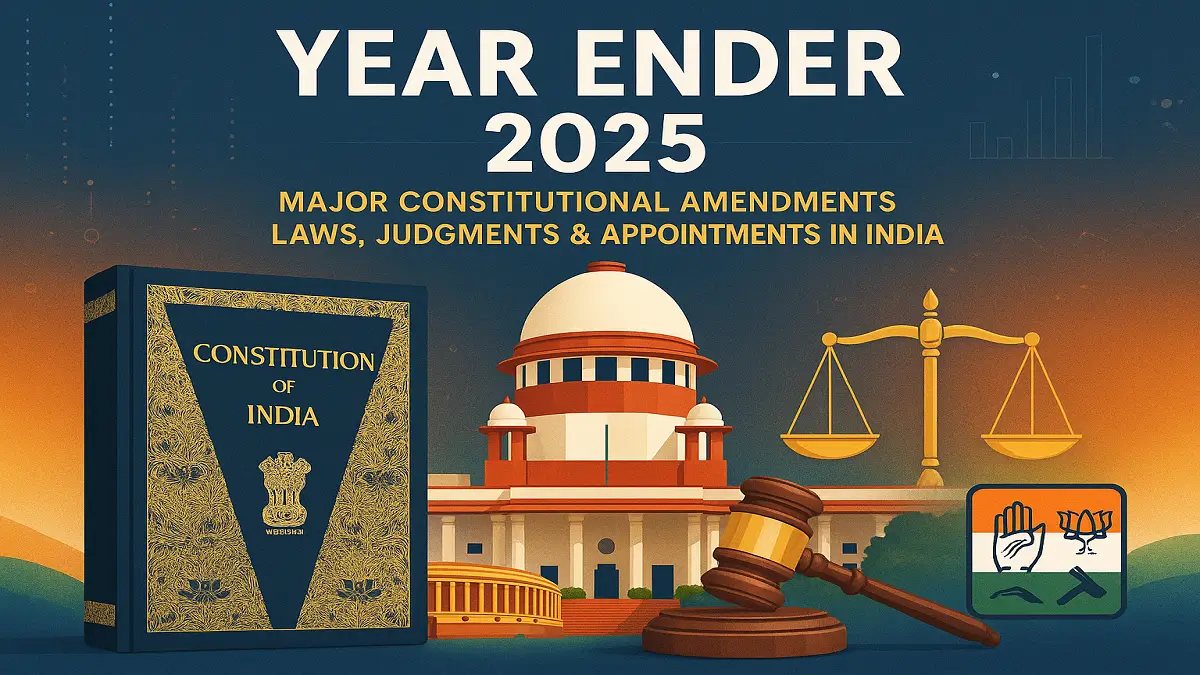
The year 2025 emerged as a landmark period in India’s constitutional and governance history. It witnessed intense debate on federalism, clean governance, data privacy, and institutional powers. Several constitutional amendment Bills, major Parliamentary Acts, and historic Supreme Court judgments shaped the evolving interpretation of the Constitution. Alongside, important constitutional offices saw significant transitions, giving 2025 lasting relevance for competitive examinations.
I. Constitutional Amendments & Key Constitutional Bills (2025)
1. Constitution (129th Amendment) Bill, 2024 – One Nation, One Election
Background & Objective
The Bill seeks to enable simultaneous elections to the Lok Sabha and all State/UT Legislative Assemblies under the “One Nation, One Election (ONOE)” framework. It was introduced along with amendments to UT laws to ensure alignment of electoral cycles.
Status in 2025
- Referred to a Joint Parliamentary Committee (JPC) in December 2024
- JPC deadline extended till Winter Session 2025
- Still under examination, not enacted
Constitutional Focus: Federalism, electoral democracy
2. Constitution (130th Amendment) Bill, 2025 – Removal of Ministers on Arrest (Proposed)
Core Idea
This proposed amendment aims to introduce provisions where a Minister (including Chief Minister) would automatically cease to hold office if detained or arrested for serious offences beyond a specified period.
Associated Bills
- Government of Union Territories (Amendment) Bill, 2025
- Jammu & Kashmir Reorganisation (Amendment) Bill, 2025
Status
- Listed as “In Committee”
- Not enacted as of end-2025
Theme: Ethical governance, clean politics
3. Proposed Constitution (131st Amendment) Bill – Chandigarh & Article 240
Issue
The proposal seeks to bring Chandigarh under Article 240, allowing the President to make regulations for the UT.
Controversy
- Punjab-based parties argue it affects Chandigarh’s status as a shared capital
- Raises questions on federal balance and UT governance
Status: Proposal stage only
II. Major Acts of Parliament in 2025
1. Waqf (Amendment) Act, 2025 & Mussalman Wakf (Repeal) Act, 2025
Key Changes
- Inclusion of non-Muslim experts in Waqf Boards
- Restrictions on unilateral waqf declarations
- Mandatory digital mapping and surveys
- Stronger action against encroachment
Repeal
-
The Mussalman Wakf Act, 1923 repealed as obsolete
Constitutional Link: Articles 25–30 (Minority rights)
2. Immigration and Foreigners Act, 2025
Purpose
Replaces colonial-era laws to create a single, modern immigration framework.
Scope
- Entry, stay, exit of foreigners
- Visa, detention, deportation, blacklisting
Concerns
- Broad executive powers
- Limited refugee and asylum safeguards
Constitutional Link: Article 21, foreign affairs power
3. Maritime Trade Reforms
- Bills of Lading Act, 2025: Recognises electronic bills of lading
- Carriage of Goods by Sea Act, 2025: Updates carrier liability laws
Constitutional Link: Article 19(1)(g) – trade & commerce
4. Central Excise (Amendment) Act, 2025
Key Feature
- Higher excise duty on cigarettes and luxury goods
- Aligns taxation with WHO public health norms
Constitutional Link: Article 47 (Public Health)
5. Digital Personal Data Protection Rules, 2025
Significance
Completed India’s data protection regime by operationalising the DPDP Act, 2023.
Highlights
- Duties of data fiduciaries
- Data Protection Board framework
- Children’s data safeguards
- Cross-border data rules
Constitutional Link: Right to Privacy (Article 21)
III. Landmark Judicial Decisions (2025)
A. Domicile-Based Reservation in PG Medical Courses
Case: Avijit Chander v. UT of Chandigarh (Jan 2025)
Held
- Residence-based reservation in PG medical admissions is unconstitutional
- Violates Article 14
- Institutional preference allowed, domicile quota not
Impact: Nationwide revision of PG medical quotas
B. Governor & President’s Powers on Bills
Presidential Reference No. 1 of 2025 (Nov 2025)
Key Holdings
- No fixed timelines or “deemed assent”
- Courts cannot legislate timelines
- Limited judicial review allowed for prolonged inaction
- Article 361 immunity does not bar such review
Importance: Federalism, separation of powers
C. Advocate–Client Privilege Case
Suo Motu Case on Summoning Advocates (Oct 2025)
Ruling
- Advocates cannot be routinely summoned
- Privilege protected under BSA 2023
- Linked to Articles 19(1)(g), 21, and 22(1)
IV. Key Constitutional Appointments (2025)
Vice President of India
- C. P. Radhakrishnan
- Sworn in: 12 September 2025
Chief Justices of India
- Justice B. R. Gavai (52nd CJI): May–Nov 2025
- Justice Surya Kant (53rd CJI): From Nov 2025
Chief Election Commissioner
- Gyanesh Kumar (from 19 Feb 2025)
- Led electoral reforms and global engagement
V. Governance Reforms with Constitutional Impact
- Full rollout of data-protection regime
- Shift from National Litigation Policy to administrative litigation reforms
- UIDAI tightened Aadhaar usage rules to protect privacy


 Where is the Bab-el-Mandeb Strait Locate...
 Which Country has the Cheapest Petrol in...
 Which Place is known as the Gate of Tear...