
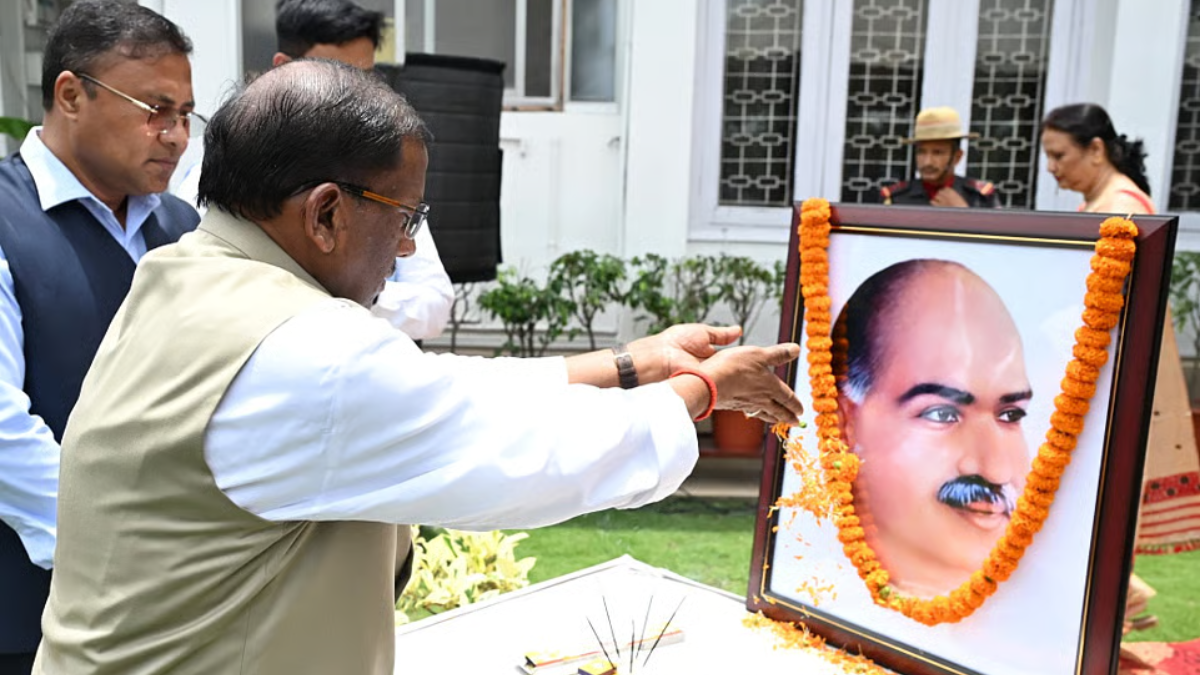
The Ministry of Culture organized a special event in New Delhi to celebrate the 125th birth anniversary of Bharat Kesari Dr. Syama Prasad Mookerjee. The programme included an exhibition, speeches and the release of a commemorative stamp and coin. This event is part of a two-year-long tribute to honour Dr. Mookerjee’s important role in India’s history and his strong voice for unity, reform and national integration.
Who was Syama Prasad Mookerjee?
Syama Prasad Mookerjee was a great leader, educationist, barrister and freedom fighter of India. Born on 6 July 1901 in Kolkata, he played an important role in shaping modern India. On his 125th birth anniversary, the nation remembers his contribution to politics, education and national unity.
Early Life and Education of Syama Prasad Mookerjee
He was born into a respected Bengali family. His father, Ashutosh Mukherjee, was a judge and Vice-Chancellor of Calcutta University. Syama Prasad was a brilliant student. He studied at Presidency College and completed his law degree. He later went to England to become a barrister and returned to India to serve the country.
Career in Education
At just 33 years old, Syama Prasad Mookerjee became the youngest Vice-Chancellor of Calcutta University. He introduced Indian languages in university exams and invited Rabindranath Tagore to speak in Bengali during convocation for the first time.
Political Journey Before Independence
He started his political career in 1929 and later joined the Hindu Mahasabha. He was elected as Finance Minister of Bengal in 1941. He opposed the Quit India Movement but also criticized British rule. He actively worked for the safety and rights of Hindus in Bengal during communal riots and strongly supported the partition of Bengal to protect Hindu-majority areas.
Role in Independent India
After India became free, Mookerjee became the first industry Minister in Nehru’s cabinet. He later resigned over differences with Nehru on the Nehru-Liaquat Pact. In 1951, with the help of the RSS, he founded the Bharatiya Jana Sangh, which later became the Bharatiya Janata Party (BJP).
Personal Life and Social Work
Syama Prasad was married to Sudha Devi and had five children. He was a devoted social worker and also served as President of the Buddhist Mahabodhi Society. He brought back holy relics of Lord Buddha’s disciples from the British Museum to India and spread India’s message of peace to other countries.
Syam Prasad Mukherjee – Legacy and Memorials
Many institutions and places are named after him, such as:
- Syama Prasad Mukherjee University, Ranchi.
- Shyama Prasad Mukherjee Port, Kolkata
- Dr. Syama Prasad Mookerjee Civic Centre, Delhi
- Chennai-Nashri Tunnel, renamed in his honour
- Shyama Prasad Rurban Mission to develop rural India


 National Maritime Day 2026: Remembering ...
 Easter Sunday 2026: Meaning, History &am...
 Weekly Current Affairs One Liners (30th ...











