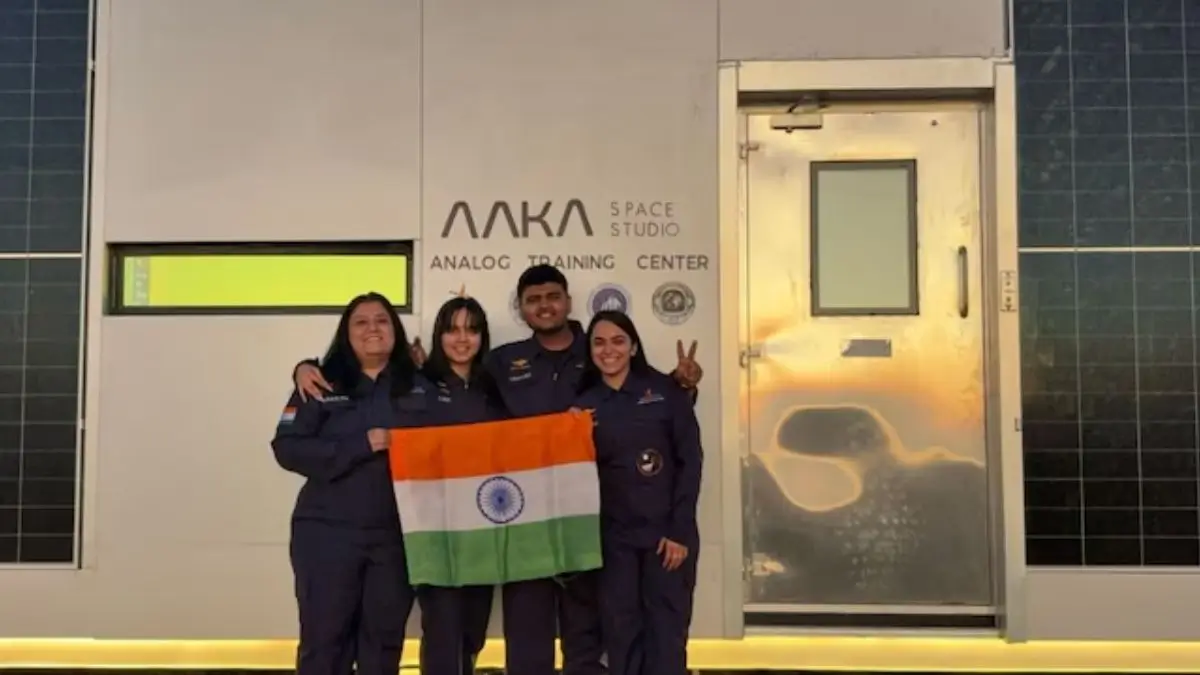
Seventeen year old Aditya Pandya has created history by becoming India’s youngest male analog astronaut. He successfully completed a lunar-habitat-inspired mission conducted by AAKA Space Studio from February 1 to 8, 2026 in Dholavira, Kutch (Gujarat). The mission simulated Moon-like isolation and autonomous operations, marking a key milestone in India’s emerging analog space research ecosystem and youth participation in advanced space technology experiments.
What Is an Analog Astronaut Mission?
An analog astronaut mission is a space simulation experiment conducted on Earth that replicates the conditions astronauts may face on the Moon or Mars.
These missions test,
- Isolation and psychological endurance
- Habitat engineering and system reliability
- Crew autonomy and human–machine interaction
- Environmental control systems
The Dholavira mission recreated harsh, isolated lunar-like conditions inside a container-based habitat to study long-duration confinement and technological resilience.
Lunar Analog Habitat in Dholavira
- The mission was conducted in the white plains of Dholavira in the Rann of Kutch, a region whose barren terrain resembles lunar landscapes.
- A four-member crew lived in strict isolation inside a modular habitat designed to simulate a Moon base.
- The habitat replicated physical and operational constraints such as limited resources, communication protocols, and controlled environmental systems.
- The mission tested how future astronauts might survive and operate in extraterrestrial settlements.
Aditya Pandya’s Dual Role in the Mission
Aditya Pandya was not only an analog astronaut but also served as the lead for hardware, IoT systems, and habitat intelligence. Over six months, he helped build and integrate the mission’s core technology stack.
His responsibilities included,
- Environmental sensor modules
- Astronaut biometric monitoring systems
- Embedded safety hardware
- Real-time telemetry systems
- 3D-printed modular components
This dual role reflects a modern approach where engineers actively test the technologies they design.
Digital Twin and Autonomous Systems
One of the mission’s key technological features was a digital twin framework. A digital twin is a virtual model that mirrors a physical system in real time.
The habitat’s digital twin enabled,
- Continuous monitoring of crew health
- Environmental condition tracking
- Real-time system performance analysis
- Post-mission data evaluation
Aditya validated the very systems he engineered while living inside the habitat, subjecting them to operational stress during the nine-day simulation.
Role of AAKA Space Studio and ISRO Ecosystem
- The mission was conducted by AAKA Space Studio, a registered Indian Space Research Organization Space Tutor.
- The initiative aligns with India’s growing focus on human spaceflight, astronaut training, and planetary habitation research.
- Such analog missions complement India’s long-term goals under programmes like Gaganyaan and future lunar exploration efforts by strengthening ground-level research and simulation capabilities.
Why This Achievement Is Significant
Aditya Pandya’s achievement highlights,
- Rising youth participation in space science
- Growth of India’s analog space research ecosystem
- Integration of engineering with experiential astronaut training
- Advancement of digital twin and IoT-based habitat technologies
- His accomplishment signals how India’s next generation is actively contributing to space innovation beyond theoretical learning.
Question
Q1. Aditya Pandya became India’s youngest male analog astronaut after completing a mission in:
A. Leh
B. Sriharikota
C. Dholavira
D. Andaman Islands


 Akasha300 3D Printer Explained: How It W...
 IVRI Produces Sahiwal Calves Using Advan...
 What is Terafab Project? Elon Musk Large...