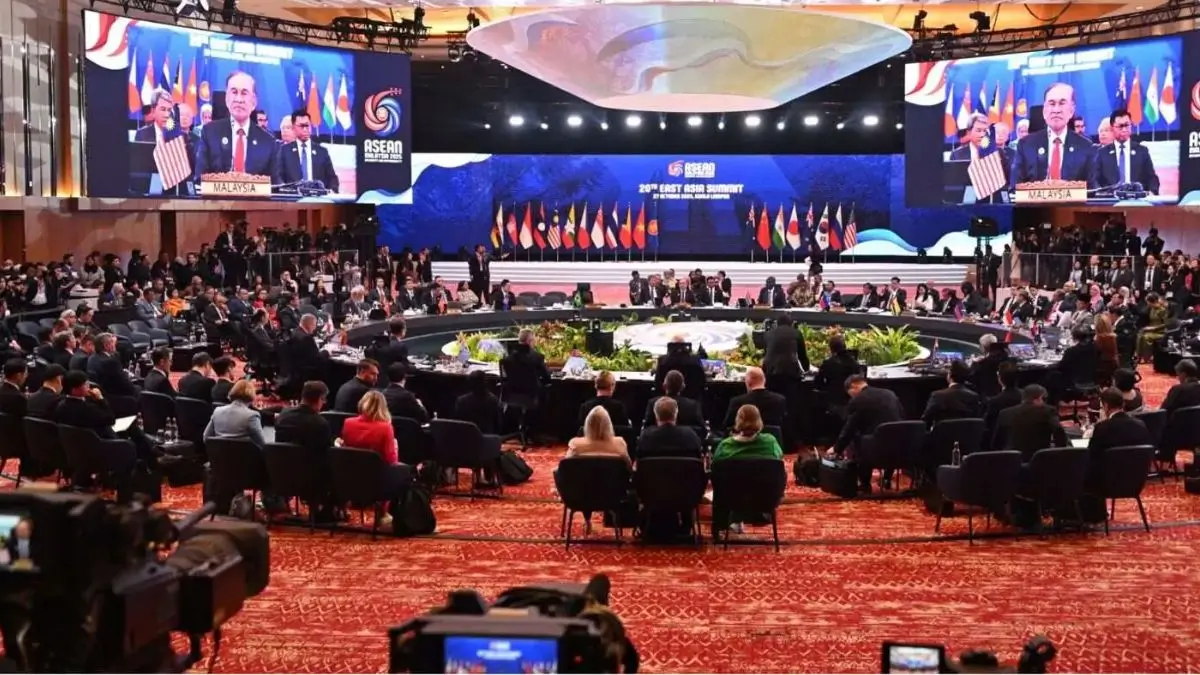
At its 20th edition in Kuala Lumpur, the 20th East Asia Summit (EAS) adopted the Kuala Lumpur Declaration, signalling renewed resolve among participating nations to uphold peace, stability and multilateral cooperation in the East Asian region. The Declaration underscores the EAS’s role in a changing geopolitical landscape, emphasising strategic trust, transparent behaviour and strong regional architecture.
Key Elements of the Declaration
The Declaration emphasises the following core ideas,
- A reaffirmation of the principles of the Kuala Lumpur Declaration 2005 and subsequent EAS milestone declarations, thereby maintaining continuity in EAS commitments.
- Recognition that the region faces geopolitical tensions, economic challenges and trans‑boundary security threats, making collective collaboration imperative.
- Commitment to maintaining the informal, leaders‑led format of the EAS, allowing candid and strategic discussions at the highest level.
- Emphasis on the centrality of the Association of Southeast Asian Nations (ASEAN) in the regional architecture, with EAS sitting at the apex of ASEAN‑centred cooperation.
- Promotion of transparent, predictable and responsible behaviour in regional and international affairs, along with peaceful settlement of disputes in accordance with international law.
- Prioritisation of cooperation in areas such as regional development, security policy, disaster management, and evolving regional architecture to bolster resilience and trust.
Strategic Significance
- In a period of evolving global power dynamics—marked by rising U.S.–China competition, maritime‑region tensions and new security challenges—the 20th EAS declaration provides a shared reference point for regional stability.
- It reaffirms commitment to a rules‑based order, multilateral dialogue and ASEAN’s central role in regional governance.
Diplomacy and Connectivity
- By endorsing structured cooperation on development, disaster management and security, the EAS declaration supports broader initiatives like the ASEAN Outlook on the Indo‑Pacific (AOIP), thereby reinforcing linkages between political, economic and security domains.
For India and Other Participants
- For countries like India, the declaration provides a platform to engage multilaterally with neighbours and major powers under the EAS framework.
- It reinforces India’s role in regional architecture and its interest in peaceful dispute settlement, connectivity and strategic autonomy.
Static Facts
- Event: 20th East Asia Summit (EAS) held in Kuala Lumpur, Malaysia.
- Declaration adopted: Kuala Lumpur Declaration.
- Main focus: reaffirming commitment to peace, stability, multilateralism, and promotion of responsible behaviour among participating countries.
- Emphasised ASEAN’s central role in regional architecture and the informal, leaders‑led nature of EAS.


 Costa Rica Launches Snake Identification...
 WTO 14th Ministerial Conference Conclude...
 Former Suriname President Chandrikapersa...