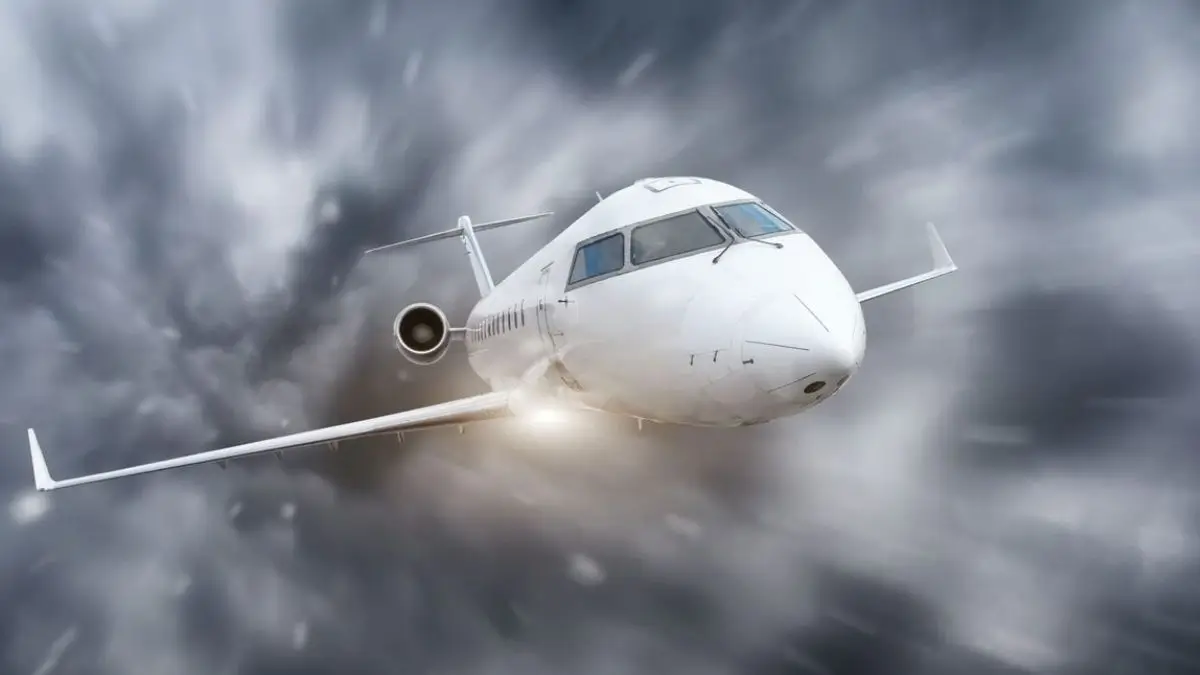
The recent incident of turbulence on Air India flight AI2379 from Phuket to Delhi has once again put the spotlight on an important aspect of air travel: flight turbulence. Turbulence is sometimes severe and unpleasant for passengers, but it is a natural phenomenon that can be safely managed by pilots and the airline.
Turbulence is caused by natural factors such as stormy weather, jet streams, mountain waves, and clear air. If passengers understand the causes of turbulence and its different types, they will become more knowledgeable about air travel and aviation safety.
What is Flight Turbulence?
Flight turbulence can be defined as the irregular and unpredictable movement of air, resulting in sudden bouncing or shaking of the aircraft.
Turbulence is a natural atmospheric event unlike mechanical failures; it is caused by the unstable air flow.
New aircraft are built to withstand even extreme turbulence safely, while pilots use sophisticated weather forecasting equipment to avoid the most turbulent areas.
Air India Incident (August 2026)
Air India Airbus A320 (Flight AI2379) from Phuket Thailand to Delhi experienced severe turbulence on 4th of August 2026.
The aircraft faced sudden changes in altitude but managed to land safely at Delhi.
Some of the passengers and crew members were injured, following which both Air India and Directorate General of Civil Aviation (DGCA) started an investigation.
Aviation specialists have explained that severe turbulence may result in trouble for automatic systems.
What are the Causes of Flight Turbulence?
The phenomenon of turbulence arises due to variations in wind speed, air pressure, temperature, and landforms. Some of the main factors affecting turbulence in flights are,
1. Storms
Thunderstorms produce high-speed upward and downward currents in the atmosphere.
2. Jet streams
Jet streams are quick-moving air in the sky.
Whenever planes passes through an area where the jet stream is irregular, it leads to severe turbulence, which is hard to predict due to the absence of clouds.
3. Mountain waves
Venturing in the mountains, strong winds create tunnel-like disturbances in the air that flows in a manner similar to waves.
These waves can extend to very long distance and creates turbulence for the aircraft.
4. Weather changes
Presence of warm air and cold air in proximity leads to adverse atmospheric conditions that cause turbulence in aircraft.
5. Ocean Winds
Ocean turbulence is caused due to high winds across oceanic regions.
Categories of Flight Turbulence
Various atmospheric conditions may create various types of turbulence.
Convective Turbulence
- Caused by thunderstorms and the upward motion of warm air.
- Generally, foreseen by weather radar.
Mechanical Turbulence
- Generated when the wind navigates around hills, buildings, forests, or uneven surfaces.
- Mostly occurs during landing and take-off.
Mountain Wave Turbulence
- Created when strong winds go past the mountain ranges.
- Its effects can be felt even far away from the mountain area.
Wake Turbulence
- Created by a nearby jet.
- Air traffic controllers always make sure that a safe distance is maintained to avoid this type of turbulence.
Clear-air Turbulence (CAT)
- Due to jet streams and wind shear.
- Most difficult to detect, since there are no weather signals visible.
Which Flight Routes Have the Most Turbulence in the World?
According to world-wide research in the aviation field regarding turbulence, the following flight routes tend to experience turbulence because of their crossing of mountain ranges, jet streams, and unstable weather patterns.
| Rank | Flight Route | Main Reason |
| 1 | Santiago (Chile) – Santa Cruz (Bolivia) | Andes Mountains |
| 2 | Almaty – Bishkek | Central Asian mountain winds |
| 3 | Lanzhou – Chengdu | Tibetan plateau |
| 4 | Nagoya (Centrair) – Sendai | Pacific weather systems |
| 5 | Milan – Zurich | Alps mountain waves |
| 6 | Kathmandu – Paro | Himalayan terrain |
| 7 | Wellington – Christchurch | Cook Strait ocean winds |
| 8 | Osaka – Sendai | Pacific jet streams |
| 9 | Santiago – Mendoza | Andes cross |
| 10 | Chengdu – Lhasa | Tibetan plateau |
Why Are Weather Conditions Over Mountains so Turbulent?
The occurrence of mountains changes the direction of air.
Strong winds hitting massive mountain chains trigger the movement of air upwards.
This leads to the formation of waves beyond the mountains.
So, our aircraft fly through these invisible waves, resulting in various ups and downs.
The turbulence is encountered in the Himalayas, Andes, Alps, and Rockies mountains.
Is Turbulence a Serious Problem?
Although turbulence is unpleasant, it is not typically dangerous to planes.
Modern airplanes are built to stand up to much higher forces than ordinary turbulence. Pilots have constant access to weather updates and utilize onboard radar to avoid turbulence.
Most cases of injuries due to turbulence occur because the passengers or crew members are not buckled up at the time of turbulence.
Safety Measures During Turbulence
There are a few simple measures that travelers can take to be secure,
- Always have your seat belt on when seated.
- Make sure that you comply with instructions from the staff.
- Store all loose articles.
- Never walk through the cabin when the seat belt light is on.
- Stay calm, as turbulence is a usual part of the flight.
How Air Companies Prevent Turbulence
Airlines rely on new technology to minimize the impact of turbulence.
- Weather radar systems
- Satellite weather tracking
- Air Traffic Control
- Sharing information with other airplanes (PIREPs)
- Meteorological forecasts
Airlines often modify the airplane’s route and/or altitude to avoid turbulence as much as possible.








 Guava Capital of India: Which Place Is K...
 7 Most Beautiful Train Stations in the W...
 World Architecture Day 2026: 8 Clever Fe...