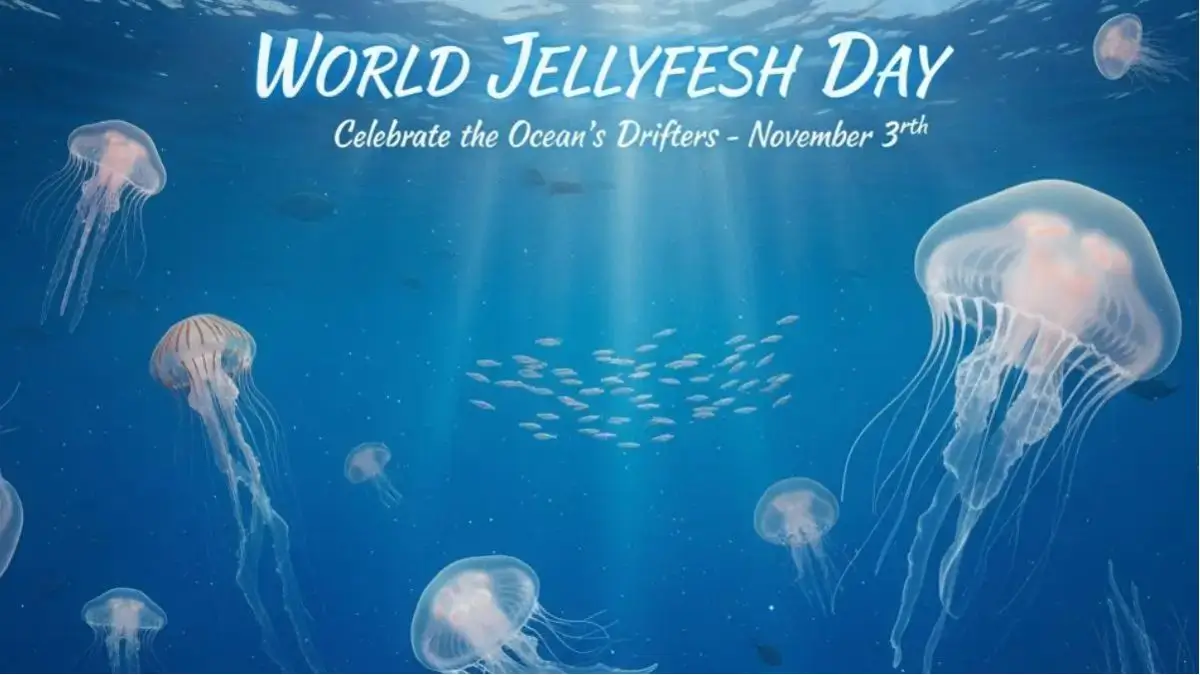
World Jellyfish Day is celebrated every year on the 3rd of November. Jellyfish are ancient marine invertebrates with umbrella-shaped bodies and long, flowing tentacles. Jellyfish consist of around 95% water. They don’t have a brain, heart or blood, but do have a very basic nervous system. They play a vital part of the food chain and are studied due to their fluorescent proteins and uses within biotechnology.
When Is World Jellyfish Day Celebrated?
- World Jellyfish Day is celebrated every year on the 3rd of November to raise awareness about jellyfish.
- The day has been acknowledged in multiple holiday calendars as an annual event since 2014. However, it is difficult to find any solid historical information about who originally started the event or why they chose the 3rd of November.
- There is also not enough evidence to show that it relates to Ernst Haeckel, a German biologist.
Why Is World Jellyfish Day Important?
- World Jellyfish Day raises awareness of the importance of jellyfish in keeping marine ecosystems balanced. Despite being seen as dangerous due to their stingers, they play a vital role in the ocean.
- Jellyfish play many roles in the marine food chain. They eat plankton, fish eggs, larvae and small crustaceans. They are also eaten by sea turtles, ocean sunfish and some fish.
- The day also raises awareness of marine conservation, scientific research and how changing environments affect jellyfish.
Jellyfish In Marine Ecosystems
- Jellyfish help to move energy around marine food chains. They are predators of smaller marine life but are also prey to bigger animals such as leatherback sea turtles and ocean sunfish.
- Jellyfish blooms can cause issues for fisheries. Large numbers of jellyfish can compete with fish larvae for food and cause a blockage in fishing nets.
Importance Of Jellyfish In Science And Biotechnology
- Jellyfish have helped make some important discoveries in biological research due to their fluorescent proteins.
- The most famous fluorescent protein is Green Fluorescent Protein (GFP). This was originally discovered in the jellyfish Aequorea victoria by Japanese scientist Osamu Shimomura in the 1960s.
- Osamu Shimomura, Martin Chalfie and Roger Y. Tsien were awarded the Nobel Prize in Chemistry in 2008 for discovering and developing the Green Fluorescent Protein. This protein is widely used as a biological marker to help observe what is happening in cells and observing how proteins behave in living cells.
Jellyfish Conservation
- Jellyfish are affected by changes in ocean temperatures, pollution, nutrients, marine habitats and the number of predators in the ocean.
- Keeping track of jellyfish helps scientists to understand how marine ecosystems are changing. It can help with managing fisheries, keeping coastal regions safe and conserving marine biodiversity.
Jellyfish Classification And Biology
- Jellyfish are aquatic invertebrates that belong to the phylum Cnidaria. This also includes corals, sea anemones and hydras.
- Jellyfish are easily recognised due to their umbrella-like shape, known as bells, and long flowing tentacles. Their bodies are filled with a jelly-like substance known as mesoglea.
- Jellyfish don’t have a brain, heart, blood or bones. They do, however, have a very simple nervous system known as a nerve net.
Important Biology Facts
- Phylum Cnidaria
- Umbrella-shaped bodies with tentacles
- Around 95% water
- Simple Nerve Net
- No bones
- No blood or heart
- A gastrovascular cavity with one opening
- Have specialised cells called cnidocytes with stingers known as nematocysts.
10 Interesting Facts About Jellyfish
1. Ancient Creatures
- Jellyfish and other gelatinous marine animals have lived for 500 million years or more. They are therefore much older than dinosaurs!
2. 95% Water
- Jellyfish are made up of approximately 95% water! The remaining 5% is made up of proteins, muscle cells and nerve cells.
3. No Brain
- Jellyfish don’t have a brain. They use their network of nerves called a nerve net to sense any changes in their environment.
4. One Opening
- Most jellyfish have one opening, which acts as their mouth and where waste is passed out.
5. Carnivores
- Jellyfish are mostly carnivores. They prey on plankton, small crustaceans, fish eggs, larvae and sometimes other jellyfish.
6. Bioluminescence
- Some jellyfish can glow using chemical reactions. This is known as bioluminescence and is often used as a defence mechanism.
7. Varied Lifespans
Depending on the type of jellyfish, they can have very varied lifespans. Some only live for a few hours or days, whereas others can live for several years.
8. Immortal Jellyfish
- The immortal jellyfish can change back from their adult Medusa stage to their younger Polyp stage when certain conditions are met. This is known as transdifferentiation.
9. Long Tentacles
- The Lion’s Mane Jellyfish (Cyanea capillata) has incredibly long tentacles.
10. Important In Science
- The Jellyfish Aequorea victoria gave us the Green Fluorescent Protein (GFP), which was an important discovery in modern biological and medical research.








 International Day to End Impunity for Cr...
 Important Days in November 2026: Nationa...
 Kerala Piravi 2026: History, Significanc...