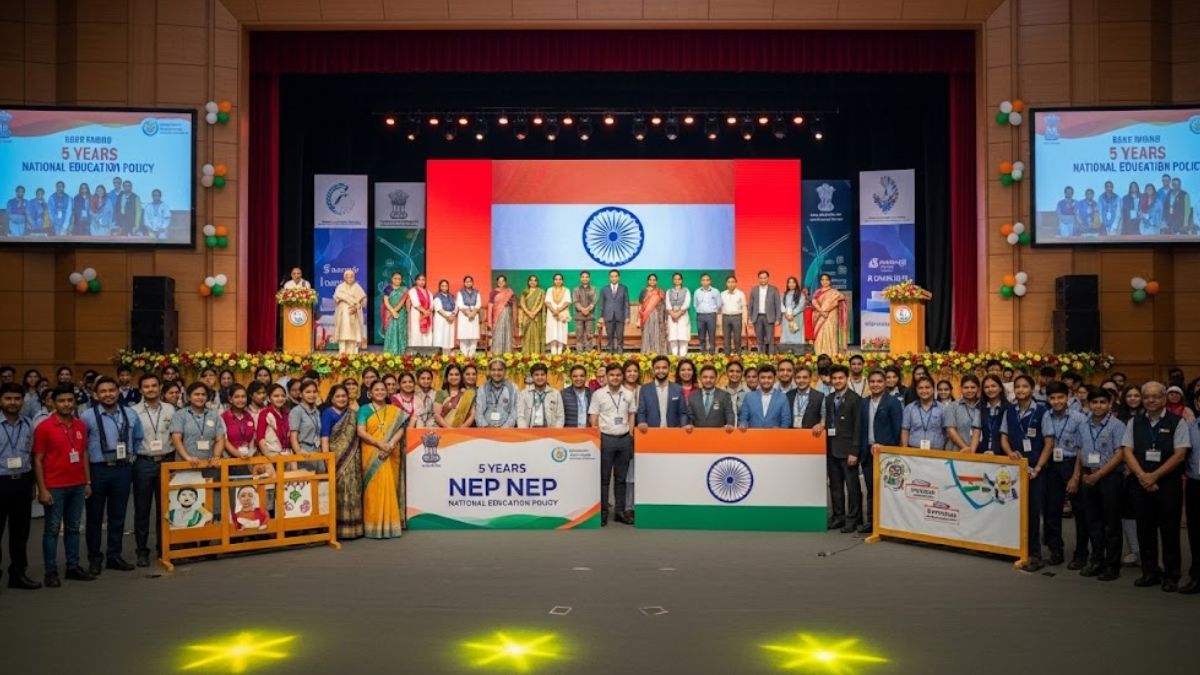
The National Education Policy (NEP) 2020, India’s third education policy since Independence, was introduced as a transformative reform to modernize the education system. Five years since its launch, the policy has made noticeable strides in school education and higher education, but several reforms remain stuck due to institutional delays and Centre-state disputes.
Reshaping School Education
Transition from 10+2 to New Structure
One of the biggest shifts under NEP has been the replacement of the traditional 10+2 system with a new four-stage framework,
- Foundational stage (pre-primary to class 2)
- Preparatory stage (classes 3 to 5)
- Middle stage (classes 6 to 8)
- Secondary stage (classes 9 to 12)
The National Curriculum Framework for School Education (NCFSE 2023) has outlined clear learning outcomes and competencies for each stage.
Integrated Textbooks and Curriculum
The NCERT has rolled out new textbooks for classes 1-8, which integrate subjects like history, geography, political science, and economics into a single social science textbook, moving away from fragmented subject-wise learning. Textbooks for classes 9-12 are expected soon.
Early Childhood Care and Education (ECCE)
Universal Pre-Primary Education Goal
NEP aims to achieve universal pre-primary education by 2030. To support this, NCERT’s Jaadui Pitara kits and a national ECCE curriculum have been introduced.
Minimum Age for Class 1
States like Delhi, Karnataka, and Kerala have enforced the minimum age of six years for admission to class 1. This has led to a drop in enrolments — from 2.16 crore to 1.87 crore in 2023-24. About 73% of students entering class 1 had prior preschool experience.
Key Challenges
The main hurdles include,
- Training Anganwadi workers to improve teaching quality.
- Strengthening infrastructure in early learning centres.
Strengthening Foundational Skills
- The NIPUN Bharat Mission, launched in 2021, focuses on ensuring universal literacy and numeracy by the end of class 3.
- A recent survey showed 64% proficiency in language and 60% in mathematics.
- While this reflects some progress, the mission is still far from its universal goals.
Flexible Learning Through Credits
Academic Bank of Credits (ABC)
NEP introduced a digital system allowing students to store credits and switch courses or institutions without losing progress.
- One-year study earns a certificate,
- Two years earn a diploma,
- Four years earn a multidisciplinary degree.
National Credit Framework (NCrF)
Extending flexibility to schools, the NCrF allows skill-based learning hours to be counted as credits. The CBSE has launched a pilot programme for this system.
Higher Education Reforms
Common University Entrance Test (CUET)
Introduced in 2022, the CUET has become a centralized gateway for undergraduate admissions, reducing the stress of multiple entrance exams.
Global Outreach of Indian Institutes
- IIT Madras (Zanzibar), IIT Delhi (Abu Dhabi), and IIM Ahmedabad (Dubai) have opened international campuses.
- Foreign universities like the University of Southampton and others at GIFT City, Gujarat, have started operations in India, with more approvals underway.
Four-Year Undergraduate Degrees
NEP’s vision of a four-year UG programme with multiple exit points is being implemented in central universities and Kerala, though many colleges face faculty shortages and infrastructure constraints.
Language and Medium of Instruction
The NEP encourages teaching in the mother tongue or regional language until class 5.
- CBSE has directed schools to begin from pre-primary to class 2, with optional continuation till class 5.
- NCERT is preparing textbooks in more Indian languages.
However, the three-language formula remains controversial. States like Tamil Nadu oppose it, citing concerns of Hindi imposition.
Ongoing and Pending Reforms
Changes in Board Exams
From 2026, CBSE class 10 students will be allowed to appear for board exams twice a year to reduce exam pressure. Karnataka has already experimented with this model.
Holistic Progress Report Cards
PARAKH, an NCERT body, has designed report cards that assess not just marks but also peer and self-evaluations. However, many state boards have yet to adopt them.
Teacher Education Reforms Stalled
The National Curriculum Framework for Teacher Education is still pending. The proposed four-year integrated B.Ed course under the Integrated Teacher Education Programme (ITEP) is facing resistance from colleges offering existing courses like B.El.Ed.
Higher Education Commission of India (HECI) Delayed
The plan to replace the University Grants Commission (UGC) with a single umbrella regulator — HECI — is still under drafting.
Centre-State Conflicts
The implementation of NEP has been marred by Centre-state tensions,
- States like Kerala, Tamil Nadu, and West Bengal refused to sign MoUs for PM-SHRI schools, citing autonomy concerns.
- Tamil Nadu opposed both the three-language formula and the four-year UG structure.
- The Centre withheld Samagra Shiksha funds from some states, linking funds to NEP reforms. Tamil Nadu has challenged this in the Supreme Court.
- Karnataka is preparing its own state education policy, scrapping the earlier four-year UG structure.

 Health Ministry Grants Lifetime Validity...
 José Antonio Kast Rist Takes Oath as the...
 Government Launched National Initiative ...