
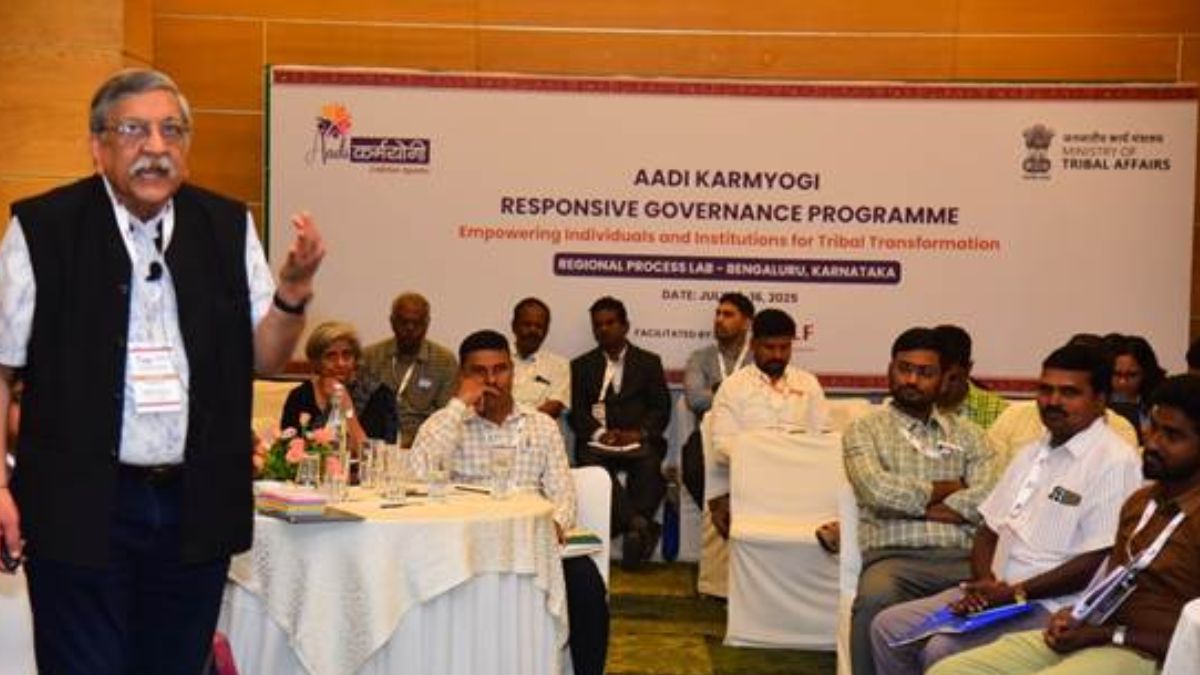
The Adi Karmayogi Abhiyan, launched by the Ministry of Tribal Affairs on August 19, 2025, marks a historic initiative to empower India’s tribal communities through grassroots leadership and responsive governance. Positioned as the world’s largest tribal leadership programme, the Abhiyan aims to mobilize over 20 lakh change leaders across 1 lakh tribal-dominated villages, forming the foundation for a people-centric and inclusive development model aligned with the vision of Viksit Bharat by 2047.
Core Vision and Philosophy
The Adi Karmayogi Abhiyan is guided by the principles of,
- Sewa (Service)
- Sankalp (Resolve)
- Samarpan (Dedication)
These ideals reflect the inclusive governance motto of “Sabka Saath, Sabka Vikas, Sabka Prayas, Sabka Vishwas”, central to the Government’s approach to tribal upliftment.
This initiative is a central component of the Janjatiya Gaurav Varsh, celebrating the legacy and future of tribal communities in India.
Key Objectives of the Abhiyan
The programme focuses on building a structured framework for tribal empowerment through,
- Promoting responsive, people-driven governance at all administrative levels.
- Conducting multi-departmental Governance Lab Workshops, from state to village level, to build the capacity of government officials.
- Co-creating development plans with tribal communities under the “1 Lakh Tribal Villages – Vision 2030”, detailing goals, investments, and local strategies.
- Developing a network of 20 lakh tribal change leaders across 550 districts and 30 States/UTs.
Major Components and Outcomes
1. Adi Sewa Kendra
Dedicated service hubs in tribal-dominated villages, where officers and community members offer ‘Adi Sewa Samay’, spending 1–2 hours fortnightly to address local issues, mentor youth, and guide village development.
2. Governance Lab Workshops
Structured process labs at various administrative levels help officers and villagers co-create solutions to local problems. These labs have been operational since July 10, 2025, and serve as capacity-building hubs for state, district, and block master trainers.
3. Tribal Village Action Plans
Every tribal village will design a Vision 2030 roadmap through participatory planning. These plans align with India’s Sustainable Development Goals (SDGs) and aim for the saturation of government schemes and services.
4. Community Leadership & Volunteer Network
- Adi Sahyogi: Professionals like teachers, doctors, and mentors who guide communities.
- Adi Saathi: Local stakeholders such as SHGs, NRLM members, tribal elders, and youth leaders involved in implementation and outreach.
Capacity-building initiatives will train tribal youth, women, and local leaders in governance, problem-solving, and social mobilization.
Integration with National Programmes
The Adi Karmayogi Abhiyan synergizes with flagship tribal initiatives such as,
- Dharti Aaba Janjatiya Gram Utkarsh Abhiyan
- Pradhan Mantri Janjati Adivasi Nyaya Maha Abhiyan (PM JANMAN)
- National Sickle Cell Anaemia Elimination Mission
- These alignments ensure a holistic and mission-mode development strategy for tribal regions.
Strategic Importance
This initiative is not just symbolic—it represents a systems transformation that places tribal citizens at the center of governance. By involving communities in planning and problem-solving, it builds a stronger democratic grassroots framework.
It empowers India’s tribal population to become active architects of their development journey, fostering trust, accountability, and sustainable progress.


 Govt Launches First-Ever ASISSE Survey t...
 Menaka Guruswamy Takes Oath, Becomes Ind...
 India Adds Highest Ever Wind Power Capac...











