
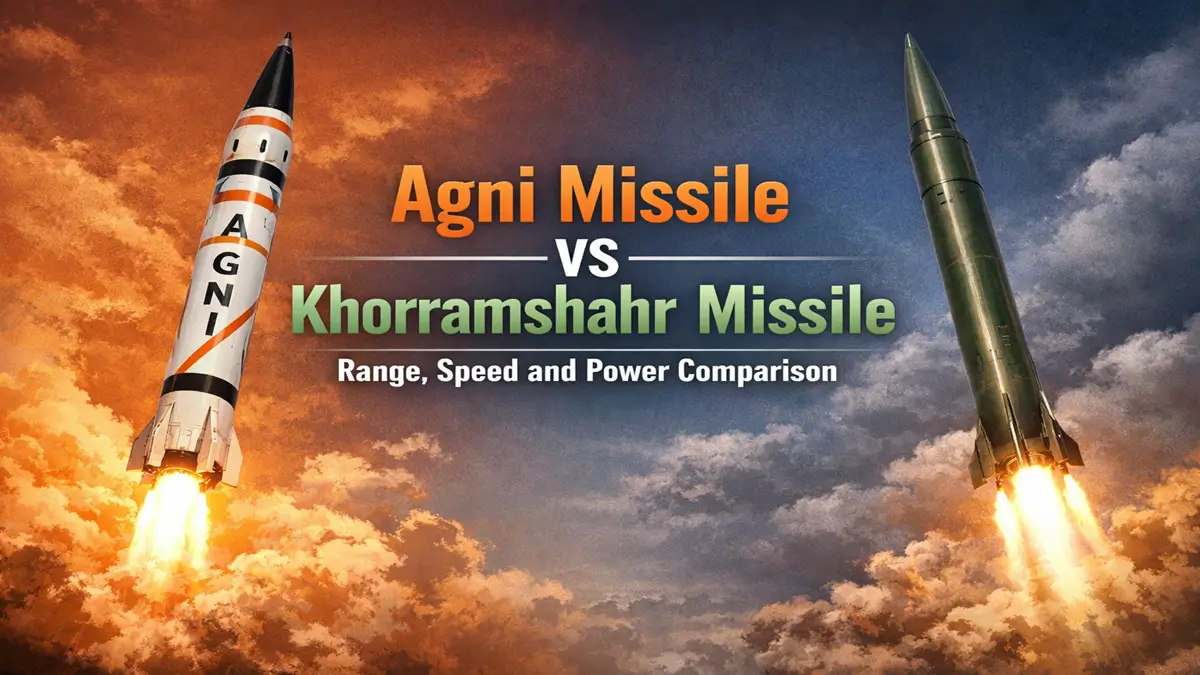
Ballistic missiles are among the most powerful strategic weapons used by countries for deterrence and long-range strike capability. India’s Agni missile series and Iran’s Khorramshahr missile are two important ballistic missile systems developed for strategic defense. While both missiles are capable of carrying powerful warheads, they differ in range, payload capacity, speed, and propulsion technology.
Agni Missile (India)
The Agni missile series is a family of long-range ballistic missiles developed by India as part of its strategic defense program. The series includes several variants such as Agni-I, Agni-II, Agni-III, Agni-IV, and Agni-V, each with increasing range and capability.
Key Features
- Type: Surface-to-surface ballistic missile
- Range: Approximately 700 km to over 5,000 km depending on the variant
- Speed: Up to Mach 20+ during the terminal phase in advanced variants
- Warhead Capacity: Around 1,000 kg (can carry conventional or nuclear payloads)
- Fuel Type: Solid-fuel rocket propulsion
- Launch Platform: Road-mobile and canisterized launch systems
The Agni-V variant is considered one of India’s most advanced missiles and significantly strengthens the country’s long-range deterrence capability.
India’s Agni-4 vs Pakistan’s Shaheen-II: Range, Payload and Capability Comparison
Khorramshahr Missile (Iran)
The Khorramshahr missile is a medium-range ballistic missile developed by Iran and first revealed in 2017. It is designed to deliver a heavy payload over long distances and is part of Iran’s strategic missile program.
Key Features
- Type: Medium-range ballistic missile (MRBM)
- Range: Around 2,000 km
- Speed: Estimated Mach 8–16 during flight
- Warhead Capacity: Approximately 1,500–1,800 kg payload
- Fuel Type: Liquid-fuel propulsion
- Launch Platform: Mobile ground launchers
The Khorramshahr missile is known for its high payload capacity, allowing it to carry heavier warheads compared to many missiles in the same category.
Agni-2 vs Shahab-3 Missile Comparison: Range, Speed, and Power
Power Comparison
| Feature | Agni Missile (India) | Khorramshahr Missile (Iran) |
|---|---|---|
| Missile Type | Ballistic missile series | Medium-range ballistic missile |
| Maximum Range | Up to 5,000+ km (Agni-V) | Around 2,000 km |
| Speed | Up to Mach 20+ | Around Mach 8–16 |
| Warhead Capacity | Around 1,000 kg | Up to 1,500–1,800 kg |
| Fuel Type | Solid fuel | Liquid fuel |
| Launch Platform | Road-mobile / canister launch | Mobile ground launch |
Pralay vs Zolfaghar Missile: Tactical Strike Range and Power Comparison
Key Differences
Range Advantage – Agni
The Agni missile series, especially the Agni-IV and Agni-V, has a significantly longer range, allowing India to strike targets thousands of kilometers away.
Speed Advantage – Agni
Agni missiles reach extremely high speeds during the terminal phase, making them harder to intercept by missile defense systems.
Payload Advantage – Khorramshahr
The Khorramshahr missile can carry a heavier warhead, which increases its destructive capability even though its range is shorter.
Fuel Technology
Agni missiles use solid fuel, enabling faster launch readiness and easier storage. Khorramshahr uses liquid fuel, which generally requires more preparation before launch.


 India's Defense Exports Hit Record ₹38,4...
 INS Malwan Delivered to Indian Navy: Nex...
 Indian Army Appoints New Commanders for ...











