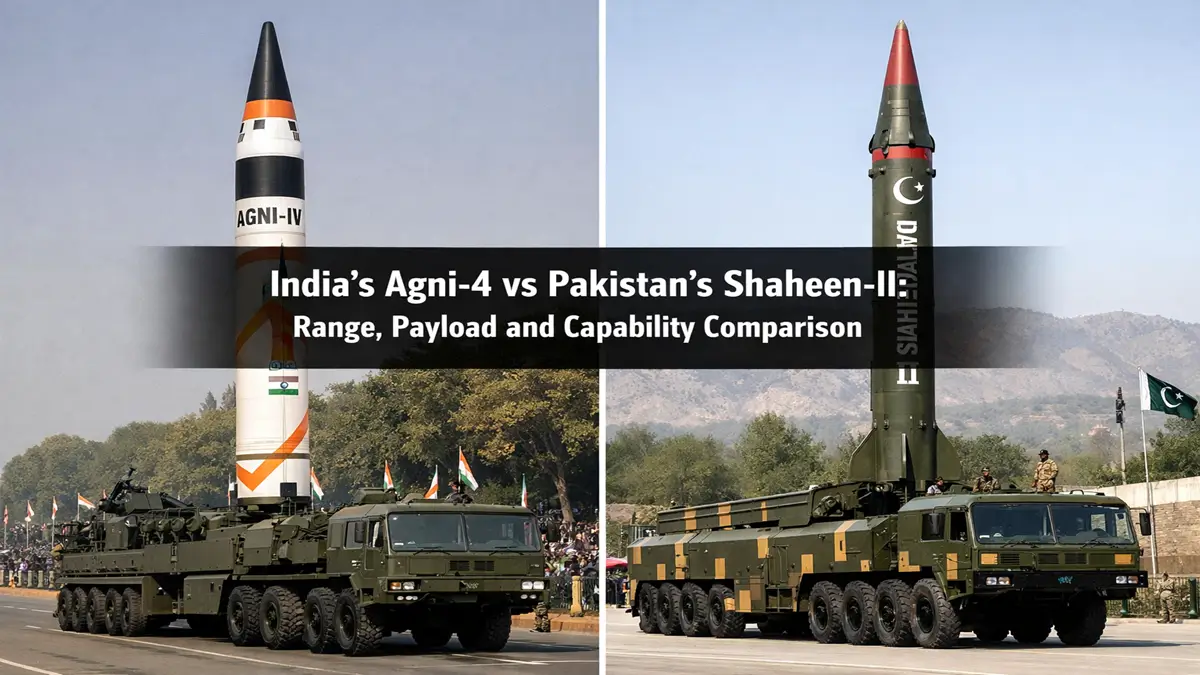
India and Pakistan have developed advanced ballistic missile systems as part of their strategic deterrence programs. Two important missiles in their arsenals are India’s Agni-4 and Pakistan’s Shaheen-II. Both are medium to intermediate-range ballistic missiles designed to deliver conventional or nuclear payloads.
While these missiles serve similar strategic purposes, they differ in range, payload capacity, technology, and operational capability. This article provides a detailed comparison of Agni-4 and Shaheen-II.
Overview of Agni-4 Missile
The Agni-4 is an intermediate-range ballistic missile developed by India’s Defence Research and Development Organisation (DRDO). It is part of the Agni series of missiles that strengthen India’s nuclear deterrence capability.
Agni-4 is a two-stage solid-fuel missile designed for high accuracy and improved survivability against missile defense systems. It can carry nuclear warheads and can be launched from a road-mobile launcher, which increases operational flexibility.
Key Features of Agni-4
- Type: Intermediate-Range Ballistic Missile (IRBM)
- Range: Up to 4,000 km
- Payload Capacity: About 1,000 kg
- Propulsion: Two-stage solid fuel
- Length: Around 20 meters
- Launch Platform: Road-mobile launcher
- Guidance: Advanced inertial navigation with ring laser gyroscope
The missile was designed to bridge the gap between Agni-II and Agni-III and provides improved range and accuracy for India’s strategic deterrence.
Agni Missile vs Khorramshahr Missile: Range, Speed and Power Comparison
Overview of Shaheen-II Missile
The Shaheen-II (Hatf-VI) is a medium-range ballistic missile developed by Pakistan’s National Engineering and Scientific Commission. It is one of Pakistan’s key strategic missiles designed to carry nuclear warheads.
Shaheen-II uses solid propellant and a two-stage rocket system, allowing faster launch readiness and safer storage compared to liquid-fuel missiles.
Key Features of Shaheen-II
- Type: Medium-Range Ballistic Missile (MRBM)
- Range: 1,500–2,000 km
- Payload Capacity: Around 700–1,000 kg
- Propulsion: Two-stage solid fuel
- Length: Around 17.2 meters
- Launch Platform: Transporter-erector-launcher (TEL)
- Guidance: Inertial guidance with terminal corrections
This missile forms a crucial part of Pakistan’s strategic deterrence system.
Pralay vs Zolfaghar Missile: Tactical Strike Range and Power Comparison
Agni-4 vs Shaheen-II: Detailed Comparison
| Feature | Agni-4 (India) | Shaheen-II (Pakistan) |
|---|---|---|
| Missile Type | Intermediate-Range Ballistic Missile | Medium-Range Ballistic Missile |
| Range | Up to 4,000 km | 1,500–2,000 km |
| Payload | Around 1,000 kg | About 700–1,000 kg |
| Propulsion | Two-stage solid fuel | Two-stage solid fuel |
| Length | ~20 meters | ~17.2 meters |
| Launch System | Road-mobile launcher | Transporter-erector-launcher |
| Guidance System | Advanced inertial navigation with ring laser gyroscope | Inertial guidance with terminal correction |
| Role | Strategic deterrence | Strategic nuclear delivery |
Range Comparison
One of the biggest differences between the two missiles is their strike range.
- Agni-4 can reach targets up to 4,000 km, giving India the ability to strike distant strategic locations beyond South Asia.
- Shaheen-II has a range of 1,500–2,000 km, primarily covering regional targets within South Asia.
This means Agni-4 provides greater strategic reach compared to Shaheen-II.
Technological Capabilities
Agni-4
Agni-4 incorporates several advanced technologies such as:
- Ring Laser Gyroscope-based navigation
- Micro inertial navigation systems
- Composite rocket motors
- Reduced radar signature for better survivability
These technologies improve missile accuracy and help it evade missile defense systems.
Shaheen-II
Shaheen-II focuses on:
- Solid-fuel propulsion for faster launch readiness
- Guidance systems that improve targeting accuracy
- High mobility through transporter-erector launchers
These features allow rapid deployment during strategic operations.
Strategic Importance
Both missiles play a major role in maintaining strategic deterrence in South Asia.
- Agni-4 strengthens India’s long-range deterrence capability by expanding strike coverage and improving accuracy.
- Shaheen-II strengthens Pakistan’s regional deterrence strategy, ensuring the ability to respond to potential threats.
The development of such missiles reflects the ongoing strategic competition between the two countries.







 DRDO Successfully Tests Quantum Key Dist...
 Indian Navy to Commission Indigenous Mul...
 Indian Army Launches Bharat Rice for Tro...