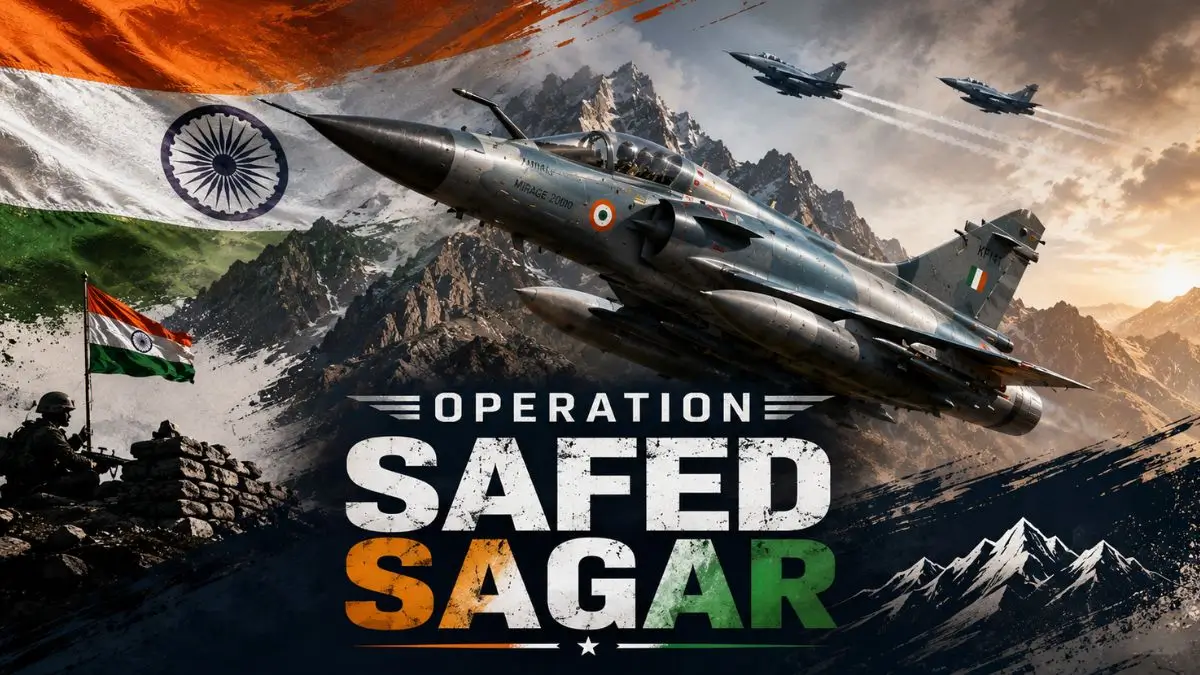
Operation Safed Sagar took place in the year 1999, which witnessed one of the most challenging military operations for India. In the context of the Kargil War, Pakistani troops had occupied key locations in the mountains, which posed a major challenge to the Indian Army. With a view to assisting the land force attacks, the Indian Air Force undertook Operation Safed Sagar. The operation started from the month of May 1999.
Operation Safed Sagar: An Overview
| Aspect | Details |
| Battle | Kargil War, 1999 |
| Country | India |
| Military force involved | Indian Air Force |
| Commenced May | 1999 |
| Associated with | Operation Vijay |
| Principal areas | Mushko Valley, Drass, Kaksar, Batalik and Turtok |
| Primary aircraft | Mirage-2000 |
| Weapons used | Laser-Guided Bombs and Precision Weaponry |
| Altitude of target | About 16,000-18,000 feet |
| Primary limitation | Flyers were prohibited from crossing the Line of Control |
These figures, however, speak for themselves. The real challenge was carrying out the mission over the world’s most formidable mountains.
Background Of Operation Safed Sagar
The Kargil dispute arose following the occupation by Pakistani troops and military personnel of some vital positions along the Line of Control.
From these high grounds, they had the tactical advantage over some important passes such as the Srinagar-Leh highway.
India started Operation Vijay for reclaiming these occupied positions.
But there was another challenge which the terrain posed to them.
These were enemy positions that were positioned at a height of about 16,000-18,000 feet. The troops had to climb uphill from the bottom while the enemy had positions overlooking their position.
Thus came in the need for air support from the Indian Air Force.
Operation Safed Sagar was thus born.
Inside the Mission: The Role of Safed Sagar
Contrary to what may seem initially, Safed Sagar was not just another bombing operation, but a series of air operations that comprised several stages.
01 – Reconnaissance
- Prior to an attack, the IAF needed to know where the enemy was deployed.
- For this purpose, various planes conducted aerial reconnaissance and electronic intelligence (ELINT) flights.
The problem
- Terrain, camouflage, and weather conditions might have made locating the enemy a very complicated task.
The solution
- Reconnaissance and intelligence gathering allowed to obtain a more detailed understanding of the battlefield before any strikes.
02 – Precision Strikes
- Having located important targets, fighter planes could be launched against enemy positions.
- During the course of the operation, the Mirage-2000 became especially valuable for the IAF. It allowed the use of laser-guided bombs and laser designators which enabled the Indian Air Force to launch more effective strikes against the targets in the mountains.
The problem
- It is one thing to bomb a regular target. Bombing a mountain installation is completely another matter.
The solution
- Using precision-guided weapons reduced the importance of conventional bomb drops and allowed the IAF to launch strikes against the chosen targets.
03 – Disruption of Logistics
- However, there was more to the battle than destruction of enemy fighting positions.
- In order to occupy the heights in the mountains, the enemy needed supplies, such as ammo, food, equipment and other.
- Thus, IAF had to interfere with enemy logistics as well.
- The goal was clear to decrease the enemy’s ability to hold out while Indian forces would continue their advance.
- This air-ground coordination became one of the most important elements of Safed Sagar.
04 – Air Defence and Escorts
- The aircraft operating in the war theatre would also need protection.
- The Indian Air Force carried out escorting and air defence operations to provide protection to the aircraft participating in the operation and control of the airspace.
- Thus, Safed Sagar became a larger air operation instead of separate bombing missions.
05 – Helicopter Support
- The other major requirement of the operation was helicopters.
- The helicopters were utilized for the following purposes which is Casualty evacuation → Air transport → Logistics → Operational support
- Over 2,000 helicopter missions were conducted during the operation.
- The importance of the use of helicopters was due to the fact that the mountainous terrain rendered conventional modes of transport very difficult.
The Biggest Limitation: Don’t Go Across the LoC
Another one of the truly amazing things about Operation Safed Sagar was that the level of operational limitation imposed on Indian fighter jets.
IAF fighters were asked not to go across the LoC.
This created a huge tactical dilemma.
Because enemy positions were near the LoC and usually at commanding heights, pilots had to plan their flight trajectories, angles and points of attack.
It was not a case of,
- Identify the target → Attack it.
It was more like,
- Identify the target → Identify the position of the target → Compute safe angle of approach → Do not cross the LoC → Attack accurately → Come back safely.
Why Kargil Proved to be Tough for Airplanes?
In high-altitude areas, the surroundings themselves pose a military problem.
Problem & Its Consequence
- Rarity of air: Affects performance of the planes
- High altitude: Affects carrying capacity and maneuvering capability
- Mountainous terrain: Makes navigation and targeting difficult
- Camouflage Makes it hard to spot the enemy’s location
- Low visibility Less accurate targeting
- Anti-aircraft defense Increased threat to aircrafts and helicopters
- LoC constraint Limited attacking routes
The IAF had to fight not just the enemy but also the terrain of the battle area.
It was important to note that it was the first time that the IAF had undertaken combat operations in such high altitudes.
Mirage-2000: The Advantage of Precision Strikes
- Among all the planes used in the Kargil conflict, the Mirage-2000 got special attention.
- Precision weapons capability turned out to be especially helpful in attacking well-defended objects in the mountains.
- The employment of Laser-Guided Bombs and Laser Designator Pods is a significant step towards the use of precision weaponry.
- Instead of using conventional bombers, the IAF began to focus more on the precision strikes at targets.
- Thus Kargil experience has revealed another important principle:
- Accuracy may be more useful than the sheer quantity of explosives thrown at the enemy in mountain warfare.
- The mission showed the increasing value of precision weapons, targeting systems and intelligence-driven air strikes.
28 May 1999: The Message of the Battlefield
- Operation Safed Sagar also made clear the danger that was hidden in flying of helicopters in Kargil area.
- On 28 May 1999, one IAF Mi-17 helicopter was shot down by a Stinger missile.
- This showed that helicopters used in mountain warfare can be vulnerable to the shoulder-fired surface-to-air missiles.
- It became one of the lessons of the battle and affected the further helicopter use in the war.
- Flying in Kargil, pilots had little room for mistakes.








 Guava Capital of India: Which Place Is K...
 7 Most Beautiful Train Stations in the W...
 World Architecture Day 2026: 8 Clever Fe...