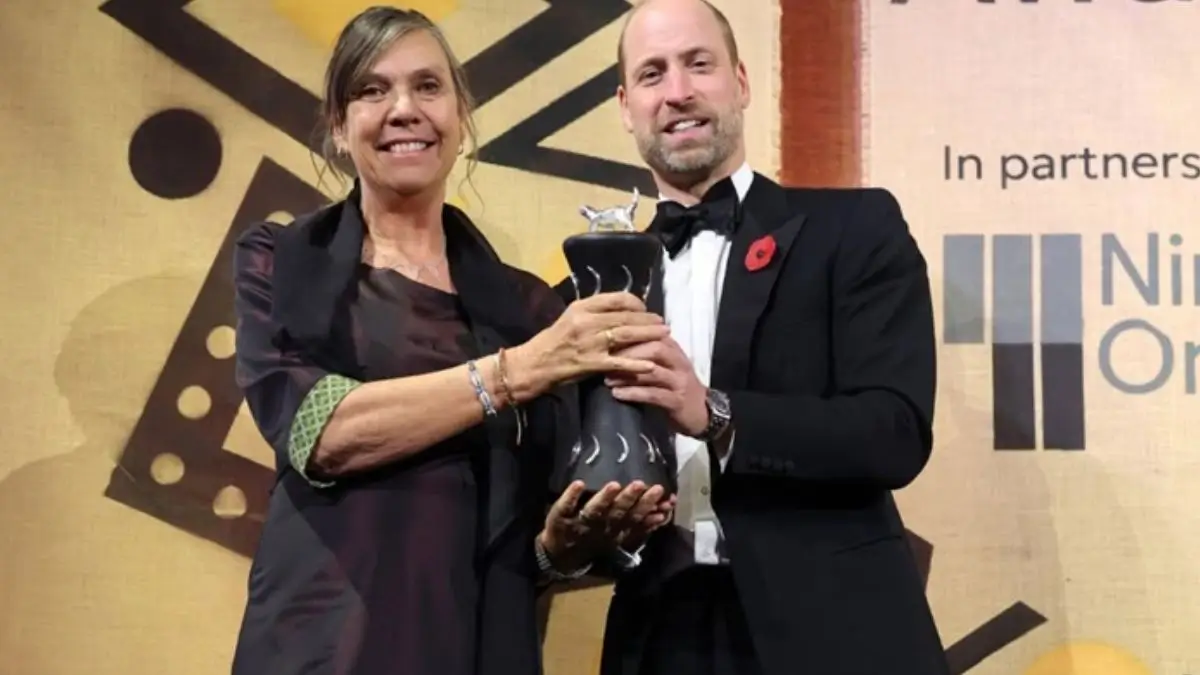
Dr Colleen Begg from South Africa has won the 2026 Prince William Award for Conservation in Africa. The award was presented at the Tusk Conservation Awards in London by Prince William. Dr Begg has worked in conservation for over 30 years, and has worked to protect endangered species in Mozambique for over 20 years. She is the first female to win the lifetime achievement award in the history of the awards, which were first given out in 2013.
Prince William Award for conservation in Africa (2026)
This award is granted to those with significant contributions to conservation of wildlife in Africa.
Dr Colleen Begg has been awarded this for contributing to the protection of endangered species, improving local conservation and working with local communities.
The award was presented at the Tusk Conservation Awards 2026 in London. It was presented by Prince William, Patron of Tusk.
Who is Dr Colleen Begg?
Colleen is a conservationist from South Africa. She has worked to protect wildlife within local communities in Mozambique.
In 2002, she travelled to Mozambique to research honey badgers, honey guide birds and traditional honey collection methods. However, her research identified knowledge gaps in understanding of large carnivores in the area.
Alongside her husband and fellow conservationist, Keith Begg, Dr Begg carried out a survey on the predators in the region. As a result of this work, the Niassa Carnivore Project was founded in 2003.
Niassa Carnivore Project
The Niassa Carnivore Project works in the Niassa Special Reserve of Mozambique. This area of protected land covers around 42,000 km2 .
The project aims to conserve 4 key carnivore species,
- Lions
- Leopards
- Spotted hyenas
- African wild dogs
The reserve contains vital habitats for endangered carnivores. It also contains some of the most significant lion populations in Africa.
Working with communities
Begg places great emphasis on working with local communities within her conservation work. Within the project, it was acknowledged that in order to successfully conserve wildlife in the area, people’s safety and livelihoods must also be considered.
Initiatives have included,
- Community wildlife protectors
- Environmental education
- Alternative income sources
- Measures to reduce human-wildlife conflict
- Employing and training local people to work on conservation projects.
One key project includes recreating traditional elevated dwellings called ‘sanja’ houses. This allows families to live elevated, reducing dangerous interactions with wildlife.
Within this project, many staff members are local to Mozambique. Local people have become increasingly important within conservation and decision-making.








 National Gopal Ratna Award 2026: Winners...
 Assamese Film Adishakti Wins Best Film a...
 Taylor Swift to Ranveer Singh: Complete ...