
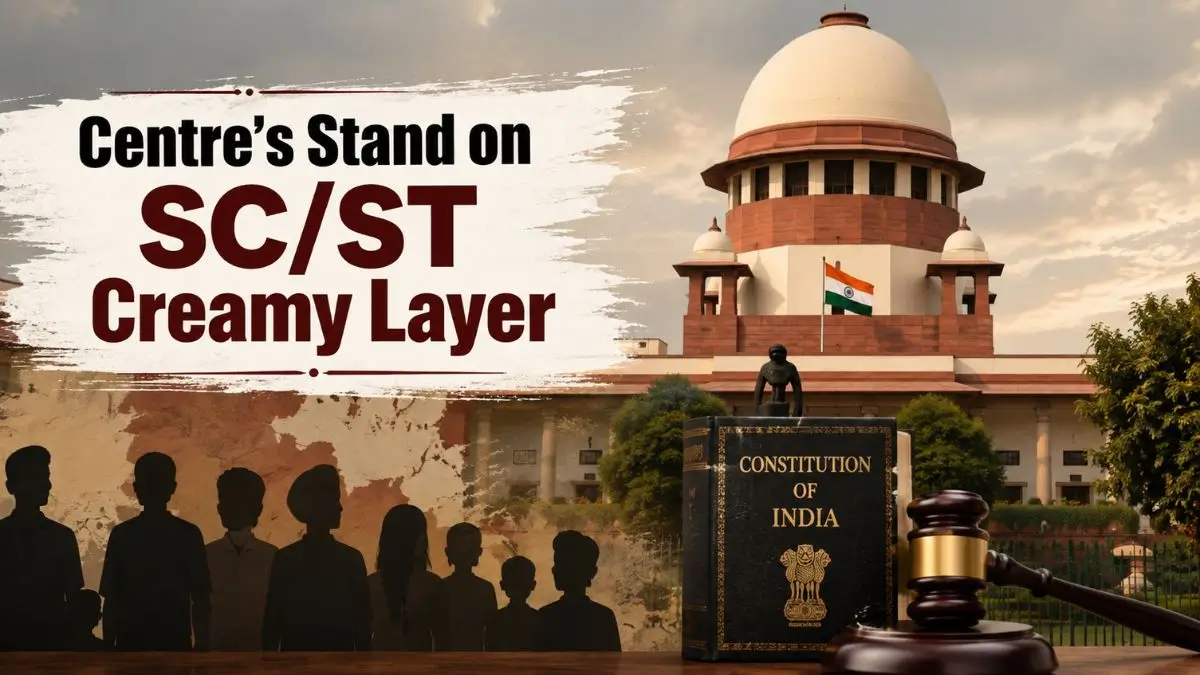
The Centre has informed the Supreme Court of India that the concept of ‘creamy layer’ cannot be extended to Scheduled Castes (SCs) and Scheduled Tribes (STs) in the way it has been applied to Other Backward Classes (OBCs). The government stated that the basis of reservation is not only economic but also discrimination in the past and social backwardness, caste and tribe status and inadequate representation. The petition has come against the backdrop of recent 2024 landmark judgment by the Supreme Court to allow sub-classification within SC and ST categories.
What Is the Centre’s Stand on SC/ST Creamy Layer?
The Union government has objected to the extension of the creamy layer principle to SCs and STs.
The government told the Supreme Court that the creamy layer principle is applied traditionally to the category of OBCs.
According to the Centre, the reservation policy for SCs and STs is not only based on economic considerations or economic status.
Instead it is based on the following criteria,
- Past discrimination
- Social backwardness
- Caste
- Tribe status
- Inadequate representation
- Persistent social disadvantage
The government said that applying the criterion of income for exclusion of SCs and STs will involve a comprehensive review and extensive empirical study.
Why Is the Discussion on the Creamy Layer Arising?
There is an ongoing discussion on the creamy layer in the larger context of distribution of benefits of reservation among the disadvantaged community.
The primary basis for the argument behind the creamy layer is that the relatively advanced members of a backward category should not receive benefits of reservation forever when there are some more disadvantaged members in the same category.
With respect to OBCs, the creamy layer principle is applied for excluding the relatively socially and economically advanced members from reservation benefits.
However, applying the same principle with respect to SCs and STs creates a totally different constitutional and social issue.
SCs and STs have been facing caste-based discrimination, untouchability, social exclusion and other such forms of structural discrimination since long.
Therefore, the argument against the application of income-based test is that economic advancement does not eliminate all the social disabilities that come along with being of a caste/tribal identity.
What Is the Creamy Layer Principle?
Creamy layer principle makes sure that benefits of reservation go to the relatively more disadvantaged members of a backward class.
This concept was established by the Supreme Court of India in the famous case of Indra Sawhney v. Union of India (1992), which is also known as the case of Mandal Commission.
In this case, the Supreme Court upheld reservation for OBCs but held that the relatively advanced members of the OBCs category, i.e., the creamy layer, should be excluded from reservation benefits.
The principle implies that affirmative action policy must primarily benefit the disadvantaged members.
One should remember that the creamy layer principle is quite distinct from EWS reservation.
What Did the Supreme Court Rule on SC Sub-Classification in 2024?
The ongoing controversy is also related to the Supreme Court ruling of 2024 on sub-classification of SCs.
By a majority of 6:1, the Supreme Court sustained the constitutional legality of the sub-classification of the SC community and set aside the earlier judgement of the five-judge bench in E.V. Chinnaiah v. State of Andhra Pradesh (2004).
The 2024 ruling acknowledged that members of the reserved community as per the Constitution need not always have equal disadvantage.
It was ruled that sub-classification may be carried out by states to make sure that reservation reaches more disadvantaged groups, subject to supporting evidence.
The ruling highlighted the following criteria,
- Quantitative data
- Greater disadvantage
- Inadequate or ineffective representation
- Rationality of classification
The idea is to make sure that sub-classification is not arbitrary.
What Is the Difference Between Sub-Categorisation and Creamy Layer?
Even though both the terms refer to the distribution of the benefit of reservation in different ways, there is a distinction between sub-categorisation and creamy layer.
Sub-categorisation refers to division of the reserved category into smaller categories so that the backward communities could be given reservation in a more focussed manner.
While on the other hand, creamy layer exclusion refers to exclusion of relatively advanced members of reserved category from certain benefits of reservation.
The 2024 Supreme Court ruling has paved the way for states to pursue evidence-based sub-classification within SCs and STs.
However, it has also been made clear that any criterion which is developed for identifying relatively advanced sections among SCs and STs needs to keep in view the unique historical and social disadvantages suffered by them.
This is very much essential in the present case.
Reservation in India: Existing Structure
As per existing guidelines of central government regarding direct recruitment to central government posts in all India service through open competitive examination, the reservation has been fixed as under,
Category Wise Reservation
- Scheduled Castes (SC): 15%
- Scheduled Tribes (ST): 7.5%
- Other Backward Classes (OBC): 27%
Further, 103rd Constitutional Amendment Act, 2019 provides for reservation up to 10% for Economically Weaker Sections (EWS).
Constitutional Provisions Relevant to Reservation
There are a number of constitutional provisions which constitute the legal basis of reservation and affirmative action in India.
Article 14
- Article 14 assures the right to equality of status and of opportunity, including equality before the law or equal protection of laws.
- This principle of equality of status or opportunity does not mean that there must be identity of treatment in cases of individuals whose positions are really different.
Article 15(4)
- Article 15(4) allows the State to make provisions for the advancement of socially and educationally backward classes, SCs and STs.
- It forms an important part of the constitutional basis of affirmative action in education.
Article 16
- Article 16 assures the right to equality of opportunity in respect of employment in the service under the State.
- Article 16(4) allows the State to make provisions for reservation of appointments or posts in favour of backward classes which are not adequately represented in services.
Article 16(4A)
- Article 16(4A) allows the State to make provisions for reservation in respect of promotion of SCs and STs in case of inadequate representation.
Article 335
- Article 335 takes into account the claims of SCs and STs to services and posts in such a way that these must be maintained with due regard to administrative efficiency.
Article 341
The topic in question here is Article 341 and Scheduled Castes.
Article 341 says that the President will notify which castes, races, and tribes are to be considered Scheduled Castes in the given state or UT.
Parliament thereafter will decide on inclusion or exclusion of some castes from the list by passing special acts.
This article is quite relevant to the discussion about sub-classification as its opponents claim that states should not be able to indirectly change the Presidential list of SCs.
However, in its judgment, Supreme Court in 2024 said that the distinction should be made between altering the list and distributing the benefits of reservation among recognized communities in the light of their evidence of inferiority.
Arguments for SC/ST Sub-Categorisation
The first one is that SCs and STs are not necessarily identical.
There may be some communities, which will stay considerably backward and disadvantaged and, therefore, less entitled to reservation benefits.
It may be argued that ignoring these differences will perpetuate the inequality in this field.
Another argument is that the goal of reservation is not mere representation but effective representation and evidence-based sub-classification may help achieve it.
In addition, in 2024 Supreme Court claimed that sub-classification should be evidence-based.
Reasons to oppose Sub-categorization and Creamy Layer of SC/STs
First of all, there is understanding about the probability of causing fissures among SC communities.
As far as opponents are concerned, the creation of sub-quota may lead to the division of those communities which have been subjected to discrimination in the past.
Apart from this, the issue regarding the right set of criteria to measure the extent of their disadvantage is another practical challenge.
Inclusion of income-based creamy layer has posed another difficulty.
According to the critics, the economic empowerment of a person belonging to the Scheduled Castes does not mean the end of discrimination against him/her on the grounds of caste identity.








 Aadhaar Name Change Rules Revised: Docum...
 IMC 2026: PM Modi Highlights India’s 5...
 Government Unveils 2026-2030 Strategy to...










