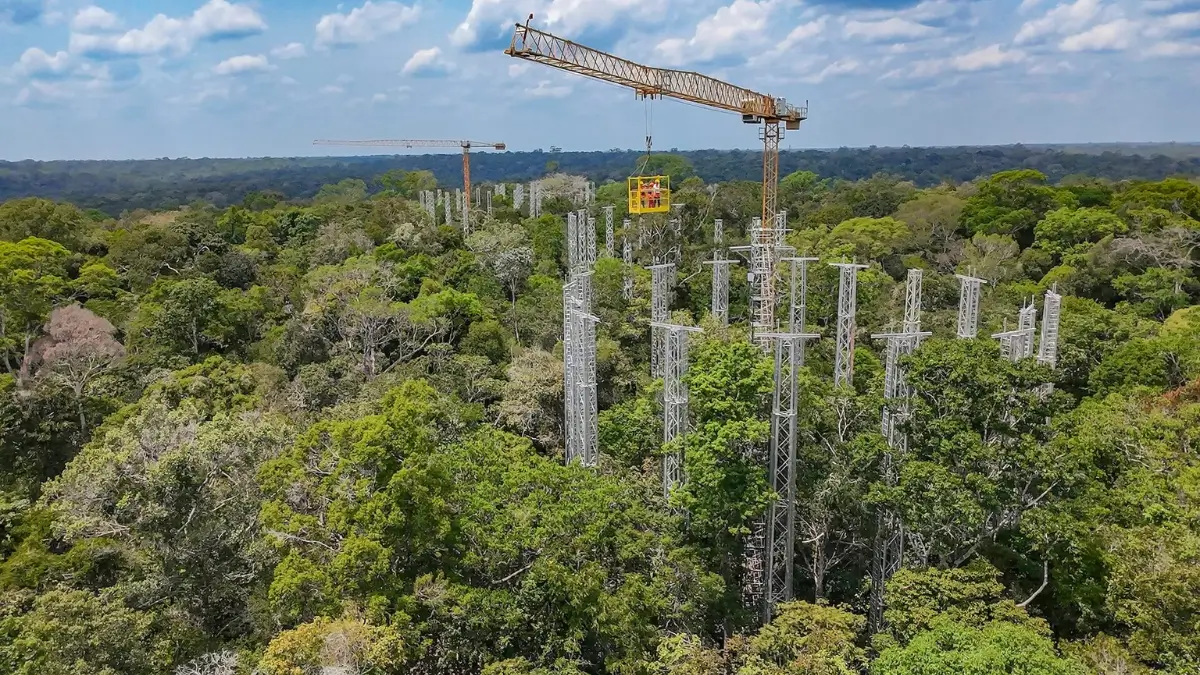
Deep in the Amazon rainforest, a group of scientists is carrying out a unique experiment to understand how rising carbon dioxide levels will affect the world’s largest tropical forest. The project, called AmazonFACE, aims to simulate future climate conditions and see how the forest adapts. Its findings are expected to play a key role in discussions at the COP30 Climate Summit, which Brazil will host soon.
Creating the Atmosphere of the Future
The AmazonFACE research site is located near Manaus, the biggest city in the Amazon region. It features six large steel rings built high above the forest canopy, each surrounding 50 to 70 mature trees.
Scientists plan to release carbon dioxide gas into three of these rings to mimic future levels of the gas expected by 2050 or 2060. The other three rings will remain unchanged as control groups.
“We’re trying to create the atmosphere of the future,” said Carlos Quesada, a coordinator at the National Institute for Amazon Research (INPA), which leads the project with support from Universidade Estadual de Campinas.
Why the Project is Important?
Tropical rainforests like the Amazon play a crucial role in absorbing carbon dioxide and slowing global warming. However, scientists still don’t fully understand how these forests will respond to higher CO₂ levels in the future.
By observing real-time changes in the Amazon, this experiment will help researchers predict whether the forest will continue to act as a carbon sink — absorbing more carbon than it releases — or if it could eventually become less effective in balancing Earth’s atmosphere.
How the AmazonFACE Experiment Works?
The term FACE stands for Free-Air CO₂ Enrichment. This technique allows scientists to increase the concentration of carbon dioxide in open-air environments without using greenhouses.
Sensors installed throughout the site record data every ten minutes, tracking how trees:
- Absorb CO₂,
- Release oxygen and water vapor, and
- React to sunlight, rain, and storms.
Over time, scientists will also create artificial microclimates with higher CO₂ levels to study the forest’s response in different conditions.
Global and Local Collaboration
The AmazonFACE project is supported by Brazil’s federal government and the United Kingdom. It’s the first experiment of this kind in a tropical forest, although similar FACE experiments have been done in countries like the United States to study temperate forests.
Forestry engineer Gustavo Carvalho described it as a “new frontier in environmental science,” adding that the results will help the world understand how tropical ecosystems may change in the coming decades.
Relevance to COP30 Climate Summit
The findings from AmazonFACE are expected to be discussed at the COP30 Climate Conference, scheduled from November 10–21, 2025, in Belem, where the Amazon River meets the Atlantic Ocean.
These insights will be crucial for climate policy decisions, helping world leaders create science-based strategies for protecting rainforests and reducing the effects of global warming.


 How many Nuclear Power Plants in India? ...
 India's First Quantum Computer to be Lau...
 List of Important Days in April 2026, Na...