
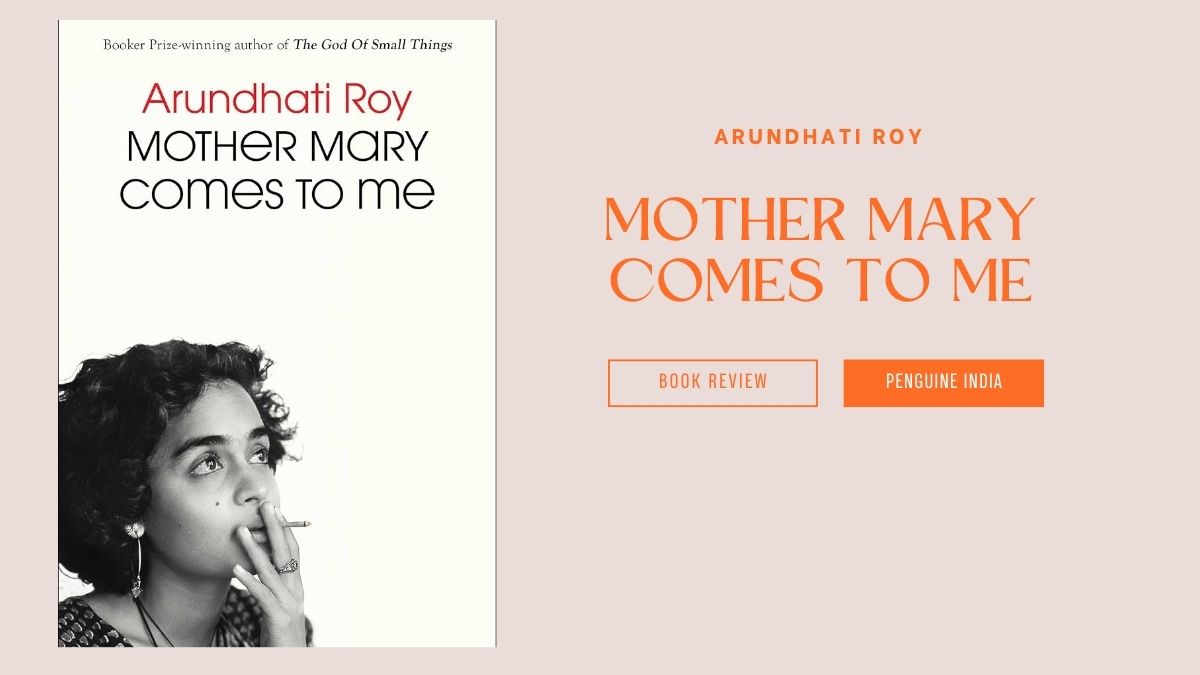
Arundhati Roy, best known for her Booker Prize-winning novel The God of Small Things, returns to publishing in 2025 with a profoundly personal memoir, Mother Mary Comes to Me. Released on September 2, the 374-page narrative is as unflinching as it is poetic, offering an intimate account of her lifelong relationship with her mother, Mary Roy—a trailblazing educator and fierce advocate for women’s rights.
This deeply candid work pushes the boundaries of literary memoir, not only revealing emotional scars and mother-daughter tensions but also exploring how pain and brilliance coexisted in one woman who shaped the writer and the woman Roy became.
A Portrait of a Mercurial Mother
- Mary Roy, founder of the Pallikoodam school in Kottayam and an influential public figure, looms large throughout the memoir. Arundhati Roy presents her mother not just as a parent but as an overbearing force, both emotionally turbulent and intellectually luminous. Recounting her mother’s attempts to abort her and verbal abuse that followed, Roy writes with unflinching honesty, “I am the outcome of their failure to deliver on their promise as abortion-inducers.”
- Despite this, the memoir is not a vendetta. It’s a story of deep complexity—a daughter torn between hurt and admiration, estrangement and attachment. Even when distance prevails, Mary Roy remains ever-present—“just a thought away,” as Roy writes.
Childhood Memories That Haunt
- Roy dives into the recesses of childhood with startling clarity. From episodes of being told to “get out” of cars and homes to being slapped for showing her chickenpox-marked belly, the memoir captures a harrowing psychological terrain. Yet, these moments are offset by episodes of love, storytelling, and learning that Roy absorbed at home.
- She refers to herself as her mother’s “valiant organ child”, a label born from growing up with a severely asthmatic parent. Even in trauma, she acknowledges how her mother’s ambitions shaped her artistic identity.
Art, Abuse, and Ambivalence
- One of the memoir’s central achievements is how Roy never settles into a binary view of her mother. Mary Roy is at once abusive and inspiring, oppressive and empowering. Roy wrestles with the contradictions—how the same person who rebuked her also read her Dostoevsky and nurtured her imagination.
- This conflict is summarized poignantly when Roy says, “You can’t hug a porcupine. Not even over the phone.”
- The author captures the torment of a childhood spent in fear and confusion, but also the awe she felt toward a woman who refused to be ordinary, and who ignited a flame of resistance and imagination within her daughter.
Literary and Emotional Depth
- Written in lucid, lyrical prose, the memoir often reads like a novel. Roy urges the reader to treat it as such, declaring, “Read this book as you would a novel. It makes no larger claim. But then, there could be no larger claim.”
- In one standout chapter titled The God of Small Things, Roy reflects on how she completed her debut novel over four years, while navigating personal upheavals. This not only offers insights into her creative process but also bridges the personal and political dimensions of her work.
Grief as Catalyst
- The memoir, as Roy states, began in the aftermath of Mary Roy’s death on September 1, 2022. The grief that follows is not sanitized or filtered. Roy is shocked by how deeply she mourns. The book becomes not only a way to make sense of her mother, but also of herself, their bond, and the conflicted inheritance of memory.
- This makes Mother Mary Comes to Me an example of how memoirs are acts of reckoning, not judgment. Roy questions whether writing it is a betrayal of her younger self. Yet, she proceeds, choosing literary truth over self-protection.
A Must-Read for Literature and Life
- From architectural school influenced by Laurie Baker to odd jobs in Delhi and early encounters with fame, the memoir charts Roy’s growth into an iconoclast, never fully free from her origins, yet always in defiant dialogue with them.
- Comparisons will likely be drawn to Jeet Thayil’s Elsewhereans, another literary memoir released earlier in 2025. But where Thayil’s tone is travelogue-like and observational, Roy’s is searing, introspective, and emotionally layered.
Key Takeaways for Exam
- Author: Arundhati Roy
- Title: Mother Mary Comes to Me
- Released: September 2, 2025
- Publisher: Penguin Hamish Hamilton
- Subject: Relationship with mother Mary Roy
- Context: Personal grief, feminist legacy, literary formation


 Sudha Murty Book 'Tides of Time' Highlig...
 CM Bhupendra Patel Releases Gujarati Bio...
 VP C. P. Radhakrishnan Unveils 'Atal Bih...











