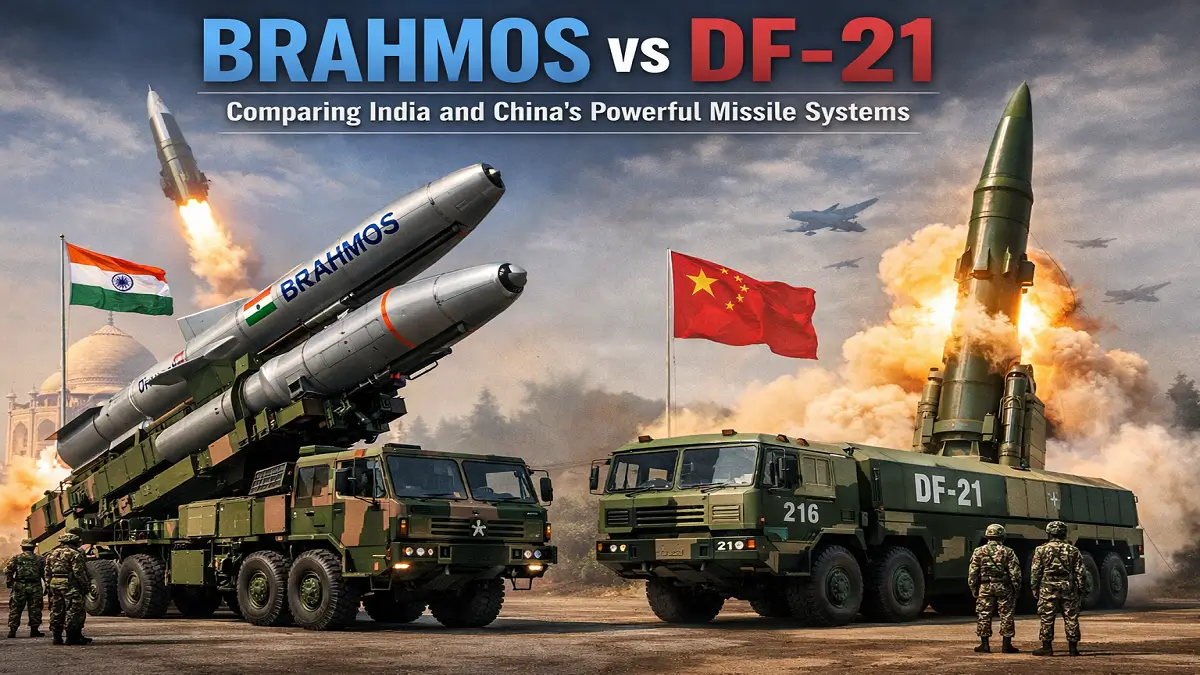
As India and China continue to modernize their armed forces, missile technology has become a key pillar of their defense strategies. Two prominent weapons often discussed in this context are India’s BrahMos supersonic cruise missile and China’s DF-21 ballistic missile. Though both are advanced and strategically significant, they are designed for different missions, speeds, and combat roles.
Let’s break down how these two missiles compare and why they matter for regional security and defense preparedness.
What is the BrahMos Missile?
The BrahMos missile is a supersonic cruise missile jointly developed by India and Russia. It is considered one of the fastest operational cruise missiles in the world.
Key Features of BrahMos
- Type: Supersonic cruise missile
- Speed: Around Mach 2.8–3 (nearly three times the speed of sound)
- Range: Originally about 290 km, newer versions reportedly extend beyond 400 km
- Launch Platforms: Land, sea, air (including the Su-30MKI fighter aircraft), and submarines
- Warhead: Conventional, high-explosive
Role of BrahMos in India’s Defense
The BrahMos is primarily designed for precision strikes against:
- Enemy warships
- Radar installations
- Command centers
- Other high-value military targets
Its low flight path (skimming close to the surface) and high speed make it extremely difficult for enemy air defense systems to intercept. For India, BrahMos strengthens both offensive capability and deterrence, especially in the Indian Ocean Region.
What is China’s DF-21 Missile?
The DF-21 (Dong Feng-21) is a medium-range ballistic missile (MRBM) developed by China. Unlike BrahMos, it is not a cruise missile but a ballistic missile, meaning it travels high into the atmosphere before descending toward its target.
Key Features of DF-21
- Type: Medium-range ballistic missile
- Range: Approximately 1,500–2,000 km
- Speed: Hypersonic during descent (much faster than cruise missiles)
- Launch Platform: Road-mobile launchers
- Warhead: Conventional and nuclear variants
One particular version, the DF-21D, is often called the “carrier killer” because it is designed to target aircraft carriers at sea.
Cruise Missile vs Ballistic Missile: Understanding the Difference
To properly compare BrahMos and DF-21, it’s important to understand the difference between cruise and ballistic missiles.
| Feature | BrahMos (Cruise Missile) | DF-21 (Ballistic Missile) |
|---|---|---|
| Flight Path | Flies low, like an aircraft | Goes high into space, then dives down |
| Speed | Supersonic | Hypersonic during re-entry |
| Accuracy | Very high precision | High, but depends on guidance systems |
| Role | Tactical precision strikes | Strategic long-range strikes |
| Target Type | Ships, land targets | Bases, carriers, large strategic targets |
In short, BrahMos is a precision tactical weapon, while DF-21 is a long-range strategic missile.
Range and Strike Capability Comparison
One of the biggest differences lies in range.
- BrahMos is mainly a short to medium-range missile, ideal for regional conflicts and battlefield use.
- DF-21 has a much longer range, allowing China to strike targets far from its mainland, including areas in the Western Pacific.
This means DF-21 supports China’s anti-access/area denial (A2/AD) strategy, which aims to keep enemy forces, especially aircraft carriers, away from its coastline.
Speed and Survivability
Both missiles are fast, but in different ways:
- BrahMos maintains supersonic speed throughout its flight, making interception very difficult.
- DF-21, as a ballistic missile, reaches extremely high speeds during its downward phase, which can overwhelm missile defense systems.
However, BrahMos’ low-altitude flight gives it an additional advantage—it can stay under radar coverage for much of its journey.
Strategic Importance for India and China
For India
The BrahMos missile enhances:
- Naval dominance in the Indian Ocean
- Rapid response against enemy naval threats
- Strong conventional deterrence without crossing nuclear thresholds
It also supports India’s push for defense self-reliance and advanced missile exports to friendly nations.
For China
The DF-21, especially the anti-ship variant, plays a major role in:
- Deterring foreign naval forces, particularly the US Navy
- Strengthening China’s long-range strike capability
- Supporting its broader military modernization and regional power projection
Final Verdict: Different Roles, Different Strengths
Comparing BrahMos vs DF-21 is not about deciding which is “better,” but understanding that they serve very different military purposes.
- BrahMos is a fast, precise, tactical cruise missile designed for flexible deployment across multiple platforms.
- DF-21 is a long-range ballistic missile built for strategic deterrence and high-value, distant targets.
Both systems reflect how India and China are investing heavily in advanced missile technologies, shaping the future of Asian military balance and regional security dynamics.


 Indian Air Force to Equip MiG-29 Jets wi...
 Indian Navy Hosts IONS Maritime Exercise...
 Indian Army Gets First Batch of Prahar L...