
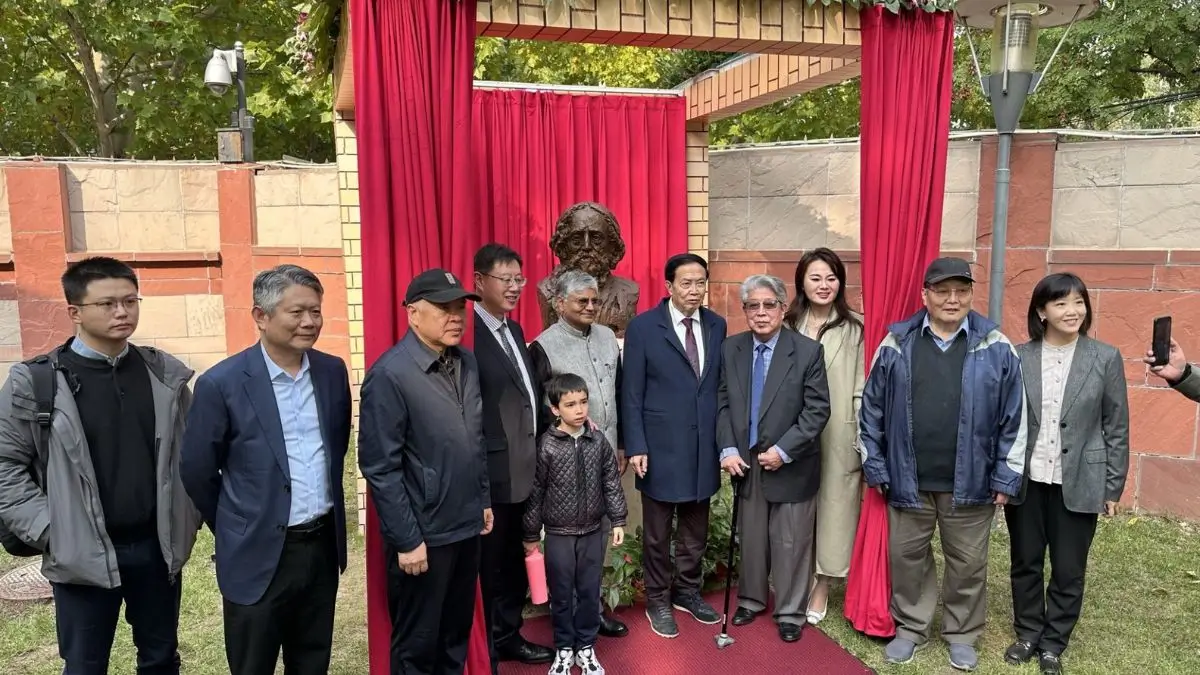
A bronze bust of the Indian literary and cultural icon Rabindranath Tagore was unveiled today at the premises of the Embassy of India, Beijing in Beijing. The sculpture, created by famed Chinese sculptor Yuan Xikun, was inaugurated on the sidelines of a cultural symposium titled “Sangamam – A Confluence of Indian Philosophical Traditions”. The event marked a significant moment in India‑China cultural diplomacy and the shared civilisational heritage between the two nations.
Significance of the Unveiling
The unveiling carries multiple layers of import,
- The bust honours Tagore’s influence beyond India and recognises his historical engagement with China; the Indian Ambassador to China, Pradeep Rawat, noted that Tagore’s visit to China a century ago “was a milestone in our civilisational dialogue.”
- The choice of Chinese sculptor Yuan Xikun underscores a bilateral cultural collaboration — a symbolic gesture reflecting artistic exchange between the two countries.
- The event took place alongside the symposium Sangamam, symbolising intellectual convergence and mutual interest in Indian philosophical traditions within a global context.
Background on Tagore’s China Connection
- Tagore’s connection with China dates back nearly a century, during which he visited Beijing, Shanghai and Hangzhou — forging cultural links and influencing Chinese literature, art and educational thought.
- His emphasis on universal humanism, cross‑cultural understanding and education resonates with the notion of “world citizenship” and shared civilisational heritage — themes that underpin today’s unveiling.


 E20 Petrol India 2026: Nationwide Rollou...
 NCERT Gets ‘Deemed University’ Status: W...
 India Ranks 3rd Globally in Renewable En...











