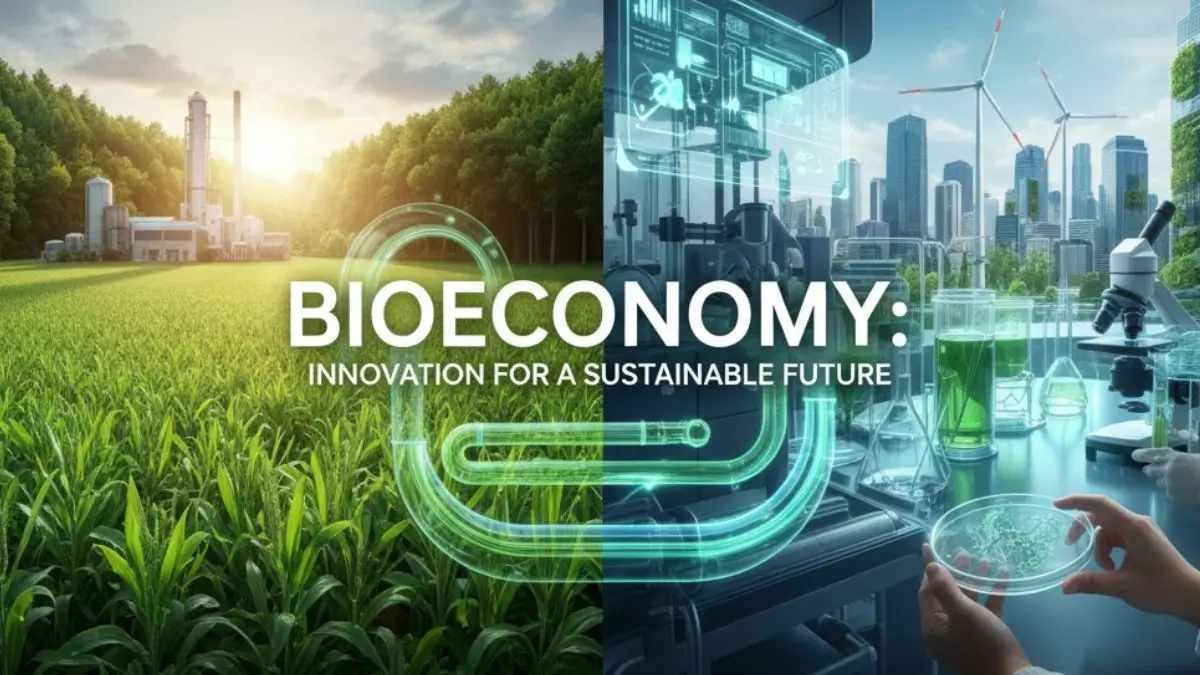
India’s bioeconomy sector—which integrates biotechnology with agriculture, energy, environment, and health—is emerging as a key pillar of sustainable economic growth. Valued at $150 billion in 2024, it is heavily driven by agriculture, which contributes nearly 55% of the total. With rising export demand, green job potential, and rural income growth, the sector is poised to play a transformative role in the government’s Viksit Bharat @2047 vision.
Sector Snapshot: Growth & Potential
India’s bioeconomy is not just growing—it’s diversifying rapidly,
- Valuation: $150 billion in 2024, targeting $300 billion by 2030 (BioE3 Policy)
- Agri-biotech exports: Growing at 14–16% annually, especially in biofertilisers and biopesticides
- Startups: Over 3,000 Agri-biotech startups currently active, supported by DBT, ICAR, and state tech missions
Tech Focus Areas,
- Climate-resilient seeds
- AI & digital twins in precision farming
- Bio-inputs like enzymes, biofortified crops
- Smart mechanisation for small farms
Socio-Economic Significance
The bioeconomy is not only an economic driver—it also supports food, nutrition, and climate goals,
- Food Security: Agriculture still employs 43% of the workforce; biotech helps raise productivity and resilience
- Rural Employment: Expected to create up to 10 million green jobs by 2030
- Income Growth: Bio-based value chains can raise farm incomes by 25–30% (NITI Aayog Rural Model)
- Nutritional Security: Biofortified crops help fight hidden hunger among 35% of rural households
- Green Growth: Bio-based technologies could reduce CO₂ emissions by 20 million tonnes by 2030
- Global Share: India aims to capture 5% of the $1.5 trillion global bioeconomy by 2030 (DBT report)
Farmer Segmentation & Tech Needs
India’s farm population is not homogenous, and tech adoption must match user profiles,
- 70–80%: Aspiring smallholders needing low-cost, simple solutions
- 15–20%: Transitioning farmers adopting intermediate mechanisation
- 1–2%: Advanced cultivators using digital tools and data-driven inputs
- This segmentation requires customised agri-tech models rather than a one-size-fits-all approach.
Government Schemes Supporting Bioeconomy
Several flagship schemes are boosting bioeconomy growth,
- BioE3 Policy (2024): Expansion roadmap to $300 billion by 2030
- National Policy on Bioeconomy (Draft 2024): Promotes sustainable bioresource use
- Gobardhan Yojana: Circular economy for bio-waste to bio-products
- Digital Agriculture Mission (2021–25): GIS and digital tools for precision agriculture
- National Biotech Strategy (2022–25): R&D networks for bio-industrial scaling
- NMSA: National Mission on Sustainable Agriculture, focused on climate-resilient technologies
Key Challenges Hindering Growth
Despite the momentum, several barriers limit sector expansion,
- Low Tech Penetration: Only 12% of farmers use advanced agri-tech (FAO 2024)
- Land Fragmentation: Average holding size is just 1.08 hectares, affecting mechanisation scalability
- Credit Crunch: Agri-tech startups receive only 1.8% of total agricultural lending (NABARD 2025)
- Skilled Workforce Shortage: Only 7% of rural youth trained in biotech or digital farming (NSDC 2024)
- Import Dependence: Nearly 80% of bioenzymes, lab tools, and bioreactors are imported, inflating costs
- Weak Research-Industry Linkage: Only 15% of ICAR–DBT R&D outputs reach market
- Slow Regulatory Clearances: 18–24 months average approval time for bio-inputs delays innovation
Static Facts & Takeaways for Exams
- Current bioeconomy size: $150 billion (2024)
- Target for 2030: $300 billion, 5% global share
- Agri-biotech exports: Growing at 14–16% annually
- Jobs forecast: Up to 10 million green jobs by 2030
- Tech challenges: 12% adoption, 1.08 ha avg land size, 1.8% agri-credit to startups
- Top policies: BioE3, Digital Agriculture Mission, Gobardhan, NMSA
- Key gaps: Regulatory delay, import dependence, low research commercialisation


 India’s GST Collections Hit ₹1.78 Lakh C...
 India Approves IBC Amendment Bill 2026 t...
 India’s Industrial Output Grows 5.2% in ...