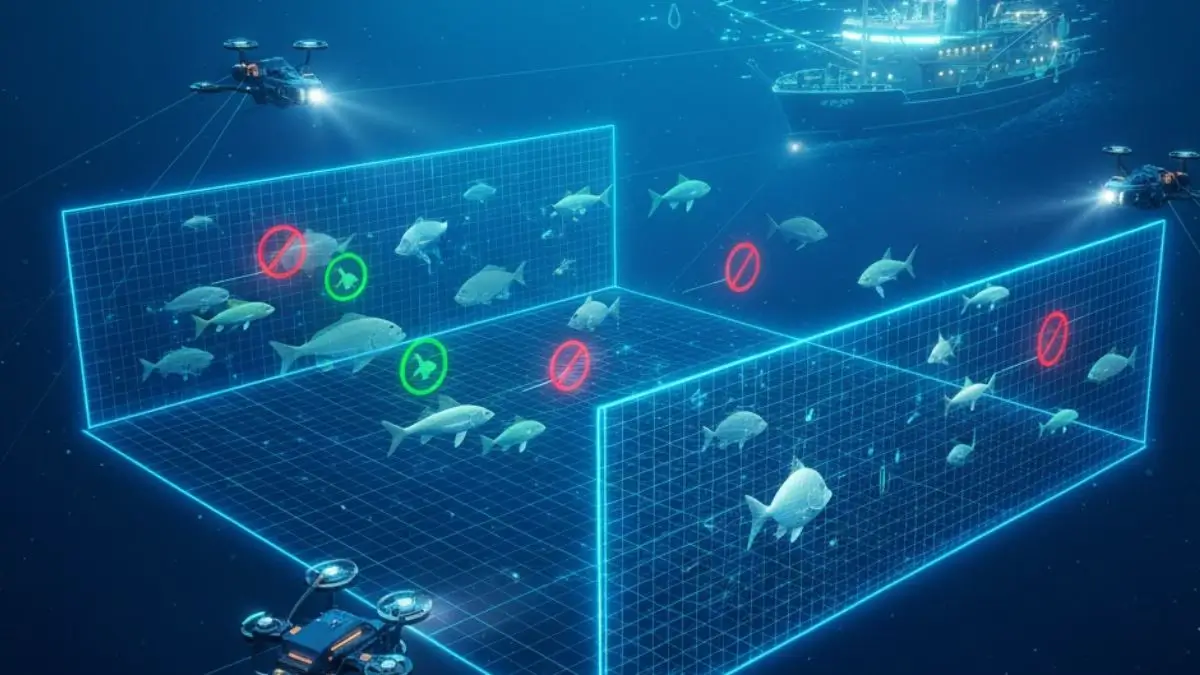
In a major policy shift, the Government of India has notified new deep-sea fishing rules for operations within its Exclusive Economic Zone (EEZ), covering over 23 lakh square kilometres of marine territory. Announced on November 4, 2025, these rules aim to unlock high-value marine resources—particularly tuna—while empowering local fishers, cooperatives, and safeguarding marine biodiversity. The reforms implement promises made in the Union Budget 2025–26 and signal a strategic push to make India a leader in sustainable and tech-enabled marine exports.
Key Features of the New Rules
1. Prioritising Indian Cooperatives & Fish Farmers
The new framework gives priority to,
- Fishermen Cooperative Societies
- Fish Farmer Producer Organisations (FFPOs)
- These entities can now undertake deep-sea fishing using advanced vessels, enabling smaller players to access untapped ocean wealth.
2. Ban on Foreign Vessels
- Foreign fishing vessels are completely banned from Indian EEZ operations.
- This safeguards coastal livelihoods and resource sovereignty, especially for small-scale fishers.
3. Mother-and-Child Vessel Model
This model allows mid-sea transhipment (transfer of catch from small to large vessels) under RBI guidelines, especially benefiting Andaman & Nicobar and Lakshadweep Islands, which together hold 49% of India’s EEZ.
Digital Access Pass via ReALCraft Portal
For regulated EEZ access,
- Mechanised and large-sized motorised vessels must get a free Access Pass via the ReALCraft portal.
- Small-scale and traditional boats are exempted.
- So far, 2.38 lakh vessels are registered; 64,187 mechanised boats need passes.
ReALCraft Benefits,
- Minimal documentation
- Real-time tracking
Integration with MPEDA and Export Inspection Council (EIC) for issuing,
- Fish Catch Certificates
- Health Certificates (key for seafood exports)
Environmental Protections
The new rules enforce strict ecological safeguards,
Ban on destructive practices:
- LED light fishing
- Pair trawling
- Bull trawling
- Minimum legal size norms to prevent juvenile fish harvesting
- Development of Fisheries Management Plans in collaboration with states and stakeholders
Boost to Exports and Traceability
By integrating digital tracking with export certification systems, India can,
- Meet global sanitary and eco-labelling standards
- Improve traceability, a key demand from international seafood markets
- Increase competitiveness in exports worth ₹60,000 crore annually
Also, fish caught beyond the contiguous zone but within the EEZ will now be treated as ‘Indian origin’, easing customs and revenue processes.
Financial and Technical Support
To support fishers in adapting to the new regime,
Access to credit through flagship schemes like:
- Pradhan Mantri Matsya Sampada Yojana (PMMSY)
- Fisheries and Aquaculture Infrastructure Development Fund (FIDF)
- Focus on value addition, branding, and international marketing
Safety & Surveillance Provisions
To enhance security,
- Transponders made mandatory for deep-sea vessels
- QR-coded Aadhaar/Fisher ID cards for onboard identification
- Integration with Nabhmitra App to aid navigation and alert systems
- Improved coordination with Indian Coast Guard and Navy for maritime enforcement
Static Facts & Takeaways
- Rules Notified: November 4, 2025
- Jurisdiction: India’s EEZ (~23 lakh sq. km)
- Main Focus: Empower cooperatives, ban foreign vessels, enable sustainable tech-led fishing
- Key platform: ReALCraft portal for Access Passes
- Fish catch certification: MPEDA + EIC integration
- Environmental bans: LED, bull and pair trawling
- Exempted vessels: Non-motorised and small motorised crafts


 India's First Digital Census 2027 Begins...
 PM Modi Launches Kaynes Semiconductor Pl...
 India Census 2027 Digital: Phase 1 Start...