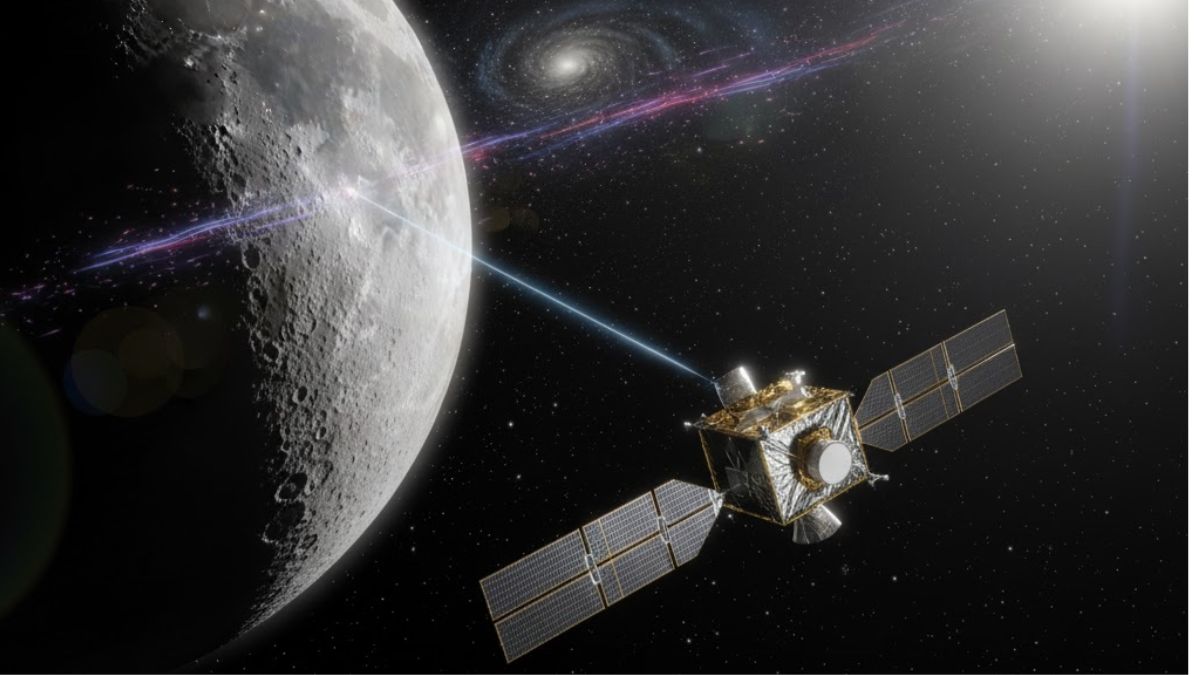
In a major scientific achievement, the Indian Space Research Organisation (ISRO) has confirmed that its Chandrayaan-2 lunar orbiter has made the first-ever direct observation of how solar activity, specifically Coronal Mass Ejections (CMEs), impacts the Moon’s exosphere. This landmark discovery offers unprecedented insight into lunar space weather and the dynamics of the Moon’s extremely thin atmosphere.
What Are Coronal Mass Ejections?
- Coronal Mass Ejections (CMEs) are massive bursts of plasma and magnetic field released from the Sun’s corona, comprising mainly Hydrogen and Helium ions.
- When these ejections reach planetary bodies, they can have significant effects—on Earth, they interfere with satellites and power grids.
- On the Moon, which lacks both an atmosphere and a global magnetic field, the effects are even more direct and profound.
What Did Chandrayaan-2 Observe?
- On May 10, 2024, a rare series of CMEs impacted the Moon, allowing CHACE-2 to record a substantial increase in the total pressure of the sunlit lunar exosphere.
- ISRO scientists reported that the number density of neutral atoms and molecules rose more than tenfold, validating theoretical models that had previously lacked empirical proof.
- This observation confirmed that solar outbursts can drastically alter the Moon’s atmospheric conditions by increasing the liberation of atoms from its surface.
- These liberated atoms form part of the Moon’s exosphere, which is a surface-boundary exosphere—meaning the exosphere is directly influenced by the Moon’s surface conditions.
Why Is the Moon’s Exosphere So Sensitive?
Unlike Earth, the Moon is airless and lacks a global magnetic field, making its exosphere extremely susceptible to even minor fluctuations in solar activity. According to ISRO, the lunar exosphere is created and maintained through,
- Solar radiation
- Solar wind (ions from the Sun)
- Meteorite impacts
When a CME occurs, it bombards the Moon with high-energy particles, enhancing the process that knocks atoms and molecules off the lunar surface. These then become part of the exosphere, increasing its density and pressure temporarily.
ISRO’s Expanding Lunar Legacy
- Chandrayaan-2, launched in 2019, continues to yield scientific dividends through its orbiter, despite the lander’s unsuccessful touchdown attempt.
- CHACE-2, which builds on its predecessor from Chandrayaan-1, is proving to be a highly valuable instrument for studying the lunar atmosphere.
- This latest finding puts India among a select group of nations conducting advanced lunar science and reinforces ISRO’s growing role in planetary research and interplanetary exploration.


 India's First Quantum Computer to be Lau...
 India Strengthens Marine Research with B...
 AP Science City Signs 5-Year MoU with CS...