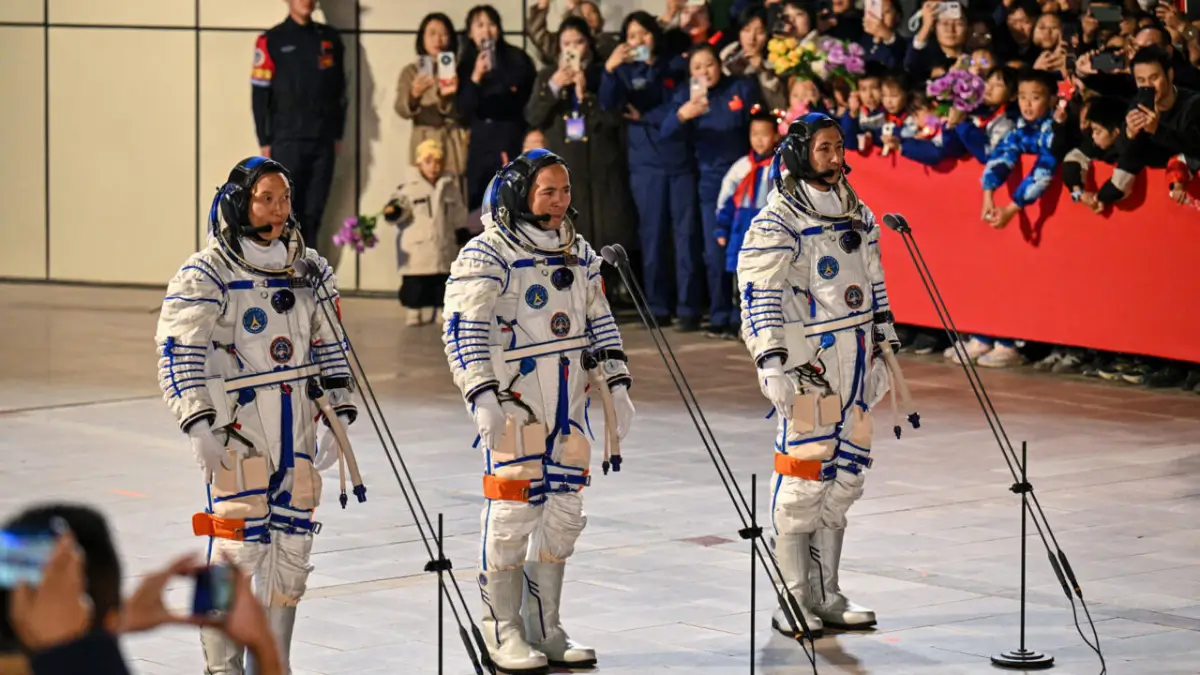
China has successfully launched the Shenzhou-21 spacecraft from the Jiuquan Satellite Launch Centre in the Gobi Desert, marking another achievement in its expanding space programme. The mission lifted off at 11:44 pm local time (1544 GMT) aboard a Long March-2F rocket and is set to dock with the Tiangong Space Station within a few hours. The crew includes Commander Zhang Lu, Engineer Wu Fei, and Specialist Zhang Hongzhang, who will stay in orbit for six months conducting research and maintenance work.
Wu Fei, China’s Youngest Astronaut in Space
Among the crew, Wu Fei, aged 32, has made history as China’s youngest astronaut to enter orbit. His participation symbolizes the next generation of Chinese space explorers, showing the nation’s commitment to nurturing young talent for future lunar and planetary missions. Wu’s inclusion highlights China’s growing emphasis on training skilled astronauts to support its long-term space ambitions.
Scientific Goals and In-Orbit Mouse Experiments
The Shenzhou-21 mission carries a unique scientific payload — four laboratory mice, two male and two female, marking China’s first in-orbit biological experiment involving rodents. Scientists will study how microgravity affects the body and reproduction of mammals, providing insights crucial for long-duration space travel. Alongside biological research, astronauts will perform spacewalks, install anti-debris shields, and engage in science outreach activities to inspire young students in China.
A Step Toward China’s ‘Space Dream’
Under President Xi Jinping’s “space dream” vision, China is accelerating efforts to become a global space power. After landing the Chang’e-4 probe on the Moon’s far side in 2019 and deploying a rover on Mars in 2021, China now aims to send astronauts to the Moon by 2030. The Tiangong Space Station, completed in 2022, serves as the nation’s permanent orbital base for conducting research, testing new technologies, and training future lunar crews.
China’s Growing Global Role in Space
Since being excluded from the International Space Station (ISS) in 2011, China has built its own independent space platform and developed partnerships with countries like Pakistan. The Shenzhou-21 mission not only reflects China’s scientific growth but also showcases its ability to contribute independently to global space exploration. The mission’s experiments and training activities will help prepare for deep-space missions, solidifying China’s role as a leading spacefaring nation.


 Which City is known as the Garlic Capita...
 What is National Investigation Agency? C...
 Which State is the Largest Petroleum Pro...