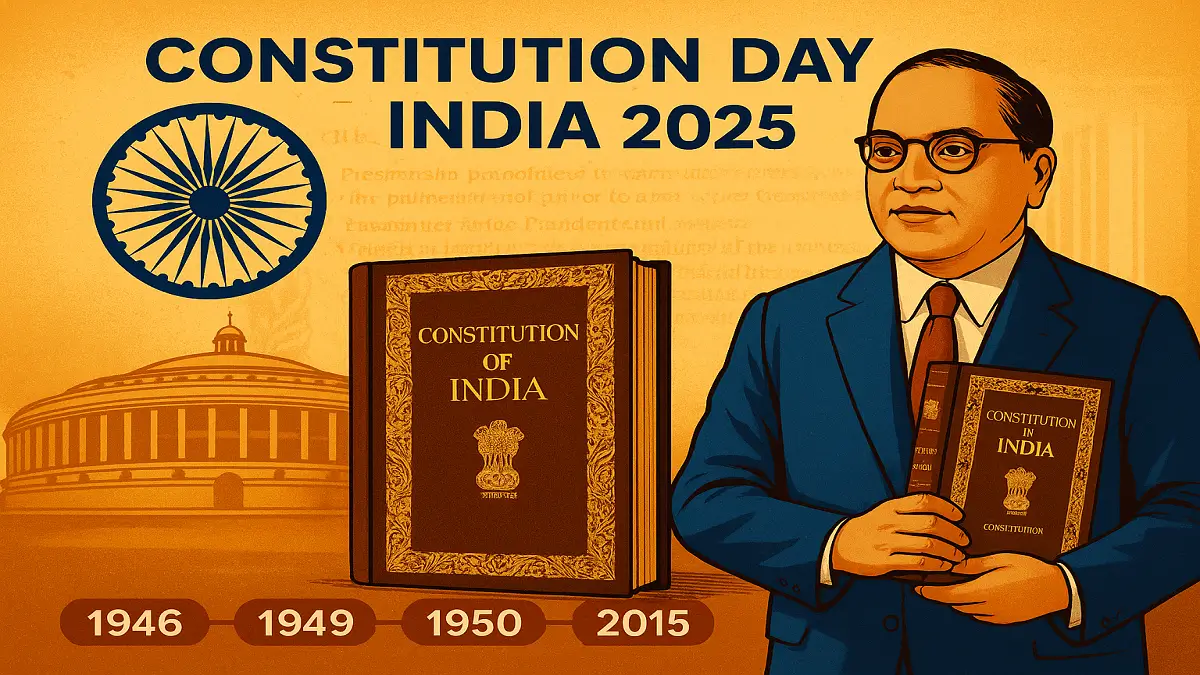
Constitution Day, observed every year on November 26, commemorates the historic moment when the Constituent Assembly adopted the Constitution of India in 1949. The year 2025 marks the 76th anniversary of this landmark event—an occasion that not only celebrates India’s democratic foundation but also reminds citizens of their commitment to constitutional values, rights, and duties.
Why November 26 Is Celebrated as Constitution Day
Before 2015, November 26 was observed as National Law Day to honour Dr. Bhimrao Ambedkar, the Chairman of the Drafting Committee and India’s first Law Minister.
In 2015, the Government of India officially declared November 26 as ‘Constitution Day’ (Samvidhan Divas) to promote constitutional awareness among citizens. The declaration also coincided with Dr. Ambedkar’s 125th birth anniversary, paying tribute to the “chief architect of the Indian Constitution”.
The Adoption of the Constitution: A Historic Journey
The Indian Constitution was adopted on November 26, 1949, and came into force two months later on January 26, 1950, celebrated as Republic Day.
The drafting process was one of the most extensive and inclusive in history. The Constituent Assembly spent:
- 2 years, 11 months, 18 days drafting the Constitution
- Discussed the draft for 114 days
- Considered over 7,600 amendments, of which 2,400 were accepted
- Worked with 207 members, including 9 pioneering women
Timeline of Key Events Leading to the Adoption of the Constitution
Early Foundation
- 1934: M.N. Roy proposes the idea of a Constituent Assembly.
- 1946: Constituent Assembly formed under the Cabinet Mission Plan.
Constituent Assembly Milestones
- December 9, 1946: First meeting with 207 members.
- January 22, 1947: Objectives Resolution, later the basis of the Preamble, adopted.
- August 29, 1947: Drafting Committee formed under Dr. B.R. Ambedkar.
- November 4, 1948: First Draft presented.
- November 26, 1949: Constitution adopted.
- January 26, 1950: Constitution comes into force—India becomes a Republic.
The Structure of the Constitution Today
The Indian Constitution currently contains:
- 395 Articles
- 25 Parts
- 12 Schedules
These have evolved through numerous Constitutional Amendments, many of which significantly shaped the country’s governance.
Major Constitutional Amendments
1. Forty-Second Amendment Act, 1976 — The “Mini Constitution”
This far-reaching amendment:
- Introduced “Socialist”, “Secular”, and “Integrity” in the Preamble
- Added Fundamental Duties
- Enhanced central authority
- Limited judicial review powers
2. Forty-Fourth Amendment Act, 1978
This amendment:
- Corrected excesses of the 42nd Amendment
- Safeguarded Article 368 from arbitrary misuse
- Modified Emergency provisions
- Downgraded Right to Property from a fundamental right to a legal right
3. Sixty-First Amendment Act, 1989
Reduced the voting age from 21 to 18 years, empowering India’s youth.
4. Eighty-Sixth Amendment Act, 2002
- Introduced Article 21A—Right to Education
- Mandated free education for ages 6–14
- Added 51A(k): duty of parents/guardians to educate children
5. One Hundred and First Amendment Act, 2016
Introduced GST (Goods and Services Tax)—a major tax reform unifying India’s indirect tax structure.
Landmark Supreme Court Judgments Shaping the Constitution
Over the decades, the Supreme Court has delivered landmark rulings strengthening constitutional democracy. Some of the most important include:
1. Golaknath v. State of Punjab (1967)
- Limited Parliament’s power to amend Fundamental Rights for the first time.
2. Kesavananda Bharati v. State of Kerala (1973)
- Established the Basic Structure Doctrine
- Held that core features like secularism, democracy, and judicial review cannot be altered
3. Indira Nehru Gandhi v. Raj Narain (1975)
- Struck down a part of the 39th Amendment and reinforced free and fair elections as part of the basic structure.
4. Maneka Gandhi v. Union of India (1978)
- Expanded the scope of Article 21
- Established that laws must be just, fair, and reasonable
5. Minerva Mills v. Union of India (1980)
- Reaffirmed that Parliament cannot damage the basic structure
- Balanced Fundamental Rights and Directive Principles
6. Olga Tellis v. Bombay Municipal Corporation (1985)
- Recognized Right to Livelihood as part of Right to Life
7. S.R. Bommai v. Union of India (1994)
- Placed limitations on President’s Rule
- Made it subject to judicial review
8. Justice K.S. Puttaswamy v. Union of India (2017)
- Declared Right to Privacy as a Fundamental Right
9. NCT Delhi v. Union of India (2018)
- Defined powers of the Delhi Government and Lieutenant Governor
10. ADR v. Union of India (2024)
- Struck down the Electoral Bonds Scheme, declaring it unconstitutional.


 World Health Day 2026 - Theme, Date, Sig...
 List of Important Days in April 2026, Na...
 International Day of Sport for Developme...