
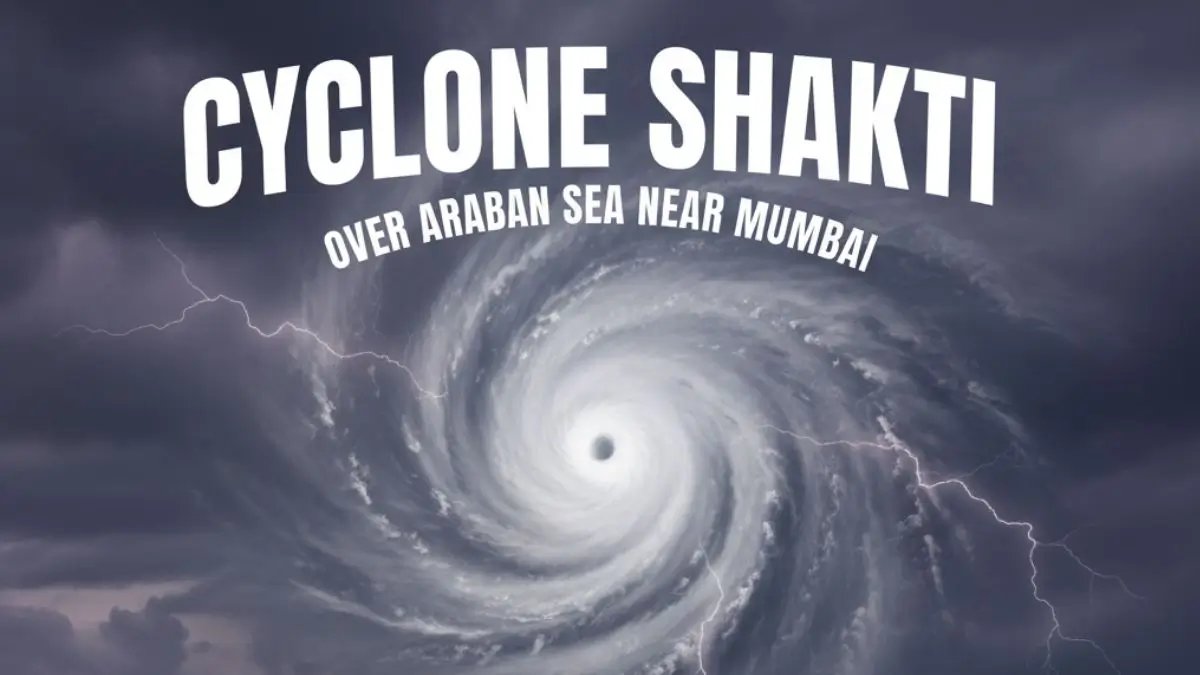
Cyclone Shakti, formed in October 2025 over the Arabian Sea, marks a growing trend of strong tropical storms on India’s west coast. While it may not make landfall, its development has triggered alerts across Maharashtra and Gujarat. Understanding this cyclone provides valuable insight into how climate change is reshaping weather systems in the Arabian Sea, with major implications for disaster preparedness and environmental planning.
How Cyclone Shakti Formed
- The formation of Cyclone Shakti followed the typical process of tropical cyclogenesis.
- It developed over the east-central Arabian Sea, where sea surface temperatures exceeded 27°C, providing the necessary heat energy.
- The presence of low vertical wind shear, abundant moisture, and strong upper-level outflow allowed the system to intensify rapidly.
- These conditions helped the storm reach the classification of a Severe Cyclonic Storm, with wind speeds exceeding 89 km/h.
Naming of the Cyclone
- The name Shakti, meaning “power” or “energy”, was proposed by Sri Lanka under the naming protocol of the WMO/ESCAP Panel on Tropical Cyclones.
- The naming system helps streamline communication during emergencies and is vital for public awareness.
- Thirteen countries contribute names for cyclones forming in the North Indian Ocean.
Classification and Intensity
- The India Meteorological Department (IMD) categorizes cyclones based on wind speeds.
- Cyclone Shakti falls under the “Severe Cyclonic Storm” category with sustained winds of 89–117 km/h.
- It is a middle-tier classification, with stronger systems labeled as Very Severe, Extremely Severe, or Super Cyclones.
- These terms help predict the likely damage and guide disaster response actions.
Geographical Path and Position
- As of October 4, 2025, Cyclone Shakti was located around 420 km from Dwarka (Gujarat) and was moving west-southwestward at 18 km/h.
- Although it is not expected to make landfall in India, the storm’s peripheral effects are being felt across Maharashtra’s Konkan coast, especially in Mumbai,
- Thane, Palghar, and Raigad. The IMD warned of moderate to heavy rainfall in these areas, along with strong winds and rough seas.
Rising Cyclone Activity in the Arabian Sea
Historically, the Bay of Bengal saw more cyclones than the Arabian Sea. However, climate trends are reversing this. Recent studies show,
- A 52% increase in severe cyclones in the Arabian Sea between 2001 and 2019.
- Sea temperatures in this region are consistently rising, fueling cyclone formation.
- Oceanic phenomena like the Indian Ocean Dipole (IOD) also influence cyclone behaviour.
This suggests that west coast states like Maharashtra, Goa, and Gujarat may increasingly face cyclone-related risks.
Static Facts
- Cyclone Season in Arabian Sea: April to December (peak in May and October–November)
- Minimum Temperature for Cyclone Formation: 26.5–27°C sea surface temperature
- India Meteorological Department (IMD): National agency for cyclone forecasting and classification
- WMO/ESCAP Panel: Body responsible for naming cyclones in the North Indian Ocean


 India's First Digital Census 2027 Begins...
 PM Modi Launches Kaynes Semiconductor Pl...
 India Census 2027 Digital: Phase 1 Start...











