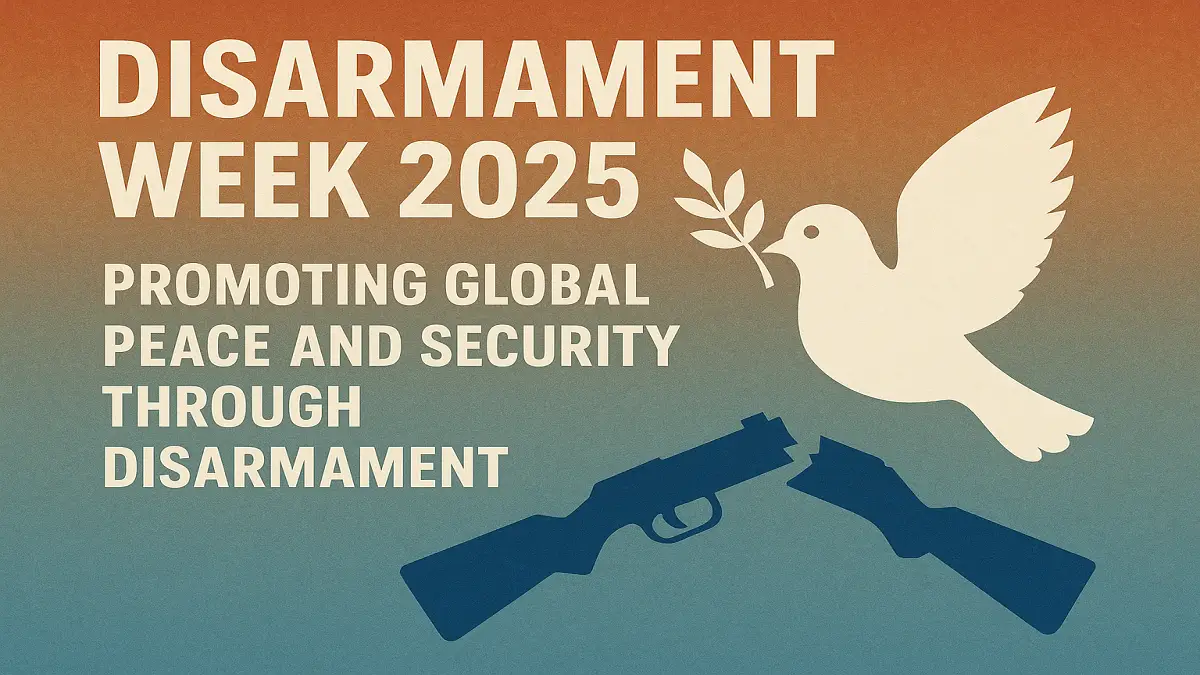
Every year, Disarmament Week is observed from 24 to 30 October, beginning on the anniversary of the founding of the United Nations. The week aims to promote awareness and understanding of global disarmament issues and their vital role in achieving lasting peace, security, and sustainable development.
The observance was first proposed in the Final Document of the 1978 UN General Assembly’s Special Session on Disarmament (Resolution S-10/2). Later, in 1995, the UN General Assembly encouraged governments and non-governmental organizations (NGOs) to actively participate in the week (Resolution 50/72 B).
Historical Background and Purpose
Since the formation of the United Nations in 1945, disarmament and arms control have been central to its mission of maintaining international peace and security. The goal is simple yet profound — to replace fear and weapon buildup with dialogue, cooperation, and trust among nations.
The idea of disarmament goes beyond just reducing weapons; it represents a commitment to human security, humanitarian values, and sustainable development. It seeks to create a world where resources spent on arms can instead be used for education, health, and global progress.
Focus Areas of Disarmament
1. Nuclear Weapons
Nuclear disarmament remains a top global priority, as nuclear weapons pose the most severe threat to humanity. Their destructive capacity makes them a continuing concern for peace, security, and survival. The UN advocates for complete nuclear disarmament through treaties like the Treaty on the Non-Proliferation of Nuclear Weapons (NPT) and the Treaty on the Prohibition of Nuclear Weapons (TPNW).
2. Conventional Weapons
The illicit trade and excessive accumulation of small arms and light weapons continue to fuel violence, crime, and instability. The UN supports global efforts to regulate conventional arms and curb illegal trafficking to ensure safety and sustainable development.
3. Emerging Weapon Technologies
New threats have emerged in recent years, such as autonomous weapons systems, cyberwarfare, and artificial intelligence in military applications. These raise new ethical, legal, and security challenges. The international community is increasingly focused on preventing misuse and ensuring accountability in these emerging technologies.
Why Disarmament Matters Today
In a world still facing conflict, terrorism, and military rivalries, disarmament is essential to prevent escalation and save lives. It promotes:
- International peace and stability
- Protection of civilians and human rights
- Trust and cooperation among nations
- Sustainable development and resource allocation
Disarmament is not just a security issue — it’s a moral and humanitarian imperative that directly affects the future of humanity.
UN’s Role and Global Efforts
The United Nations Office for Disarmament Affairs (UNODA) leads global initiatives to promote peace through disarmament, arms control, and non-proliferation. The UN continues to engage governments, civil society, and youth in building awareness about the dangers of weapon proliferation.
UN Secretary-General António Guterres has called for a “New Agenda for Disarmament”, emphasizing three key goals:
- Save humanity – by eliminating weapons of mass destruction.
- Save lives – by addressing the impact of conventional weapons.
- Secure our future – by managing new and emerging technologies responsibly.


 List of Important Days in April 2026, Na...
 Utkal Divas 2026 Odisha: Formation Day H...
 Mahavir Jayanti 2026: Why Lord Mahavir’s...