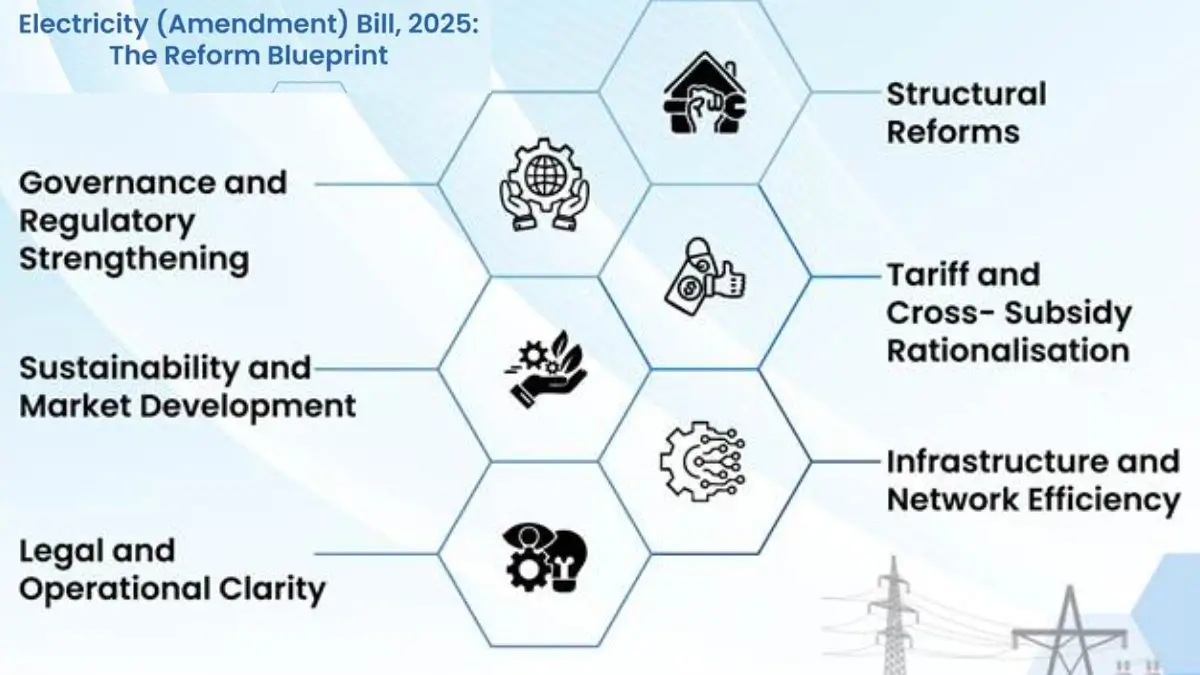
The Electricity (Amendment) Bill, 2025 marks a significant reform initiative to modernise India’s power sector. It aims to transform how electricity is supplied, priced and regulated—moving from legacy models towards a more competitive, efficient and consumer‑friendly system.
What the Bill Seeks to Do
Key Goals
- Rationalise electricity cost by promoting cost‑reflective tariffs so that prices better mirror actual supply costs.
- Reduce hidden cross‑subsidy where industrial or commercial consumers end up subsidising other categories, thereby improving competitiveness of industry and logistics.
- Fully protect subsidised tariffs for farmers and low‑income households, even as reforms proceed.
- Strengthen regulatory accountability by empowering regulatory commissions, enabling timely decisions and reducing financial stress in utilities.
- Enable shared network use to avoid duplication of infrastructure, lower system‑costs and support rapid expansion of distribution systems.
- Improve supply quality and reliability and ensure better coordination between Centre and States for policy implementation.
Major Structural Reforms Introduced
Competition in Distribution
- The Bill enables multiple distribution licence‑holders to operate in the same area, thereby breaking the monopoly model and enabling choice and performance‑driven service.
- There is a mandate for a Universal Service Obligation (USO) for all licence‑holders so that access to electricity remains non‑discriminatory.
Tariff and Cross‑Subsidy Rationalisation
- The Bill mandates that tariffs be cost‑reflective, ensuring financial viability of utilities while retaining protections for disadvantaged sections.
- It aims to eliminate cross‑subsidy for sectors like manufacturing, railways and metros within five years — moving these users to underlying cost‑tariffs.
Infrastructure and Network Efficiency
- The Bill gives regulatory commissions power to set wheeling charges and promotes shared networks to prevent inefficient duplication.
- It also introduces explicit recognition of Energy Storage Systems (ESS) as part of the electricity ecosystem.
Governance & Regulatory Strengthening
- Establishes an Electricity Council to facilitate policy coordination between the Centre and the States.
- Empowers State Electricity Regulatory Commissions (SERCs) to act proactively, including imposing penalties for non‑compliance and issuing tariff orders suo motu when submissions are delayed.
Market & Sustainability Focus
- Enhances obligations regarding non‑fossil energy procurement, aligning with clean‑energy and net‑zero commitments.
- Encourages power‑market development, new trading platforms and instruments, and efficient procurement and dispatch mechanisms.
Context & Rationale
Several structural challenges prompted the need for reform,
- Distribution companies (DISCOMs) have faced persistent financial stress, largely due to high technical & commercial (AT&C) losses, weak billing efficiency and limited competitiveness.
- The legacy single‑supplier model restricted consumer choice, led to stagnation of service quality, and inhibited innovation in the sector.
- Industrial users bore disproportionate tariffs to subsidise other consumer categories, making Indian manufacturing less competitive globally.
- The inter‑state transmission system (ISTS) model, which allows shared infrastructure and competitive services, served as a template for distribution reform.
By addressing these issues, the Bill sets up a future‑ready power sector able to support India’s growth, industry, households and climate goals.
Static Facts
- Name of Bill: Electricity (Amendment) Bill, 2025
- Key policy instrument: mandates cost‑reflective tariffs while protecting subsidised consumer categories.
- Targeted cross‑subsidy elimination: industries, railways, metro rail within five years.
- Infrastructure reform: Allows multiple distribution licencees in same area; shared network; ESS recognition.
- Governance reform: Establishes an Electricity Council; strengthens SERC powers (tariff & regulatory accountability).
- Distribution reform objective: Move from monopoly single‑supplier model to competitive choice‑based model.
Which group is assured of fully protected subsidised tariffs under the Bill?
A. Large industries
B. Metro Railways
C. Farmers and low-income households
D. IT companies


 India Withdraws Its Plan to Host COP33 S...
 IIM Rohtak Wins BIMTECH's 'Hermes' Dialo...
 Gurgaon Tops the List of India's Most Po...