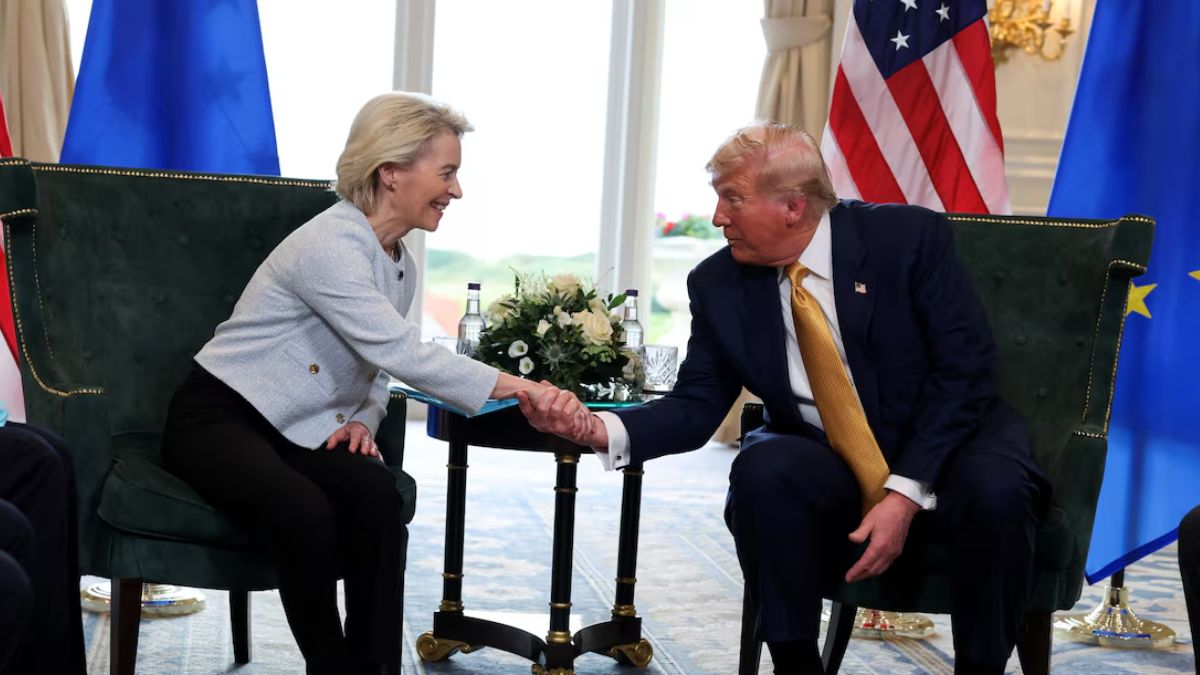
The United States and the European Union (EU) have reached a historic trade deal after months of tense negotiations, bringing an end to a prolonged tariff standoff between two of the world’s largest economic partners. The agreement, announced after high-level talks between US President Donald Trump and European Commission President Ursula von der Leyen in Scotland, sets a 15% tariff on EU exports to America, which is half of the 30% rate Trump had earlier threatened. The deal is being hailed as the largest trade agreement in history.
Key Features of the Deal
Under the agreement, the US will impose a 15% tariff on all EU goods, while the EU will open its markets to American exports with zero tariffs on certain products such as aircraft, plane parts, selected chemicals, and agricultural items. However, Trump clarified that the 50% tariff on global steel and aluminium imports would remain in place. The deal also includes a plan for the EU to invest $600 billion in the US economy over the next three years and spend $750 billion on American energy resources like liquified natural gas, oil, and nuclear fuels, aimed at reducing Europe’s dependence on Russian energy.
Negotiation Process
The agreement was finalized after a make-or-break meeting at Trump’s Turnberry golf resort in Scotland. Both leaders described the outcome as a “huge deal” after tough negotiations. Ursula von der Leyen referred to the pact as a framework agreement, with further technical details to be negotiated in the coming weeks. Approval from EU member states will be required before the deal takes full effect, with ambassadors meeting to discuss the debrief.
Political Reactions
Reactions to the deal have been mixed. While Von der Leyen hailed it as a stabilizing step, some European leaders expressed caution. France’s European Affairs Minister Benjamin Haddad called the deal “unbalanced,” despite exemptions for key French sectors like spirits. Ireland’s Prime Minister Micheál Martin pointed out that tariffs were still higher than before, making trade “more expensive and more challenging.” Germany’s Chancellor Friedrich Merz welcomed the stability the deal brings, while Italy’s Prime Minister Giorgia Meloni said further scrutiny of details was needed. Meanwhile, Trump celebrated it as a personal victory, calling himself a “deal maker”.
Impact on Global Trade
The deal is expected to generate $90 billion in tariff revenue for the US government, based on last year’s trade figures, while boosting American exports through expanded market access. It also promises to enhance energy cooperation and reduce Europe’s reliance on Russia. However, sectors such as alcohol, including French wine and Dutch beer, still remain under discussion. The agreement ensures that a potentially damaging US-EU trade war has been averted, though critics argue the EU has conceded more than it has gained.
Trade Background
Trade between the US and EU totaled about $976 billion in 2024, with the US importing $606 billion in goods from Europe while exporting $370 billion. This significant trade deficit has long been a sticking point for Trump, who views such imbalances as proof that the US is “losing” in global trade. Without the deal, the EU faced the risk of steep tariffs on products like Spanish pharmaceuticals, Italian leather, German electronics, and French cheese, while the EU threatened retaliatory tariffs on US car parts, Boeing planes, and beef.


 Preeti Saran Re-Elected as UN Committee ...
 Global Trade Hits New High in 2025: Key ...
 Iran–US Ceasefire: Iran’s 10 Conditions ...