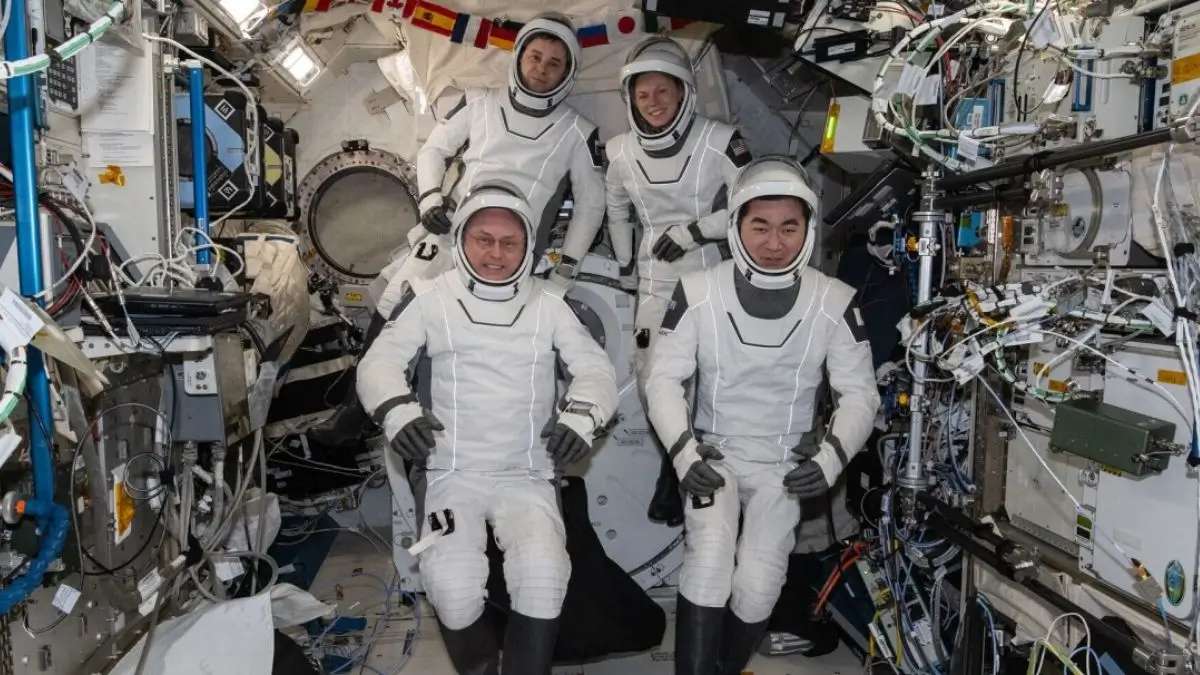
In a historic moment for spaceflight, NASA carried out the first-ever medical evacuation from the International Space Station (ISS). On 15 January 2026, the SpaceX Crew-11 mission was cut short after a non-critical medical issue affected one astronaut. The crew safely returned to Earth, marking a major milestone in space healthcare and astronaut safety.
Why in News?
NASA successfully completed the first medical evacuation from the ISS on 15 January 2026. The SpaceX Crew-11 mission returned early to ensure advanced medical care on Earth, even though the astronaut’s condition was stable in orbit.
What Happened During the Medical Evacuation?
- The medical evacuation involved the early return of SpaceX Crew-11 from the International Space Station.
- The crew had arrived at the ISS on 2 August 2025 and was scheduled for a six-month mission.
- However, following health concerns detected during routine checks in early January 2026, NASA decided to prioritize ground-based diagnostics.
- Although the condition was not critical and manageable onboard, NASA chose an early return as a precaution.
- This decision reflects a shift towards conservative medical risk management in long-duration space missions.
Timeline of the Historic Evacuation
- The sequence began on 7 January 2026, when NASA identified a medical issue after spacewalk preparations.
- NASA’s Chief Medical Officer, Dr. James Polk, assessed the situation and recommended an early return without declaring an emergency.
- The Crew Dragon spacecraft deorbited on 15 January, with splashdown occurring off the coast of Florida.
- The astronauts were recovered, medically evaluated, and transferred for further observation before being flown to Houston.
- The smooth execution demonstrated NASA’s readiness for medical contingencies in orbit.
Crew and Mission Details
- The mission was commanded by Zena Cardman and included veteran astronaut Mike Fincke, Kimiya Yui from JAXA, and Oleg Platonov from Roscosmos.
- The identity of the affected astronaut was not disclosed due to medical privacy norms.
- Despite the shortened mission, Crew-11 completed several scientific experiments, including studies relevant to long-duration human spaceflight and future Mars missions.
Impact on ISS Operations
- Importantly, the early return did not disrupt ISS operations.
- Remaining astronauts continued scientific and maintenance activities as planned.
- NASA confirmed that Crew-12 would arrive on 15 February 2026 to maintain crew rotation.
- This ensured uninterrupted research aboard the ISS, which has been continuously occupied for over 25 years.
- The event showed that the station can safely manage unexpected crew changes without operational setbacks.
Significant for Space Medicine
- This first medical evacuation highlights the challenges of healthcare in orbit, even after decades of experience.
- While the ISS has advanced medical tools, it cannot fully replace Earth-based diagnostics and treatment.
- The evacuation demonstrates how NASA is refining deep-space safety protocols, crucial for future missions to the Moon and Mars.
- It also underlines the importance of rapid decision-making, crew safety, and international cooperation in human spaceflight.
Key Summary at a Glance
| Aspect | Details |
| Why in News? | First medical evacuation from the ISS |
| Mission | SpaceX Crew-11 |
| Date of Return | 15 January 2026 |
| Reason | Non-critical astronaut medical issue |
| Outcome | Safe splashdown, continued ISS operations |
| Next Crew | Crew-12 on 15 February 2026 |
Question
Q. Which mission carried out the first medical evacuation from the ISS?
A. Crew-9
B. Crew-10
C. Crew-11
D. Crew-12


 NASA’s Artemis 2 Set for April 2026 Laun...
 Akasha300 3D Printer Explained: How It W...
 IVRI Produces Sahiwal Calves Using Advan...