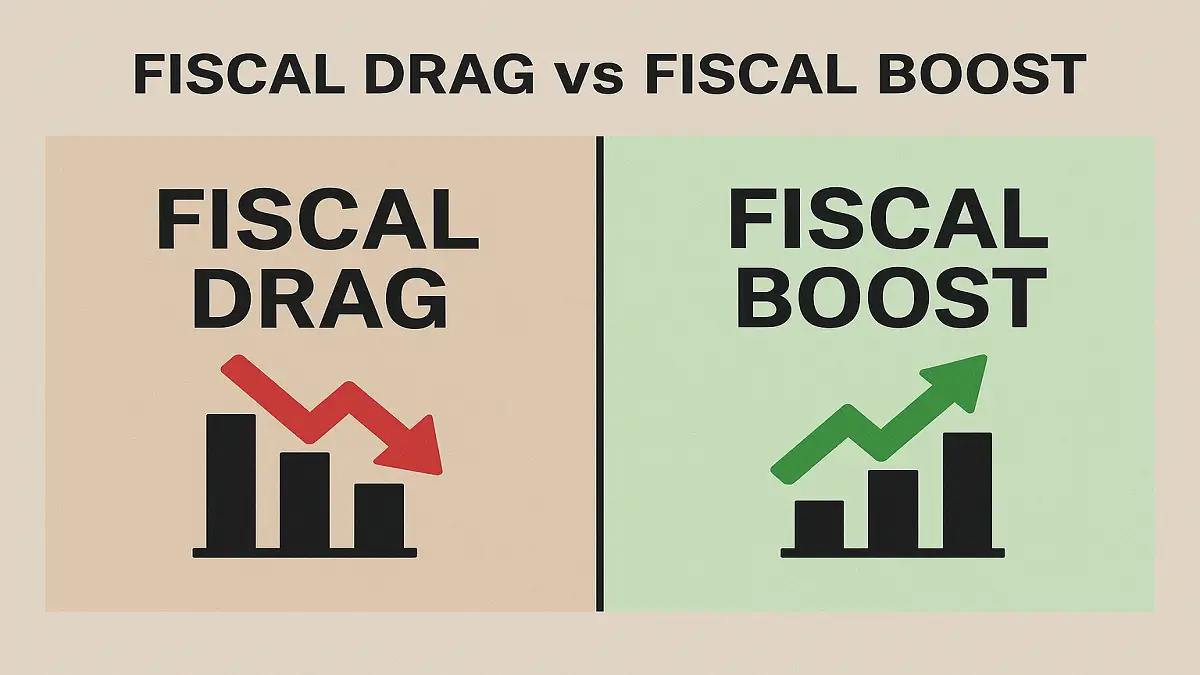
Governments use fiscal policy to manage economic growth, inflation, and overall demand in an economy. Two important concepts often discussed in public finance and macroeconomics are:
- Fiscal Drag
- Fiscal Boost
Students preparing for competitive exams frequently get confused because both terms sound similar but have opposite meanings. This article explains both concepts in simple language with examples and an easy comparison.
What Is Fiscal Drag?
Fiscal Drag occurs when government taxation or fiscal measures slow down economic growth by reducing people’s disposable income.
In other words: Fiscal Drag happens when rising taxes or lack of tax adjustments reduce spending and weaken economic growth.
Why Does Fiscal Drag Occur?
- Taxes increase faster than income
- Tax slabs not adjusted for inflation
- More people automatically enter higher tax brackets (Bracket Creep)
- Government reduces spending
Effects of Fiscal Drag
- Lower consumer spending
- Reduced business investment
- Slower economic growth
- Decline in aggregate demand
- Economy may move toward recession
Simple Example of Fiscal Drag
Suppose inflation increases people’s salaries, but tax slabs remain unchanged.
People end up paying more taxes, reducing their real income.
This lowers their purchasing power → leading to fiscal drag.
What Is Fiscal Boost?
Fiscal Boost happens when the government increases spending or reduces taxes to stimulate economic growth.
In simple words: Fiscal Boost is when the government “boosts” the economy by putting more money into people’s hands.
How Fiscal Boost Works
- Increase government spending
- Reduce direct taxes
- Reduce indirect taxes
- Provide subsidies or cash transfers
- Launch public infrastructure projects
Effects of Fiscal Boost
- Higher consumption
- More employment
- Increased demand
- Faster economic growth
- Revival from recession
Simple Example of Fiscal Boost
During an economic slowdown, the government reduces GST rates and increases infrastructure spending.
People spend more → companies profit → economy grows faster.
Fiscal Drag vs Fiscal Boost: Key Differences
Here is a clear comparison table:
| Feature | Fiscal Drag | Fiscal Boost |
|---|---|---|
| Meaning | Slows down economy due to higher taxes / reduced income | Stimulates economy by reducing taxes / increasing spending |
| Effect on Demand | Reduces aggregate demand | Increases aggregate demand |
| Government Action | Higher taxes, reduced spending | Lower taxes, increased spending |
| Economic Impact | Slower growth, recession risk | Faster growth, recovery from slowdown |
| Consumer Income | Decreases | Increases |
| Used When | Inflation is high | Economy is slowing or in recession |
| Example | Salary rises → tax bracket rises → less disposable income | Govt cuts taxes during recession |


 India’s GST Collections Hit ₹1.78 Lakh C...
 India Approves IBC Amendment Bill 2026 t...
 India’s Industrial Output Grows 5.2% in ...