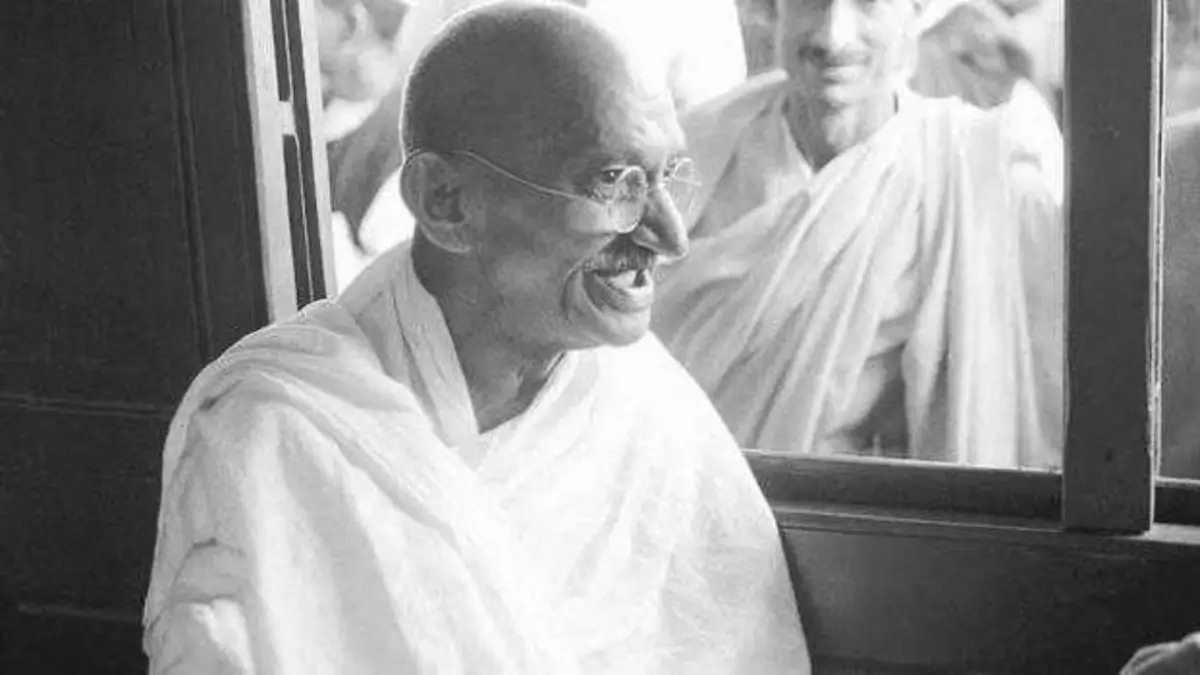
Mahatma Gandhi is remembered as the Father of the Nation, but his journey as a leader of truth and non-violence began much before India’s freedom struggle. It was in South Africa that he first faced racial injustice and developed the idea of Satyagraha. Later, when he returned to India in 1915, these experiences shaped his role in leading the fight against British rule through peace and non-violence.
Who was Mahatma Gandhi?
Mahatma Gandhi, known as the Father of the Nation, played the most important role in India’s freedom struggle. His ideas of truth (Satya) and non-violence (Ahimsa) united millions of Indians against British rule. Gandhi’s life journey, from his childhood to his leadership in the freedom movement, shows how determination, simplicity, and moral strength can bring about great change.
Early Life of Gandhi
- Born: 2 October 1869 in Porbandar, Gujarat.
- Parents: Karamchand Gandhi (a chief minister in Porbandar) and Putlibai (a deeply religious woman).
- His upbringing was influenced by Vaishnavism and Jainism, which taught him values of non-violence, vegetarianism, truth, and tolerance.
- Stories of Shravana and Harishchandra also shaped his love for honesty and sacrifice.
Gandhi in South Africa
In 1893, Gandhi went to South Africa to work for an Indian merchant. Here he faced severe racial discrimination.
- Famous incident: He was thrown out of a first-class train compartment despite having a valid ticket.
- This humiliation motivated him to fight against injustice.
Struggles and Contributions in South Africa
- Started non-violent protests against racial discrimination (1894).
- Formed the Indian Ambulance Corps during the Boer War (1899).
- Set up Phoenix Farm and Tolstoy Farm, training grounds for non-violent resistance.
- Launched the first Satyagraha in 1906 against unfair laws.
- Led several marches and was jailed multiple times, but his peaceful protests gained global attention.
South Africa became the training ground for Gandhi’s philosophy of Satyagraha (truth-force) and Ahimsa (non-violence).
Return to India and Entry into Politics
Gandhi returned to India in 1915. Senior leader Gopal Krishna Gokhale introduced him to the political and social issues of the country. Gandhi decided to travel across India to understand the problems of the poor, farmers, and workers before taking up leadership. This made him connect closely with ordinary people, who soon began to see him as their leader.
Major Movements in India
Mahatma Gandhi led several major movements in India that brought common people into the freedom struggle. Through non-violence and truth, he united farmers, workers, and ordinary citizens, turning India’s fight against British rule into a mass movement.
Champaran Satyagraha (1917)
His first successful movement in India. Gandhi supported indigo farmers in Champaran, Bihar, against the exploitation of British planters.
Kheda Satyagraha (1918)
Gandhi supported peasants in Gujarat who could not pay taxes due to crop failure and famine.
Khilafat and Non-Cooperation Movement (1920-22)
- Aimed to unite Hindus and Muslims.
- Called for boycotting British schools, titles, clothes, and goods.
- Later suspended after the Chauri Chaura incident (1922).
Civil Disobedience Movement (1930)
- Began with the historic Dandi March, where Gandhi broke the salt law.
- Spread across India, inspiring lakhs of people to defy British laws peacefully.
Round Table Conferences and Gandhi-Irwin Pact (1931)
- Gandhi attended the Second Round Table Conference in London but realized British intentions were not sincere.
- The Gandhi-Irwin Pact temporarily eased tensions, with some political prisoners released.
Quit India Movement (1942)
- Gandhi gave the call of “Do or Die” against British rule.
- Though leaders were jailed immediately, the movement sparked massive protests nationwide and shook the foundation of British power.
Assassination and Legacy
On 30 January 1948, Gandhi was shot dead by Nathuram Godse, a Hindu extremist, who blamed him for partition and his efforts to support Hindu-Muslim unity. His death was a great loss for the nation.
Yet, Gandhi’s legacy of peace, truth, and non-violence continues to inspire leaders and movements worldwide, from Martin Luther King Jr. in America to Nelson Mandela in South Africa.


 How many Nuclear Power Plants in India? ...
 List of Important Days in April 2026, Na...
 Do you Know Which is the Most Spoken Lan...