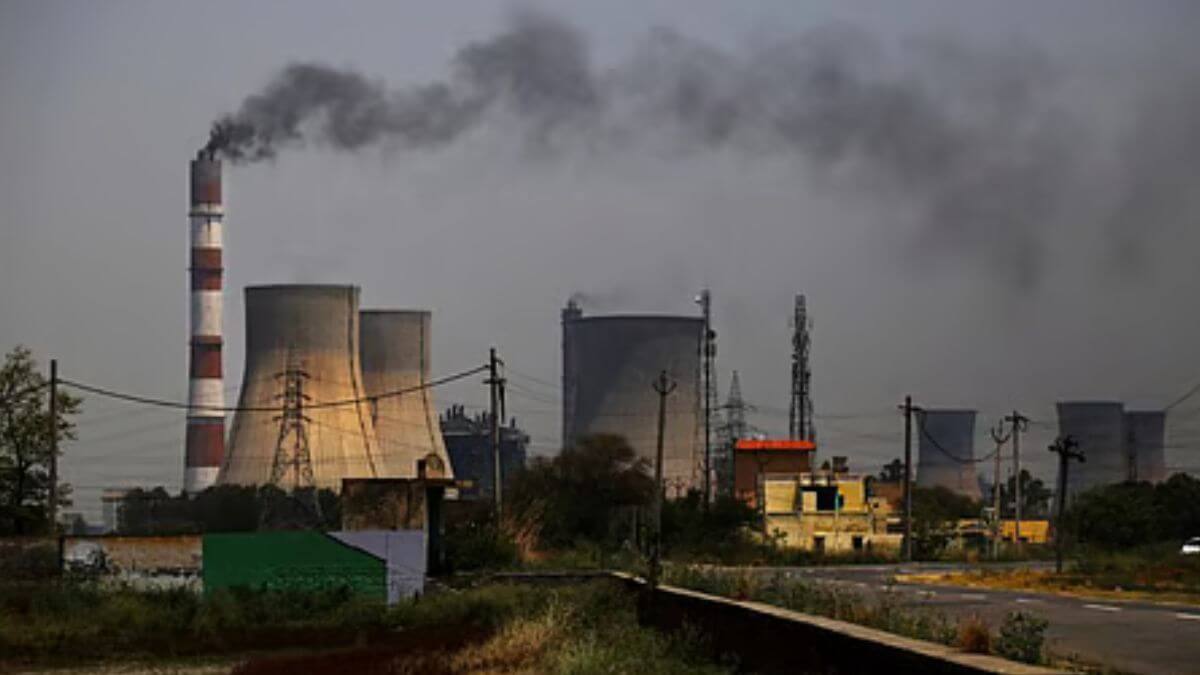
India has taken another important step towards climate action and industrial decarbonisation. In January 2026, the government notified Greenhouse Gas Emission Intensity (GEI) targets for additional carbon-intensive sectors under the Carbon Credit Trading Scheme (CCTS). The decision expands the coverage of the Indian Carbon Market and strengthens India’s commitment to reducing emissions while supporting sustainable economic growth.
Why in News?
The government has notified GEI targets for additional carbon-intensive sectors under the Carbon Credit Trading Scheme, bringing 208 new obligated entities into the compliance framework of the Indian Carbon Market.
What Are GEI Targets?
- Greenhouse Gas Emission Intensity (GEI) refers to the amount of greenhouse gas emissions produced per unit of output.
- Instead of setting absolute emission caps, GEI targets focus on improving efficiency by reducing emissions intensity. This approach allows industries to continue growing while lowering their carbon footprint.
- By notifying GEI targets, the government ensures that emission-intensive industries adopt cleaner technologies, improve energy efficiency, and align with India’s climate goals.
- GEI-based regulation is particularly suitable for developing economies where industrial growth and environmental responsibility must progress together.
Expansion of the Carbon Credit Trading Scheme
- With the latest notification, 208 additional obligated entities across carbon-intensive sectors are now required to meet prescribed GEI reduction targets.
- This significantly expands the compliance mechanism under the Carbon Credit Trading Scheme (CCTS).
- As a result, the total number of obligated entities covered under the Indian Carbon Market has increased to 490.
- These entities represent some of India’s most emission-intensive industries, making the scheme a central tool for reducing national industrial emissions.
Role of the Ministry and Regulatory Framework
- The notification was issued by the Ministry of Environment, Forest and Climate Change. The ministry is responsible for designing climate policies, monitoring emissions, and ensuring compliance.
- Under the CCTS framework, entities that outperform their GEI targets can earn carbon credits, while those that fall short must purchase credits.
- This market-based mechanism encourages cost-effective emission reductions and promotes innovation rather than relying only on penalties.
How the Indian Carbon Market Works
- The Indian Carbon Market operates on the principle of tradeable carbon credits. One carbon credit typically represents the reduction or removal of one tonne of carbon dioxide equivalent.
- Companies that reduce emissions beyond their targets can sell surplus credits, while others can buy credits to meet compliance requirements.
- This creates financial incentives for cleaner production and helps channel investments into low-carbon technologies.
- The expansion of obligated entities improves market liquidity and credibility, making the system more robust.
Impact on Industry and Economy
- For industries, the new notification means greater accountability and planning for emission reductions. While compliance may increase short-term costs, it also opens opportunities for efficiency gains, innovation, and access to carbon finance.
- In the long run, industries that adapt early can become more competitive globally as carbon regulations tighten worldwide.
- The scheme balances environmental responsibility with economic growth, making it industry-friendly yet climate-focused.
Key Summary at a Glance
| Aspect | Details |
| Why in News? | GEI targets notified for more sectors |
| Scheme | Carbon Credit Trading Scheme (CCTS) |
| New Entities | Added 208 |
| Total Obligated Entities | 490 |
| Issuing Ministry | Ministry of Environment, Forest and Climate Change |
| Main Objective | Reduce emission intensity of industries |
Question
Q. GEI targets notified under the Carbon Credit Trading Scheme relate to which of the following?
A. Absolute emission caps
B. Emissions per unit of output
C. Forest cover targets
D. Renewable energy capacity


 India Approves New NDC Targets for 2031-...
 IRCTC Food Quality Row: Fine Imposed Aft...
 What is UDAN 2.0? Full Details of India’...