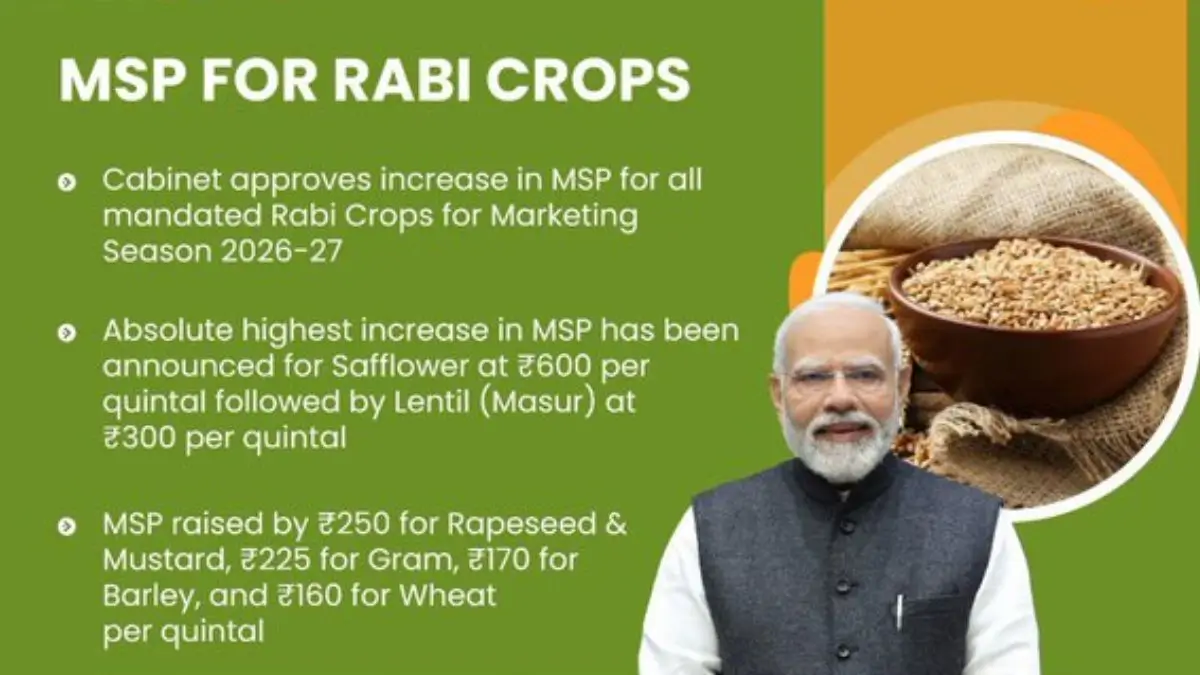
The Union Cabinet, led by Prime Minister Narendra Modi, has approved a significant Minimum Support Price (MSP) hike for all mandated Rabi crops for the 2026‑27 marketing season. This decision aims to ensure better returns for farmers and promote crop diversification. Alongside this, a major initiative—the Mission for Aatmanirbharta in Pulses—was also launched to reduce import dependency and increase domestic production.
What Is MSP and Why It Matters
Minimum Support Price (MSP) is the assured price at which the government procures crops from farmers, offering a safeguard against market volatility. It plays a crucial role in price stabilization, influences cropping patterns, and encourages the cultivation of key food crops, especially during volatile market conditions.
MSP Increases for Rabi Crops 2026-27
The Cabinet Committee on Economic Affairs (CCEA) has increased the MSP for all key Rabi crops. The highest hike is for safflower at ₹600 per quintal. Other notable increases include.
- Lentil (Masur): ₹300 per quintal
- Rapeseed & Mustard: ₹250 per quintal
- Gram (Chana): ₹225 per quintal
- Barley: ₹170 per quintal
- Wheat: ₹160 per quintal
The MSP for wheat now stands at ₹2,585 per quintal, up from ₹2,425—a 6.6% increase. These increases are expected to channel approximately ₹84,263 crore to farmers during the marketing season.
Margins over production cost are projected as follows,
- Wheat: 109%
- Rapeseed & Mustard: 93%
- Lentil: 89%
- Gram: 59%
- Barley: 58%
- Safflower: 50%
These margins suggest significant government effort to ensure profitability in Rabi farming, particularly in oilseeds and pulses.
Mission for Aatmanirbharta in Pulses
Alongside the MSP hike, the Union Cabinet also approved a major initiative titled Mission for Aatmanirbharta in Pulses, set to run from 2025‑26 to 2030‑31. The goal is to make India self-sufficient in pulse production.
Key features of the mission include,
- Financial outlay of ₹11,440 crore over six years
- Production target of 350 lakh tonnes of pulses by 2030‑31
- Benefits for two crore farmers via quality seeds, procurement assurance, and post-harvest support
- Promotion of high-yielding, pest-resistant, climate-resilient pulse varieties
- This mission is part of India’s broader strategy to reduce reliance on imported pulses and stabilize domestic markets.
Static Facts
- Wheat MSP now ₹2,585/qtl, up ₹160
- Safflower sees highest MSP hike: ₹600/qtl
- Pulses Mission: ₹11,440 crore, target 350 lakh tonnes
- Duration: 2025‑26 to 2030‑31
- Focus: high-yield, climate-resilient varieties
- Over 2 crore farmers to benefit


 India's First Digital Census 2027 Begins...
 PM Modi Launches Kaynes Semiconductor Pl...
 India Census 2027 Digital: Phase 1 Start...