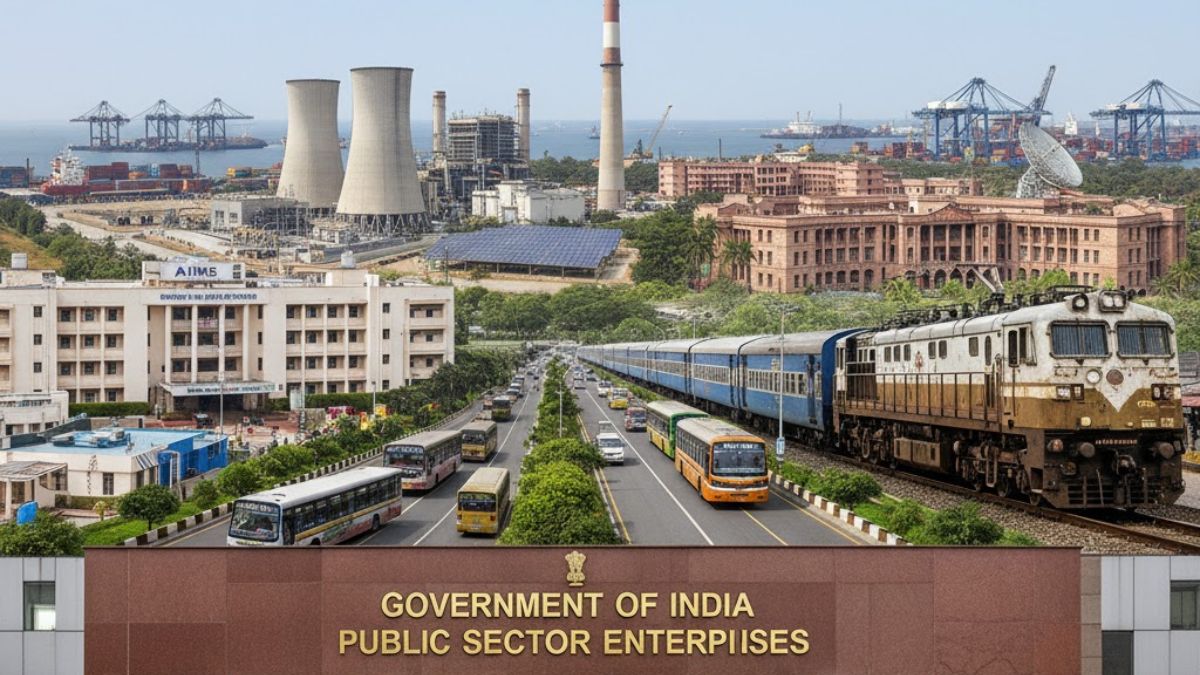
The Government of India is undertaking a significant reform in its approach to Central Public Sector Enterprises (CPSEs) by planning a revision in their classification and performance assessment criteria. The move includes the potential introduction of two new ‘Ratna’ categories, in addition to the existing Maharatna, Navratna, and Miniratna statuses, to make CPSEs more competitive, accountable, and aligned with long-term national goals under Vision 2047.
What Are CPSEs?
- Central Public Sector Enterprises (CPSEs) are companies in which the central government owns at least 51% equity, either directly or through other CPSEs. These enterprises are registered under the Companies Act, 2013 or set up by a Parliamentary Act.
- Subsidiaries of CPSEs also fall under this category.
- CPSEs operate across strategic sectors such as oil & gas, power, infrastructure, heavy industries, and defence, playing a crucial role in India’s economic development and public service delivery.
Current CPSE Classification
CPSEs are presently classified into three main categories,
- Maharatna: 14 companies
- Navratna: 26 companies
- Miniratna: 74 companies
These classifications determine the degree of financial autonomy in areas like capital investment, joint ventures, and operational decision-making.
Why the Reclassification?
Key Objectives
- To modernise and re-align CPSEs with India’s economic and strategic priorities.
- To foster a culture of performance-driven governance and efficiency.
- To encourage sustainable business practices in tune with global standards.
- To prepare public sector firms for global competitiveness, technological innovation, and future economic challenges.
Proposed Evaluation Changes
The government is working on a more comprehensive assessment framework that goes beyond traditional financial metrics. The key new evaluation parameters being considered include,
- Corporate governance standards
- Succession planning and leadership development
- Capital expenditure and investment efficiency
- Dividend payout ratios
- Sustainability practices
- Alignment with India’s Vision 2047 — a roadmap to make India a developed nation by its 100th year of independence
A 10-member committee, led by Cabinet Secretary T.V. Somanathan, has been tasked with reviewing these changes. Their report is expected before the Union Budget 2026–27.
Significance of Ratna Statuses
The ‘Ratna’ status framework was originally introduced to give CPSEs greater operational flexibility based on their size and performance. For example,
- Maharatna firms can invest up to ₹5,000 crore without government approval.
- Navratna firms enjoy autonomy in financial decisions up to ₹1,000 crore.
- Miniratna firms have more limited powers but are crucial in their domains.
The introduction of new categories may create an expanded and more nuanced structure, allowing CPSEs to grow into next-generation national champions, especially in sectors crucial for economic security like energy, technology, and infrastructure.
Static Takeaways
- CPSE Definition: A company with 51% or more central government ownership (directly or indirectly).
- Current Classification: 14 Maharatna, 26 Navratna, and 74 Miniratna companies.
- Ministry Responsible: Department of Public Enterprises, under Ministry of Heavy Industries and Public Enterprises.
- Re-evaluation Committee Head: Cabinet Secretary T.V. Somanathan.
- Key Additions in Evaluation: Governance, succession, capex, sustainability, Vision 2047 alignment.
- Expected Report Timeline: Before Union Budget 2026–27.


 India’s GST Collections Hit ₹1.78 Lakh C...
 India Approves IBC Amendment Bill 2026 t...
 India’s Industrial Output Grows 5.2% in ...