
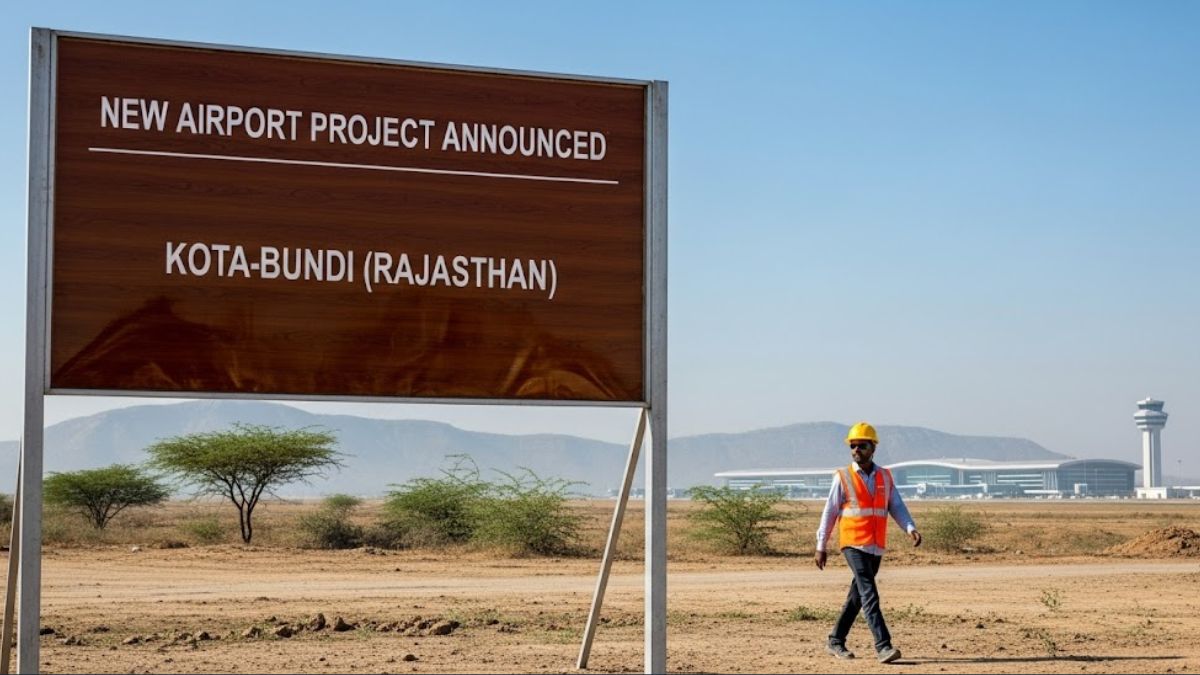
The Cabinet Committee on Economic Affairs, chaired by Prime Minister Narendra Modi, has approved the Airports Authority of India’s proposal to develop a Greenfield Airport at Kota‑Bundi in Rajasthan at an estimated cost of ₹1,507 crore. This major infrastructure initiative is poised to significantly enhance regional connectivity, support Kota’s booming education and industrial sectors, and meet rising demand for air travel.
Background and Strategic Importance
Kota’s Role in Rajasthan
Kota, perched along the Chambal River, is well‑known as the industrial capital of Rajasthan and a world‑renowned educational coaching hub. Its dual economic and academic prominence has steadily driven demand for improved transport infrastructure.
Limitations of the Existing Airport
The present Kota Airport, owned by AAI, features a 1220m × 38m runway (08/26) suitable only for small Code “B” aircraft (like the Dornier‑228), an apron handling two such planes, and a merely 400 sqm terminal with a 50‑passenger peak‑hour capacity. Urban encroachment and land constraints prevent its expansion for commercial operations.
Project Overview
Land and Capacity
The Government of Rajasthan has transferred 440.06 hectares to AAI for the airport development. The new facility will support A‑321 type aircraft and be built to accommodate future commercial operations.
Infrastructure Components
The project scope includes,
- A 20,000 sqm terminal building, designed for 1,000 peak‑hour passengers and an annual capacity of 2 million passengers per annum (MPPA).
- A 3,200m × 45m runway (Runway 11/29).
- An apron with seven parking bays for A‑321 aircraft.
- Two link taxiways, an ATC cum technical block, a fire station, and a car park, alongside allied support works.
- This layout ensures full support for modern, efficient airport operations catering to larger aircraft and passenger flows.
Benefits and Significance
Connectivity and Growth
With a larger terminal and capable runway, the new airport will,
- Improve air connectivity, linking Kota directly to major cities.
- Serve the industrial sector by facilitating swift travel for business and logistics.
- Support students and educators traveling to the renowned coaching institutes, reinforcing Kota’s status as an education hub.
Economic and Regional Development
The airport is expected to stimulate regional growth by,
- Attracting businesses, investors, and tourists.
- Generating direct and indirect employment during construction and operations.
- Catalyzing allied developments in hospitality, transport, and logistics.
Challenges and Considerations
- Implementation timeline and cost management will be critical to ensuring the ₹1,507‑crore project stays within budget and schedule.
- Environmental and social impact assessments must be carefully managed, given the scale of land developed and infrastructure involved.
- Passenger demand forecasting must align with actual trends to ensure optimal utilization and avoid over‑ or under‑capacity.


 Shree Jagannath International Airport in...
 Gujarat HC Bans AI in Courtroom Decision...
 Blackbucks Make a Comeback in Chhattisga...











