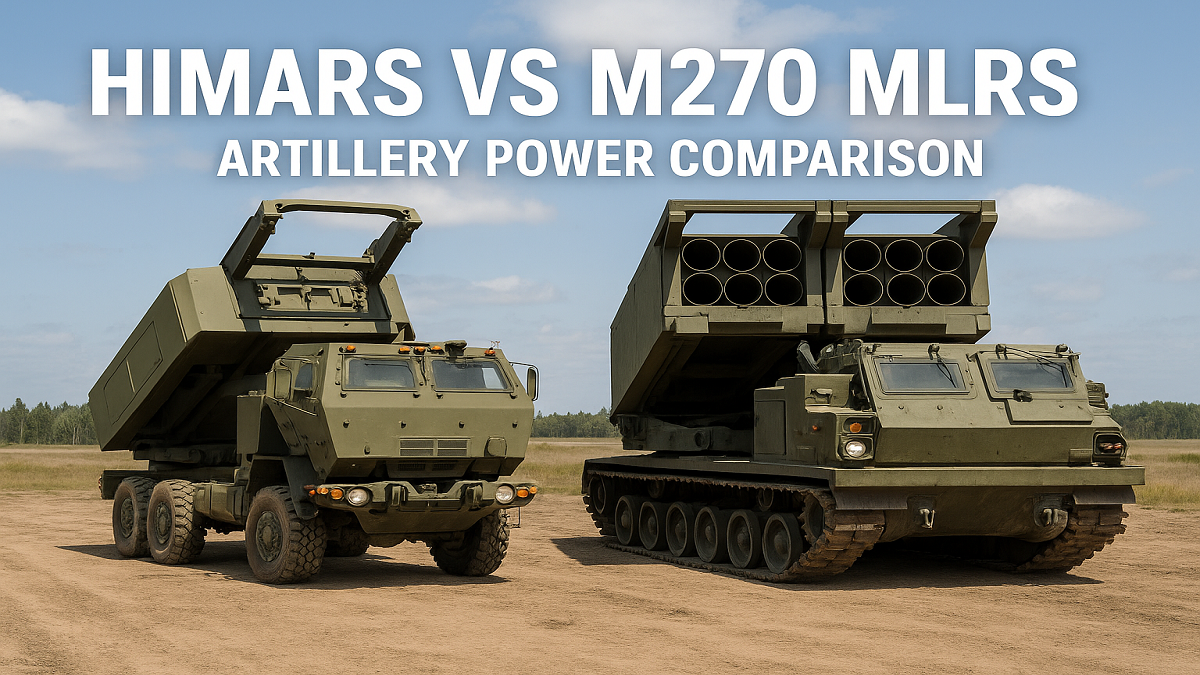
Modern warfare increasingly relies on precision long-range artillery systems to dominate the battlefield. Among the most effective systems used today are the HIMARS and the M270 MLRS. Both are products of advanced American engineering, designed to deliver devastating firepower quickly and accurately. While they share some similarities, they also have important differences that make each suitable for different battlefield roles.
This detailed comparison will help you understand how HIMARS and M270 MLRS perform, and which system might be considered superior depending on the mission.
1. Understanding the HIMARS
1.1 What is the HIMARS?
The High Mobility Artillery Rocket System (HIMARS) is a lightweight, wheeled, long-range rocket artillery system developed by Lockheed Martin. It entered service in the early 2000s and has become one of the most in-demand artillery systems worldwide, especially after its success in recent conflicts such as the Russia-Ukraine war.
1.2 Key Features of HIMARS
-
Mounted on a 6×6 wheeled truck chassis, making it highly mobile.
-
Can fire six guided rockets or one ATACMS missile at a time.
-
Uses GPS-guided munitions for precision strikes.
-
Maximum range: Up to 80 km for GMLRS rockets, and up to 300 km for ATACMS tactical missiles.
-
Crew of three, but can be operated by fewer in emergencies.
Its biggest strength is its mobility, allowing rapid shoot-and-scoot tactics to avoid enemy counterfire.
2. Understanding the M270 MLRS
2.1 What is the M270 MLRS?
The M270 Multiple Launch Rocket System (MLRS) is a tracked, armored rocket artillery system also developed by Lockheed Martin. It entered service in the early 1980s and remains a vital part of many NATO arsenals. Designed to saturate enemy positions with firepower, the M270 is heavily armored for frontline durability.
2.2 Key Features of M270 MLRS
-
Built on a tracked chassis for better off-road performance.
-
Can fire 12 guided rockets or two ATACMS missiles at a time.
-
Extremely durable and can operate in harsh combat environments.
-
Maximum range: Similar to HIMARS — up to 80 km with GMLRS rockets, and up to 300 km with ATACMS.
-
Crew of three for operation.
The M270 is a heavier, more heavily armed platform designed for sustained fire missions.
3. Firepower and Ammunition
Both HIMARS and M270 can fire:
-
GMLRS (Guided Multiple Launch Rocket System) rockets for precision strikes.
-
ATACMS (Army Tactical Missile System) for deep-strike missions against high-value targets.
However, the M270 can carry twice as many rockets (12 compared to 6) before needing to reload, giving it a higher sustained fire rate. HIMARS sacrifices firepower for speed and agility.
4. Mobility and Deployment
4.1 HIMARS Mobility
The HIMARS, being wheeled and lighter, can be rapidly deployed by C-130 transport aircraft and moved quickly on roads. This makes it ideal for fast-moving, flexible operations.
4.2 M270 Mobility
The M270’s tracked chassis makes it slower on roads but more effective in rugged, off-road terrain. However, it is heavier and harder to deploy by air, which limits its rapid strategic mobility compared to HIMARS.
5. Combat Roles
5.1 HIMARS Combat Role
-
Precision strikes against command centers, logistics hubs, and artillery batteries.
-
Quick relocation after firing to avoid counterbattery fire.
-
Excellent for hit-and-run artillery tactics.
5.2 M270 Combat Role
-
Heavy bombardment and sustained fire against fortified positions.
-
Designed to operate closer to the frontline.
-
Better suited for static or semi-static warfare where firepower volume is key.
6. Strengths and Weaknesses
6.1 HIMARS Strengths
-
High mobility for quick repositioning.
-
Easier to transport by air.
-
Lower maintenance compared to tracked vehicles.
Weaknesses:
-
Lower rocket capacity per reload.
-
Less armored protection.
6.2 M270 Strengths
-
Double the rocket capacity.
-
Heavier armor for crew protection.
-
Better off-road capability.
Weaknesses:
-
Slower and harder to deploy quickly.
-
Higher maintenance needs.
7. Which is Better?
There is no simple answer.
-
If the mission requires fast deployment, mobility, and quick strikes, the HIMARS is the clear winner.
-
If the mission needs maximum firepower, heavy armor, and sustained bombardment, the M270 MLRS is more effective.
Many modern armies use both systems together — HIMARS for rapid strikes and M270 for heavy artillery support.
8. The Future of Rocket Artillery
Advancements in precision-guided munitions and longer-range missiles will make both HIMARS and M270 even deadlier. Future upgrades may include:
-
Extended-range rockets exceeding 150 km.
-
Smarter targeting systems with AI-assisted guidance.
-
Improved reload times for faster sustained fire.


 List of Important Days in April 2026, Na...
 Weekly Current Affairs One Liners (30th ...
 Who is known as the Father of Mobile Pho...