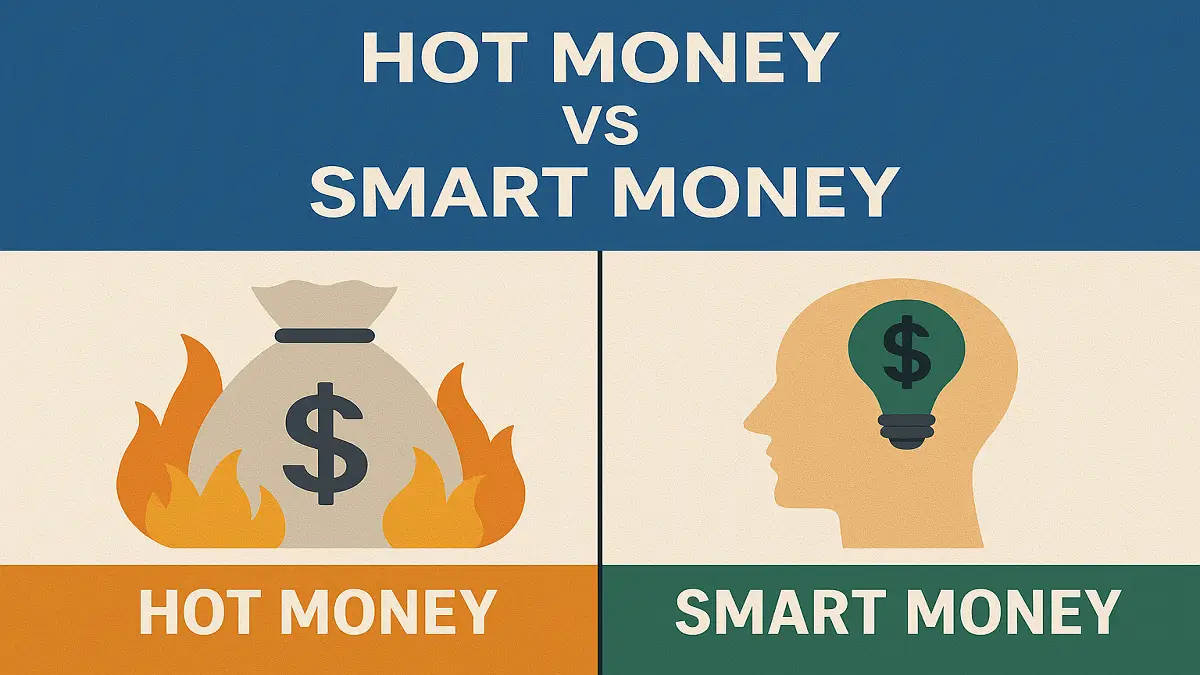
In financial markets, different types of capital flow in and out of countries every day. Some money moves quickly in search of short-term profits, while some money stays invested for long-term growth and stability.
Two important terms used to describe these behaviours are:
- Hot Money
- Smart Money
These terms often confuse students because they sound similar, but they represent very different types of investment behaviour.
This article explains both in simple language with clear examples and exam-oriented notes.
What is Hot Money?
Hot Money refers to short-term capital that enters or exits a country very quickly to take advantage of:
- Interest rate differences
- Exchange rate movements
- Stock market rally
- Short-term profit opportunities
It is called “hot” because it can move suddenly, creating instability in the financial system.
Characteristics of Hot Money
- Moves in and out quickly
- Highly speculative
- Sensitive to market news and global events
- Can cause currency volatility
- Mostly associated with Foreign Institutional Investors (FIIs)
Example of Hot Money
If foreign investors suddenly buy Indian stocks because interest rates are high, it creates a surge of hot money.
But if global conditions change, they may withdraw all at once — causing the stock market and rupee to fall sharply.
What is Smart Money?
Smart Money refers to investments made by experienced, knowledgeable, and long-term investors who study the market before investing.
It reflects informed decisions rather than impulsive moves.
Who invests Smart Money?
- Institutional investors
- Hedge funds
- Mutual funds
- Pension funds
- Banks
- Experienced market analysts
These investors invest based on deep research, economic indicators, and long-term strategies.
Characteristics of Smart Money
- Long-term investment
- Less volatile
- Based on research and data
- Stable and reliable
- Supports economic growth
Example of Smart Money
When a pension fund invests in infrastructure bonds or blue-chip stocks for long-term returns, it is considered smart money.
Hot Money vs Smart Money: Key Differences
| Feature | Hot Money | Smart Money |
|---|---|---|
| Meaning | Fast-moving, speculative capital | Long-term, informed investment |
| Objective | Quick profit | Stable returns, long-term growth |
| Nature | Volatile, unpredictable | Stable, research-based |
| Time Horizon | Short-term | Medium to long-term |
| Impact on Market | Creates instability | Boosts confidence |
| Risk Level | Very high | Moderate |
| Investors | FIIs, speculators | Institutions, pension funds, experts |
| Effect on Currency | Causes sharp exchange rate movements | Keeps currency stable |
Why Hot Money Matters for India
India often sees large inflows of hot money due to:
- Rising interest rates
- Stock market rally
- Positive global sentiment
But sudden outflows can:
- Depreciate the rupee
- Crash the stock market
- Reduce foreign exchange reserves
So, while it provides liquidity, it also increases risk.
Why Smart Money Is Important
Smart Money:
- Supports long-term economic projects
- Strengthens financial markets
- Builds investor confidence
- Reduces volatility
- Helps governments and companies raise stable funds
Smart Money is considered a healthy sign for an economy.
Simple Trick to Remember
- Hot Money = Hot Temper → Comes fast, goes fast
- Smart Money = Smart Decision → Stable, long-term, informed


 Government Revises Fiscal Deficit Ratios...
 Cabinet Eases FDI Policy for Neighboring...
 India Forex Reserves Reach Record $728.5...