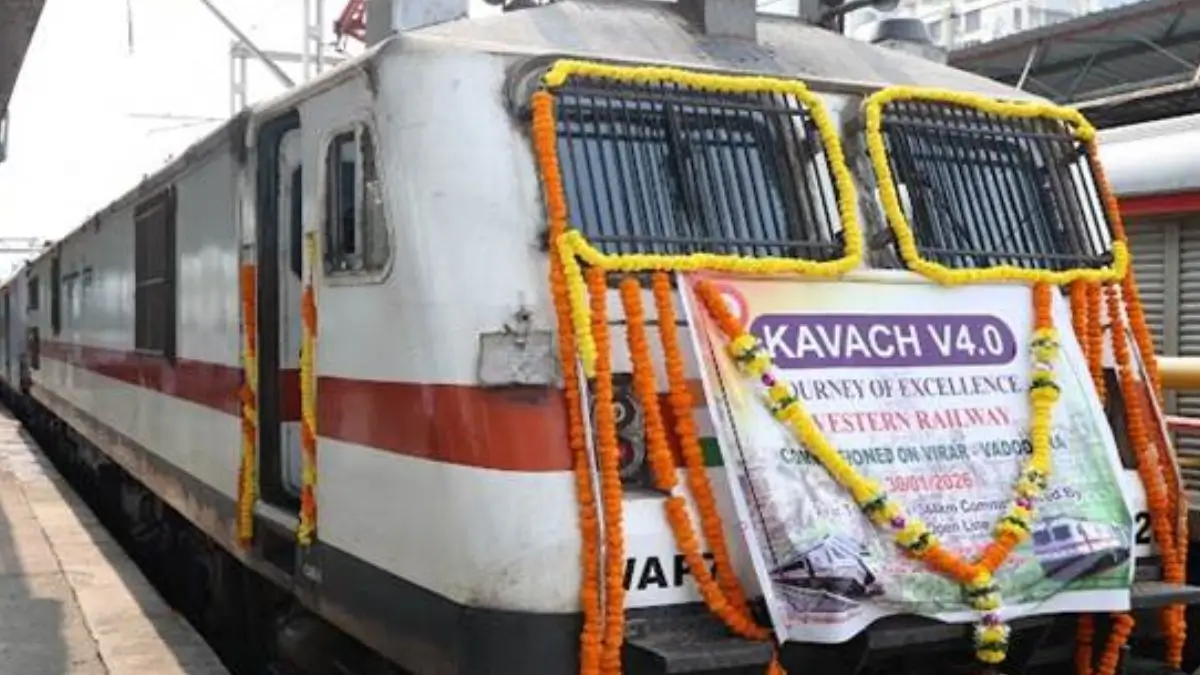
Indian Railways has taken a major leap in railway safety by commissioning Kavach Version 4.0 across 472.3 route kilometres in a single day. This achievement marks the highest-ever Kavach rollout in India’s rail history. The advanced safety system is now active on key sections of Western, Northern, and East Central Railways. With this milestone, Indian Railways continues to strengthen passenger safety, reduce accident risks, and move closer to its goal of a smarter and safer rail network.
Record Breaking Kavach 4.0 Commissioning
- The latest rollout includes Vadodara–Virar (344 km) on Western Railway, Tuglakabad Junction Cabin–Palwal (35 km) on Northern Railway, and Manpur–Sarmatanr (93.3 km) on East Central Railway.
- This single-day commissioning surpassed the previous record of 324 km on the Kota–Mathura section.
- The achievement reflects faster execution, better coordination, and growing confidence in India’s indigenous safety systems.
- With this addition, Kavach 4.0 is now operational across five Indian Railways zones, marking a decisive shift toward technology-driven rail safety on high-density corridors.
Northern Railway: Strengthening Delhi–Mumbai Corridor
- On Northern Railway, Kavach 4.0 has been commissioned on the 35 km Tuglakabad-Palwal section, part of the busy four-line Delhi-Mumbai route.
- This stretch includes two automatic signalling lines and two absolute block signalling lines, along with major station yards.
- The corridor handles heavy suburban, passenger, and freight traffic. Kavach’s activation here significantly improves operational reliability by preventing signal passing at danger and overspeeding.
- This upgrade is especially crucial for one of India’s busiest rail corridors connecting the national capital with western India.
East Central Railway: Successful Live Safety Testing
- The 93.3 km Manpur–Sarmatanr section of East Central Railway has now entered Kavach-enabled operations.
- The first train to run under the system was the 13305 Sasaram Intercity Express, which successfully demonstrated Kavach’s automatic braking during a head-on collision test.
- This section lies on the important Delhi-Howrah trunk route, cleared for speeds up to 130 kmph and targeted for 160 kmph under Mission Raftar. Kavach is planned over 4,235 route kilometres in this zone, making it a key focus area for future safety upgrades.
Western Railway: Mumbai Gets Its First Kavach Train
- Western Railway achieved a historic milestone with the commissioning of Kavach 4.0 on the 344 km Vadodara-Surat-Virar section of the Delhi–Mumbai route.
- The 20907 Dadar-Bhuj Sayajinagri Express became the first Kavach-equipped train to operate from Mumbai. Work on this corridor began in January 2023 and is progressing rapidly.
- The Vadodara-Nagda section is expected by March 2026, while the Virar–Mumbai Central section is targeted for September 2026, expanding Kavach coverage deeper into Mumbai’s rail network.
About Kavach 4.0
| Heading | Details |
| Overview |
|
| Approval & Certification |
|
| Design & Network Compatibility |
|
| Technological Components | Uses microprocessors for real-time decision making
Integrates Global Positioning System (GPS) for accurate train location Employs radio communication for continuous data exchange between trains and trackside equipment |
| Signal Protection (SPAD) |
|
Question
Q. Which route recorded the highest-ever single-day commissioning of Kavach?
A. Howrah-Bardhaman
B. Kota-Mathura
C. Vadodara-Virar and other sections (472.3 km)
D. Palwal-Mathura


 WHO Foundation and Novo Nordisk Launch I...
 NITI Aayog Releases Fiscal Health Index ...
 UIDAI Launches Bug Bounty Program to Str...