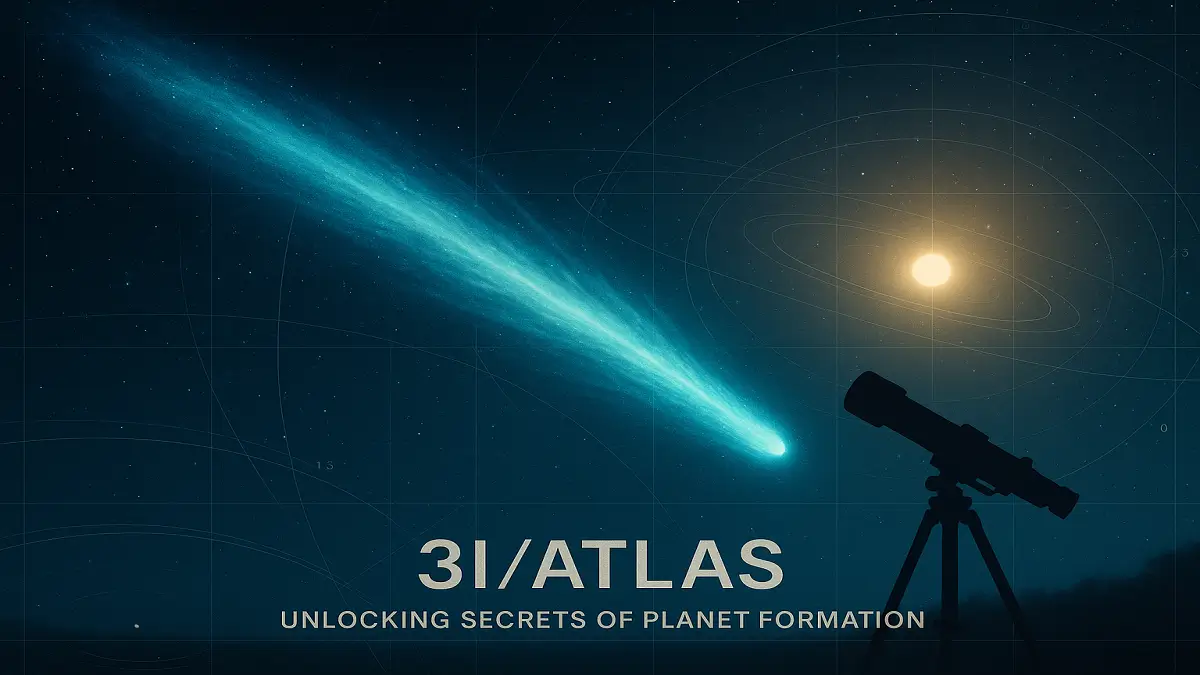
In early 2025, astronomers confirmed the discovery of 3I/ATLAS, the third-known interstellar comet to enter our solar system after the famous ‘Oumuamua (2017) and 2I/Borisov (2019).
Unlike regular comets, which orbit our Sun, interstellar objects like 3I/ATLAS originate from outside the solar system, carrying chemical signatures and materials from entirely different stars. Studying them helps scientists unlock how planets and solar systems form — not just here, but across the galaxy.
But as NASA prepared to observe this rare cosmic traveler, an unexpected event turned the spotlight eastward — toward India.
1. The Silence from the West
In late October, a temporary U.S. government shutdown caused several NASA data servers to go offline, disrupting real-time communication with global observatories. Automated updates about 3I/ATLAS’s coordinates and velocity suddenly stopped, leaving astronomers worldwide anxious.
This blackout came at a crucial moment — just as the comet began moving beyond easy visibility. Without continuous tracking, humanity risked losing vital data that could reveal how planetary systems evolve in other parts of the universe.
2. India Steps Into the Dark
While NASA’s systems went quiet, India’s observatories rose to the occasion. Under the leadership of the Indian Institute of Astrophysics (IIA), ARIES Nainital, and IUCAA Pune, Indian astronomers began emergency sky surveys to trace 3I/ATLAS’s path.
These observatories became the world’s primary eyes on the interstellar object, recording its brightness, trajectory, and fading tail through India’s pre-dawn skies.
3. The Devasthal Telescope: Eye of the World
At the ARIES Devasthal Optical Telescope in Uttarakhand — one of Asia’s most powerful ground-based observatories — researchers worked overnight to maintain the comet’s trajectory model.
Even as U.S. observatories went silent, Devasthal continued transmitting updated coordinates to the Minor Planet Center (MPC). Thanks to this, global scientists could still calculate the object’s movement with high precision.
For several days, Devasthal became the most important telescope on Earth for tracking 3I/ATLAS.
4. The Longest Night for Indian Astronomers
At the Vainu Bappu Observatory in Tamil Nadu, astronomers manually adjusted their observation schedules to prioritize 3I/ATLAS. This dedication ensured that no critical data was lost — even as other global systems went dark.
5. A Data Bridge from Bengaluru to Europe
As dawn approached, teams at IUCAA Pune and IIA Bengaluru compiled nightly datasets and transmitted them to partners in Europe, including the European Space Agency (ESA) and ESO.
This collaboration allowed European telescopes to recalibrate tracking algorithms using Indian data, ensuring continuous global coverage. It became a perfect example of international scientific teamwork in action.
6. “The Object Was Fading — But So Was the Window”
By November, 3I/ATLAS was growing dimmer as it slipped behind solar glare. Scientists knew the final nights of visibility were critical. Without India’s consistent data relay, astronomers might have lost vital positional frames, making future orbit reconstructions nearly impossible.
These last observations were essential — not only to track the comet but to study its chemical composition, which may hold the building blocks of planets.
7. When the World Looked East
As NASA’s silence continued, astronomers from across continents began relying on Indian datasets to monitor the final stretch of 3I/ATLAS’s journey.
For the first time, India became the epicenter of global interstellar observation — not through a billion-dollar mission, but through dedication, clear skies, and precise scientific collaboration.
8. How 3I/ATLAS Could Unlock Secrets of Planet Formation
The data collected from 3I/ATLAS may fundamentally reshape our understanding of how planets and solar systems form.
Researchers believe its trajectory and composition can reveal:
- Primitive ices and minerals that existed before our solar system was born.
- Organic molecules similar to those that may have seeded life on Earth.
- How dust grains and gases interact in early stellar nurseries.
- Why some planetary systems evolve differently based on star composition.
By comparing 3I/ATLAS’s data with previous interstellar visitors, NASA and global researchers aim to refine models of planet formation across galaxies.


 India's First Quantum Computer to be Lau...
 India Strengthens Marine Research with B...
 AP Science City Signs 5-Year MoU with CS...