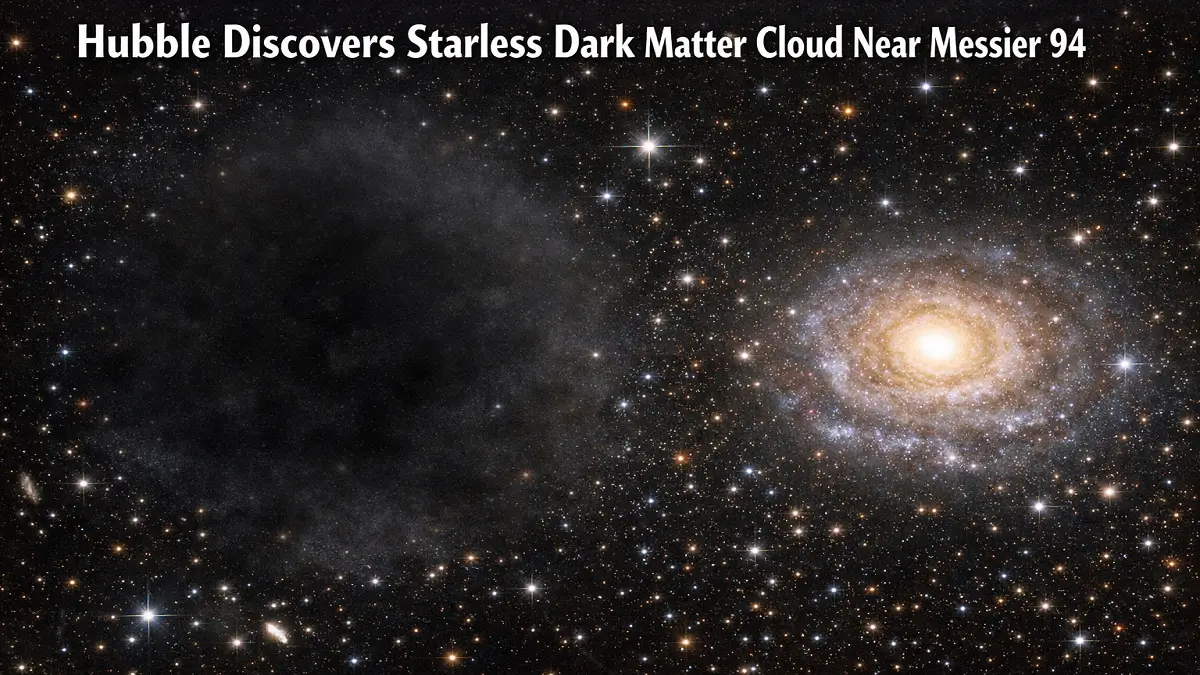
In a groundbreaking astronomical discovery, NASA’s Hubble Space Telescope has identified a rare, starless cloud dominated by dark matter, nicknamed Cloud-9, near the spiral galaxy Messier 94. Located about 14 million light-years from Earth, this mysterious object is offering scientists an unprecedented glimpse into the early stages of galaxy formation. Remarkably, Cloud-9 contains vast amounts of gas and dark matter but has never formed a single star, making it a true cosmic relic.
What Is Cloud-9?
Cloud-9 is scientifically classified as a Reionization-Limited H I Cloud (RELHIC).
- “H I” refers to neutral hydrogen, meaning the gas is non-ionised
- The cloud spans nearly 4,900 light-years
- It contains hydrogen gas with a mass close to one million Suns
- The surrounding dark matter halo is estimated at five billion solar masses
This extreme imbalance makes Cloud-9 overwhelmingly dominated by dark matter, with visible matter forming only a tiny fraction of its total mass.
A Fossil from the Early Universe
Astronomers believe RELHICs like Cloud-9 are primordial hydrogen clouds left over from the universe’s earliest epochs. These structures failed to trigger star formation after cosmic reionization, effectively freezing them in time.
According to researchers, Cloud-9 represents a “failed galaxy”—a building block of the universe that never evolved into a full-fledged galaxy. Its pristine nature provides direct observational evidence supporting long-standing theoretical models of galaxy evolution.
Why This Discovery Matters
The discovery of Cloud-9 is significant for several reasons:
Understanding Dark Matter
Dark matter does not emit, absorb, or reflect light. It is detected only through its gravitational influence. Since Cloud-9 lacks stars, astronomers can study dark matter in near isolation, free from interference by stellar activity.
Testing Galaxy Formation Theories
The existence of starless, dark-matter-dominated clouds confirms that not all early cosmic structures formed galaxies, validating modern cosmological simulations.
Clues to the Hidden Universe
Cloud-9 acts as a natural laboratory to study the universe’s hidden mass and understand why some cosmic structures thrive while others fail.
Important Facts for Competitive Exams
- H I denotes neutral hydrogen in astronomy
- Dark matter constitutes most of the universe’s total mass
- RELHICs are relic gas clouds from the early universe
- Hubble Space Telescope is jointly operated by NASA and ESA
- Messier 94 is a nearby spiral galaxy located ~14 million light-years away
Scientific Publication and Global Significance
The research findings were published in The Astrophysical Journal Letters and presented at a scientific conference in Phoenix. Experts describe Cloud-9 as a “window into the dark universe”, suggesting that many similar dark-matter-dominated structures may exist nearby but remain undetected.
The discovery strengthens the idea that the universe contains numerous invisible galactic fossils, holding vital clues to cosmic evolution and the nature of dark matter.


 Defunct NASA Satellite Van Allen Probe A...
 Sarvam AI Startup Program Launched to Bo...
 IBM Launches First Infrastructure Innova...