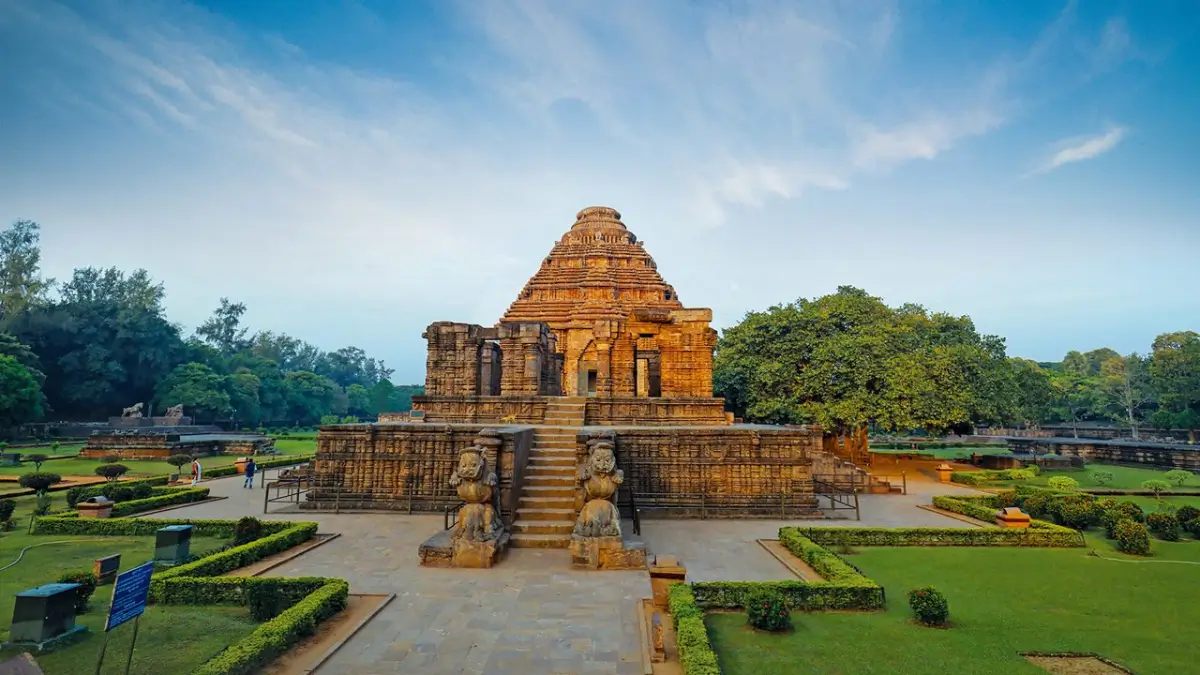
India is home to many ancient temples that reflect its rich history, art, and culture. Among these, one temple stands out for its magnificent design, intricate stone carvings, and deep spiritual significance. Built centuries ago, this temple is a true example of India’s architectural brilliance and devotion, attracting visitors, historians, and devotees from across the world.
Where is the Konark Sun Temple Located?
The Konark Sun Temple is located in the Puri district of Odisha, on the eastern coast of India, near the Bay of Bengal. It lies about 35 km from Puri and around 65 km from Bhubaneswar, the capital of Odisha.
Konark, along with Puri and Bhubaneswar, forms the famous “Golden Triangle of Odisha Tourism.” The temple’s position near the sea symbolizes the journey of the rising Sun, paying tribute to the Sun God’s daily voyage across the sky.
Historical Background
The Konark Sun Temple was built in the 13th century (around 1250 CE) by King Narasimhadeva I of the Eastern Ganga Dynasty. It was dedicated to Lord Surya (the Sun God) and designed to resemble his celestial chariot.
In ancient times, the temple was also a center for art, science, and spirituality. Some legends mention that a giant magnetic idol of the Sun God once floated inside the sanctum because of powerful magnetic forces. The temple beautifully blends geometry, astronomy, and spirituality, showcasing the scientific knowledge of that era.
Architectural Wonder of Konark
The Konark Sun Temple is one of the finest examples of Kalinga architecture, known for its grandeur and precision.
- The temple is designed like a massive chariot pulled by seven horses and supported by 24 carved stone wheels, each about 12 feet in diameter.
- The 24 wheels represent the 24 hours of the day, and the seven horses symbolize the seven days of the week.
- The temple was built using chlorite, laterite, and sandstone.
- Every part of the temple — walls, pillars, and wheels — is covered with detailed carvings of gods, dancers, animals, and scenes from daily life and mythology.
This architectural masterpiece reflects the brilliance of ancient Indian engineering and artistry.
Religious and Cultural Importance
The Konark Sun Temple holds great spiritual importance for Hindus as it is dedicated to the Sun God, symbolizing light, energy, and life.
Every year in February, thousands of devotees gather here to celebrate the Chandrabhaga Mela, one of Odisha’s most important festivals. During this festival, people take a holy dip in the nearby Chandrabhaga River and offer prayers to the rising Sun.
The temple also represents the connection between nature and divinity, highlighting the importance of solar energy in Hindu philosophy.
UNESCO World Heritage Site
In 1984, the Konark Sun Temple was declared a UNESCO World Heritage Site because of its outstanding architecture and cultural value.
Sailors in ancient times used to call it the “Black Pagoda” because of its dark stone and coastal location, which helped them navigate at sea.
Today, it is considered one of India’s Seven Wonders and remains one of the most visited tourist attractions in Odisha, admired by travelers, historians, and architects worldwide.


 Which City is known as the Silent City o...
 Which Place is known as the Onion Hub of...
 RBI Plans to Make TReDS Registration Eas...