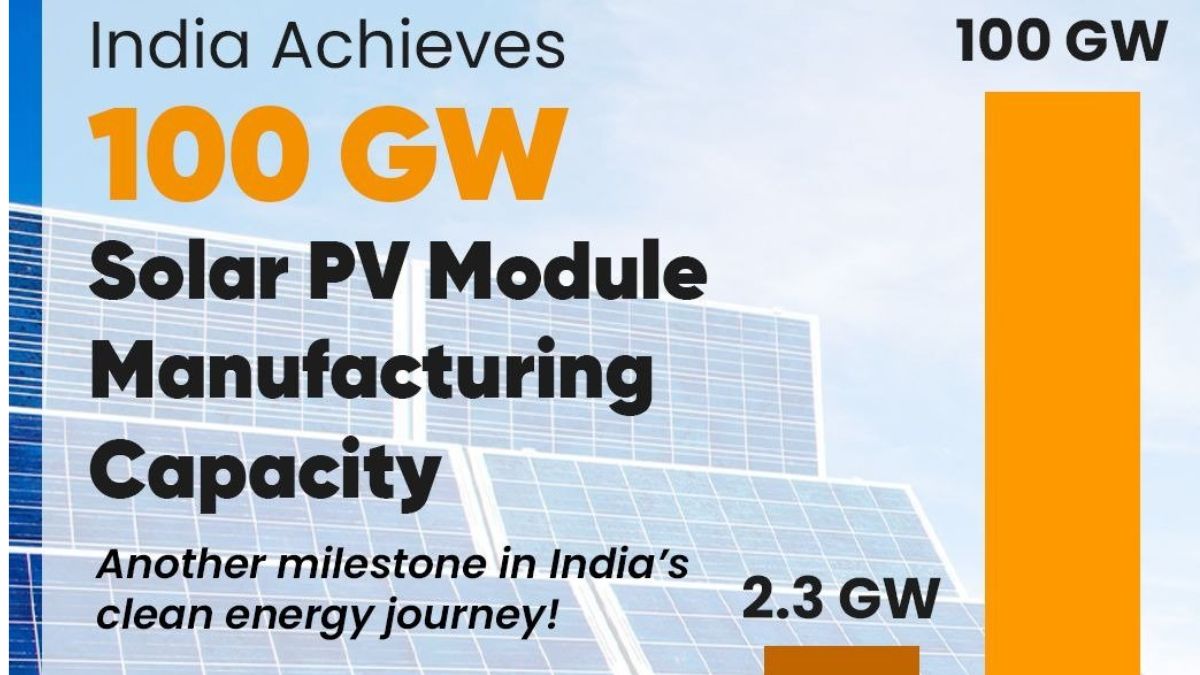
In a major boost to India’s clean energy ambitions, the country has officially reached 100 GW of solar photovoltaic (PV) module manufacturing capacity under the Approved List of Models and Manufacturers (ALMM). This milestone marks a massive leap from just 2.3 GW in 2014, showcasing India’s progress towards self-reliance in solar manufacturing and its broader target of achieving 500 GW non-fossil fuel capacity by 2030.
Government’s Strategic Push Towards Solar Manufacturing
Announcing the achievement, Union Minister for New and Renewable Energy Pralhad Joshi credited the transformation to Prime Minister Narendra Modi’s leadership and flagship policies such as the Production Linked Incentive (PLI) Scheme for High-Efficiency Solar Modules. The central government’s aim is not just to ensure energy security, but to make India a key player in the global solar value chain.
This rapid capacity expansion reflects the effective implementation of supportive schemes, industry participation, and regulatory mechanisms like the ALMM, which aims to promote quality and standardization in domestic solar manufacturing.
ALMM: From Inception to Expansion
The ALMM Order was introduced by the Ministry of New and Renewable Energy (MNRE) on 2 January 2019, with the first approved list published in March 2021, initially recording just 8.2 GW of enlisted capacity.
Over four years, the solar module capacity listed under ALMM has grown more than twelvefold, now reaching 100 GW. Alongside this, the number of approved manufacturers has also surged—from 21 in 2021 to 100 manufacturers operating across 123 units in 2025.
Diversified and Competitive Manufacturing Ecosystem
The 100 GW milestone reflects not just scale, but also technological maturity. Many of the newly listed manufacturers have adopted high-efficiency module technologies and built vertically integrated operations, contributing to a competitive and diverse ecosystem.
This growth includes both established industry leaders and new entrants, helping India not only meet its domestic solar deployment targets but also cater to international demand, strengthening India’s export potential in the clean energy sector.
Atmanirbhar Bharat and the 2030 Clean Energy Vision
This achievement is in line with India’s vision of Atmanirbhar Bharat (self-reliant India) and supports its 2030 target of 500 GW non-fossil fuel capacity, which includes solar, wind, hydro, and nuclear sources.
By significantly reducing reliance on imported solar modules, India is insulating itself from global supply chain shocks and ensuring that future energy growth is sustainable, resilient, and indigenous.


 India Withdraws Its Plan to Host COP33 S...
 IIM Rohtak Wins BIMTECH's 'Hermes' Dialo...
 Gurgaon Tops the List of India's Most Po...